







Identifying similar companies has always been crucial for strategic business moves, from competitive analysis to investment opportunities.
Whether you're a startup seeking market insights or an investor searching for promising ventures, information about how to find similar companies can boost your success.
In this article, we will explore strategies and tools to streamline your search for similar companies.
How to find similar companies?
Finding similar companies involves using key criteria like industry, product offerings, and geography, along with advanced tools such as data analytics platforms and machine learning models, to streamline your search.
By understanding these key factors, you can effectively identify companies that align with your goals and values.
Let's delve into the steps and methods that can help you discover companies similar to your own or those you are interested in.

Company search criteria
Establishing clear criteria is essential for finding similar companies.
Here are key factors to consider:
- Industry. Target companies operating within the same industry to compare business models and market dynamics.
- Product/service. Focus on companies offering similar products or services to understand competitive offerings and market saturation.
- Geography. Consider geographic location, as regional economic conditions and regulations significantly impact business operations.
- Shared keywords. Conduct SEO research and find businesses that offer similar products – they will likely have pages ranking on similar keywords.
- Company size. Compare companies of similar sizes by revenue, employee count, or market capitalization.
- Customer reviews. Analyze customer feedback to gauge business reputation and quality.
- Technological capabilities. Examine the technological infrastructure and innovation of potential companies.
Process
The process is bound to differ from company to company.
However, it’s possible to outline some key aspects that will help you put together a more comprehensive and personalized process plan.
Here are some main suggestions:
- Identify your goals. Identify the main reasons you need to find similar companies, whether for benchmarking, competitive analysis, investment opportunities, or identifying potential clients.
- Gather information. Utilize sources like company data, employee data, and business directories to conduct market research.
- Use tools to search and filter companies. Employ specialized tools and platforms that use advanced algorithms and data analytics to find similar companies efficiently.
- Analyze and refine. Review the gathered data and, if necessary, remove weak matches and adjust your search criteria to prioritize companies that best fit the original goal to get the most accurate results.
Make sure to tailor these steps to your individual needs, and you will find the perfect list of companies you’re looking for.
Similar companies search use cases
The similar companies search can benefit you in several ways. From identifying your competitors to finding investment opportunities, company search tools can bring you considerable value.
1. Find competitors
Identifying competitors is a common reason to search for companies similar to your own.
Understanding your competition provides insights into market positioning, product offerings, and pricing strategies, helping you formulate effective business strategies.
By analyzing your top competitors, you can identify gaps in the market, discover new opportunities, and make informed decisions about your product development and marketing strategies.
Additionally, understanding competitors' strengths and weaknesses allows you to differentiate your offerings and improve your competitive edge.
2. Find investment opportunities
Investors often seek similar companies to diversify their portfolios or find the next big opportunity.
By analyzing companies with similar business models and growth trajectories and evaluating overall performance, investors can make informed decisions.
This approach helps in identifying emerging trends and high-potential startups, reducing investment risks, and promoting more confident decision-making.
It also enables investors to compare the financial health, management practices, and market strategies of different companies, ensuring a balanced and more confident investment strategy.
3. Find companies that match your ideal customer profile
For businesses offering B2B services, finding companies resembling their ideal clients based on firmographic, technographic, geographic, or growth characteristics can expand market reach and match them with ideal customer profile.
By understanding the needs and preferences of these lookalike companies, businesses can offer more relevant products or services, create personalized marketing campaigns, and establish stronger relationships.
This targeted approach not only improves customer acquisition but also enhances client retention and satisfaction.

Tools for similar company search
Here are several tools and platforms that assist in finding similar companies:
- Coresignal. Coresignal offers structured company data and company discovery via multi-source company profiles. Also, it’s equipped with handy self-service tools that allow users to search company data using natural language prompts.
- SEMrush. The tool features the Organic Rankings Competitors reports, which is most useful for identifying companies or websites with overlapping organic search visibility and shared keyword rankings, offering valuable insights into market positioning and organic competitors.
- Crunchbase. A comprehensive platform for business information, Crunchbase offers detailed profiles of companies, including their industry, funding, technology, and headcount data. Depending on how that company data will be used, teams may also consider alternatives designed for sales prospecting, investment research, or data infrastructure workflows.
- LinkedIn Sales Navigator. This tool helps users with sales and account prospecting, finding lookalike companies with similar characteristics, including industry, company headcount, headcount growth, location and revenue.
- Owler. Owler provides competitive insights, including company profiles, leads, news, and community-driven data, helping you identify similar companies.
- ZoomInfo. A powerful platform for B2B intelligence, ZoomInfo offers extensive information on companies, including firmographics, technographics, intent, and contact-level data.
How to select the best tool for your business?
Choosing the right tool for finding similar companies depends on your specific needs and resources.
Here are some considerations to help you select the best tool:
- Data needs. To match your data needs, define your focus (e.g., firmographics, funding, workforce, tech stack, or SEO overlap) to determine the right depth of intelligence required.
- Budget. Assess your budget for subscription services and compare different tools and their pricing to ensure that the tool you choose provides good value for the features offered.
- Ease of use. Evaluate the user interface, search function accessibility, and ease of integration with your existing systems to ensure a smooth workflow and minimal adaptation time.
- Specific features. Identify unique features like natural language search, advanced filtering, or similar company recommendations to ensure the tool efficiently meets your needs.
Consider these factors to choose a tool that best aligns with your goals.
How to find similar companies with Coresignal
Do you need to find comparable companies in any sector worldwide? Our AI Data Search is one of the most simple self-service ways to find lookalike companies.
Describe companies you are looking for in natural language, combining multiple similarity criteria, such as industry, company size, location, or technologies, to pinpoint exactly what you need.
Identifying a company's competitors or similar businesses is crucial for understanding its market position, growth opportunities, and potential risks. Whether you're analyzing one company or conducting broader industry research, AI Data Search helps you uncover relevant matches and benchmark them effectively.
- Search competitors based on different data fields and understand your market landscape.
- Discover new investment opportunities with companies exhibiting similar growth potentials.
- Find companies that closely match your ICP, enhancing your B2B outreach strategies.
With our dashboard, you can streamline your search process and gain actionable insights with ease.
Here is how you do it:
Step 1: Register for a free trial
Before we begin, to use our AI Data Search, you must create an account on our self-service. The free trial includes:
- 7-day access to millions of company profiles (no credit card required)
- 2000 API credits
- Data enrichment features for your existing database
Step 2: Describe the companies you want to find
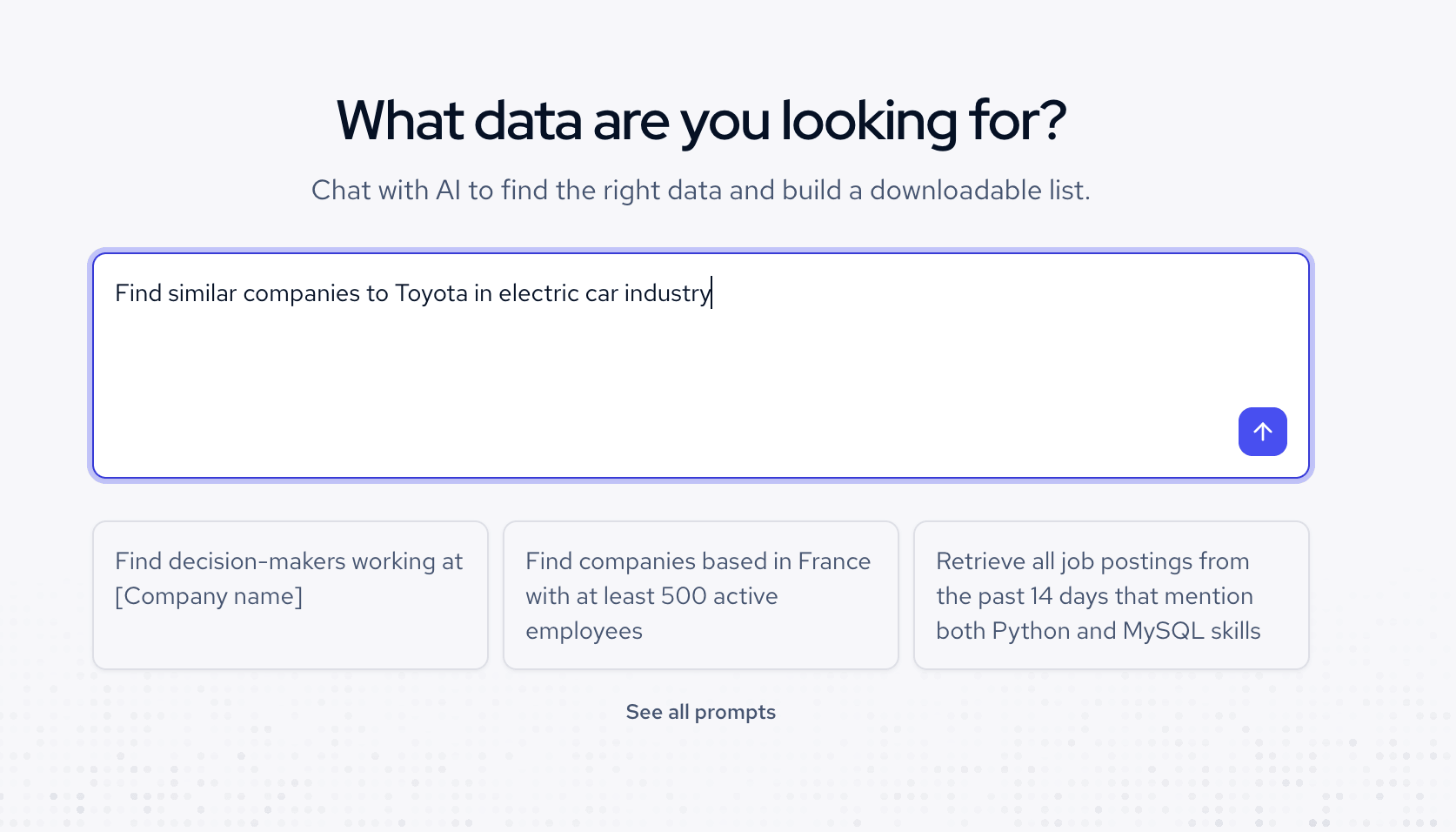
To find companies using Coresignal, go to the Data search element in the side menu to open the chat. Write a request describing the companies you are looking for in your own words in a dedicated field for a prompt. You can include any relevant criteria, such as industry, product category, or tech stack.
Once you are happy with your prompt, submit it. The tool will create a list of companies that match your search criteria.
Let's say you want to discover competitors of Toyota Motor Corporation that specifically make electric cars. Write your prompt into the tool, review it, and submit it.
The tool will instantly return you a list of full company profiles that you can explore and analyze:
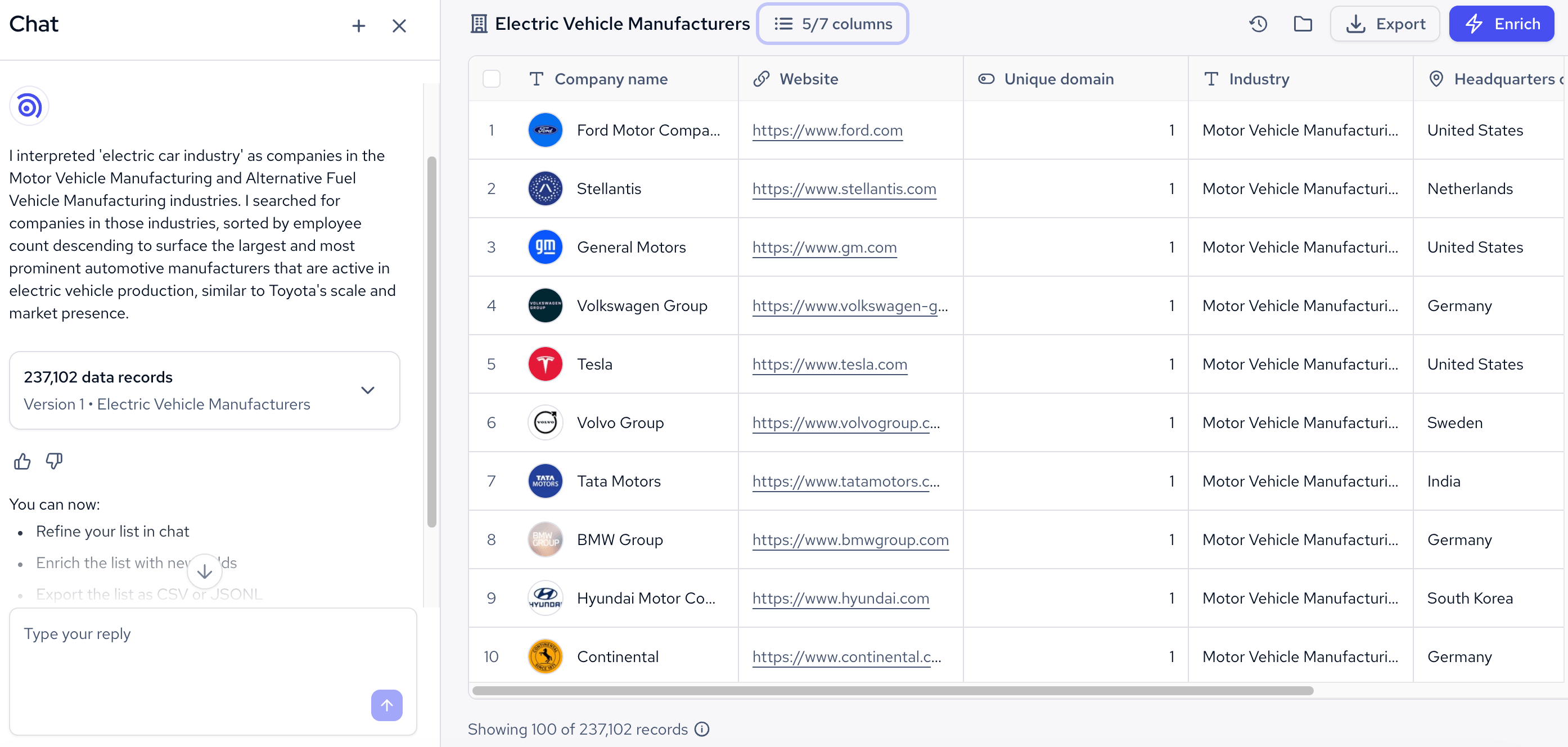
Once you have a full list of competitors, you can enrich your data with additional fields, such as employee count, funding round, and technologies used. Click Enrich on the right side of the window. This opens the Add new data fields section on the right side of the window, where you can select additional information.
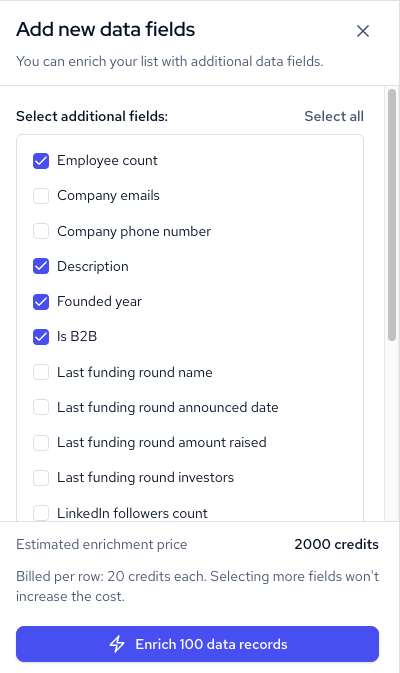
Now you have a full list of competitors, and extensive profiles with tons of valuable information that you could use right away. Use this tool for company search, identify possible partnerships, or build up a list of sales prospects.

Final thoughts
Finding similar companies is now simpler with AI-powered tools and data-driven approaches. However, success requires clear goals, relevant criteria (industry, size, location, technology), and the right platform.
While various tools serve different needs, AI Data Search solutions like Coresignal make finding companies similar to your own easy with natural language queries and multi-source data sets.


