

Crunchbase is a widely used platform for company, funding, and investment data, popular among sales teams, investors, and researchers. However, as businesses scale their data needs, many start looking for Crunchbase alternatives that offer deeper coverage, more flexible access, or better pricing for specific use cases.
Some Crunchbase competitors focus on sales prospecting, giving teams contact and firmographic details to build lead lists. Others cater to investment research, tracking funding rounds and company growth. Meanwhile, some providers focus purely on data infrastructure, delivering data through APIs and datasets. There is no single best Crunchbase alternative. The right choice depends on how your team plans to use the data.
Crunchbase alternatives for company data compared
Several providers stand out as Crunchbase alternatives for company data, each taking a different approach to coverage, freshness, and delivery format. The table below compares some of the top options based on publicly available information. Coresignal's company data is included alongside other well-known Crunchbase competitors.
For company data infrastructure and signal-based discovery
Crunchbase alternatives are relevant for teams that build on top of company data rather than just look it up. These providers focus on infrastructure, delivering company data through APIs and datasets that can feed data products, internal tools, AI workflows, company monitoring, or automated research.
Coresignal
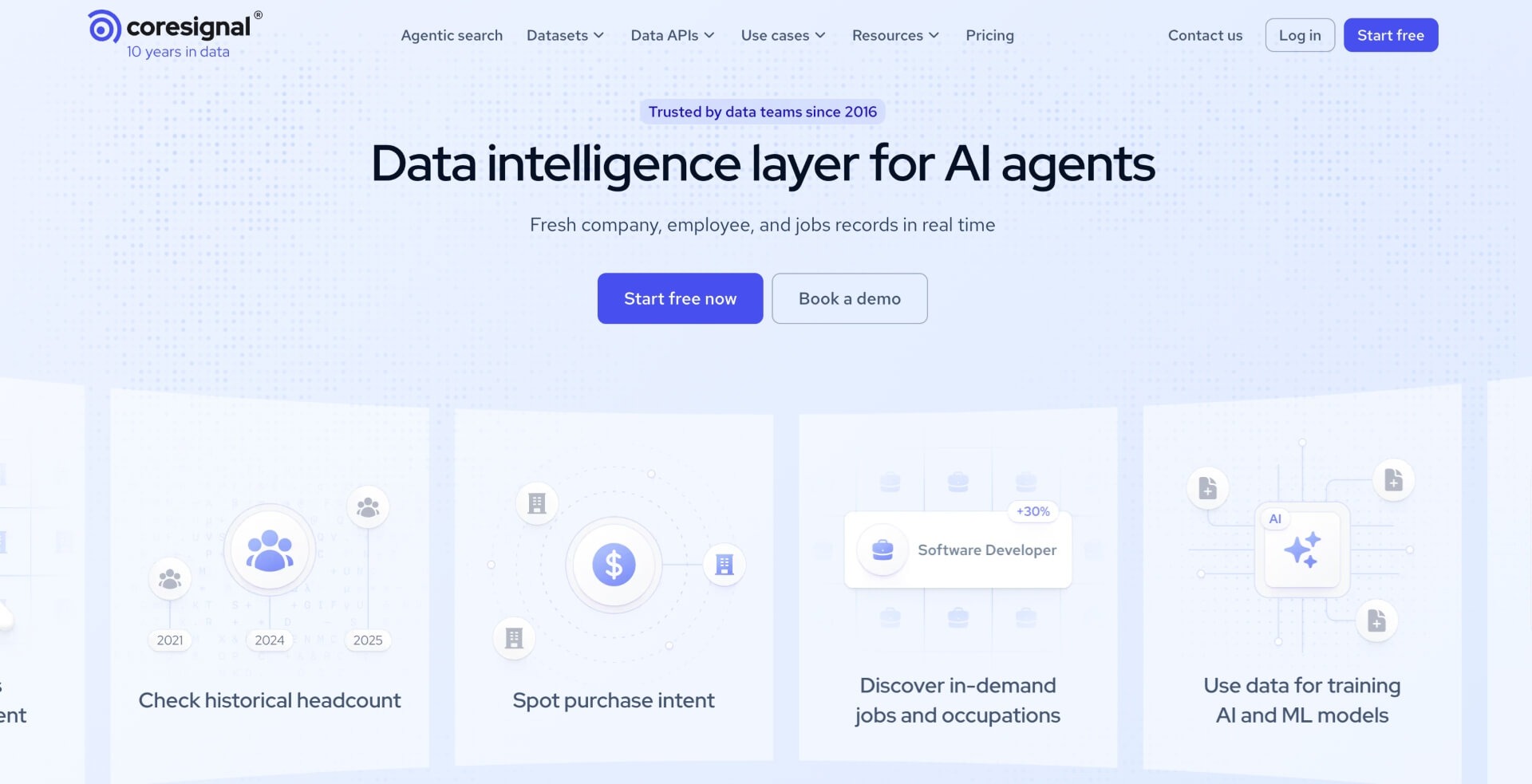
Coresignal is a strong Crunchbase alternative for teams that need company data infrastructure. It provides real-time company data through APIs and datasets, suitable for developers and data teams working on data products, AI workflows, and automated research, as well as less tech-savvy users through its self-service platform and AI Data Search.
Key features:
- 70M+ company records with 500+ data fields
- Real-time Company API and AI Data Search for natural-language queries
- Company datasets delivered as JSON, JSONL, CSV, or Parquet, with historical data available
- MCP Server support for connecting data to AI agents and automated workflows
- Data collected in line with data privacy standards, certified by the Ethical Web Data Collection Initiative
Limitations: Coresignal is a data infrastructure, not a browsable research platform.
Crustdata
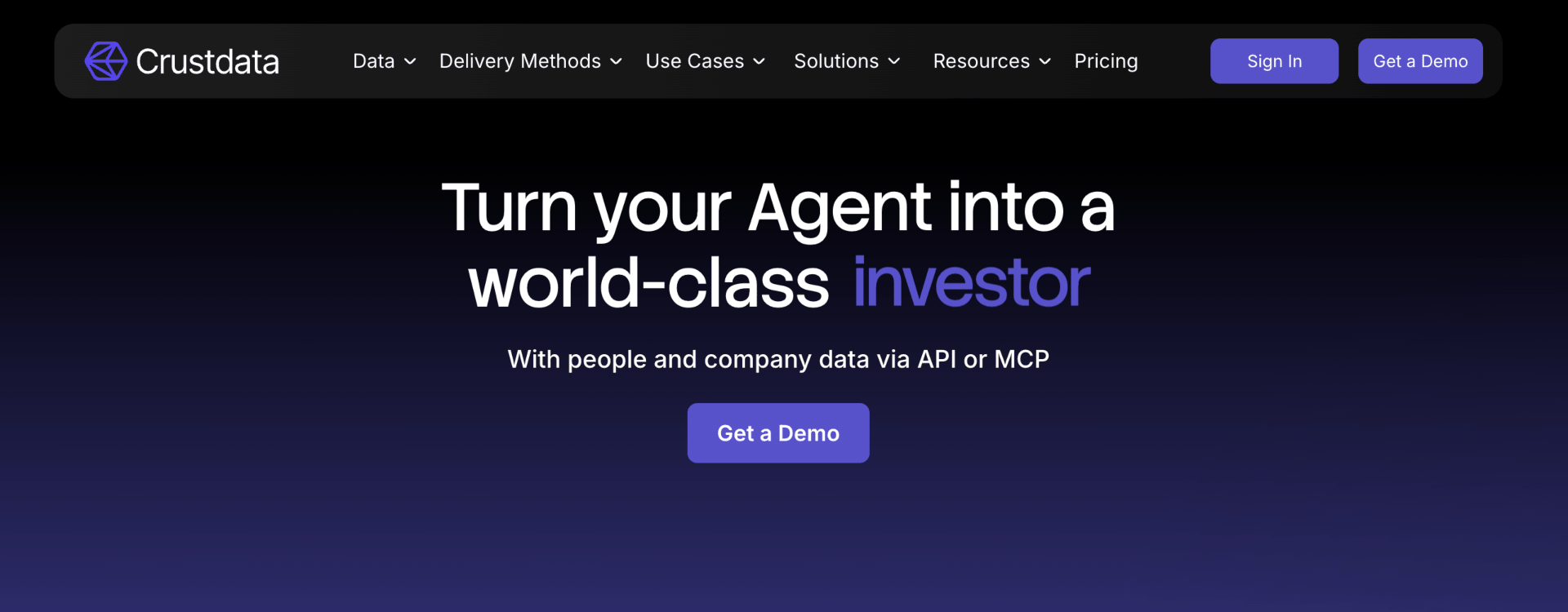
Crustdata is a real-time data provider built for AI agents, offering company and people data pulled live from the web. It appeals to teams that need continuously refreshed records rather than static exports, with a focus on sales, recruiting, and investment workflows.
Key features:
- 200M+ company records and 1B+ people records
- Real-time enrichment pulled live from the web, alongside a continuously refreshed database
- 250+ fields per company record, covering firmographics, funding, headcount, and hiring signals
- Watcher feature for tracking company and people changes over time
- API and MCP access for integrating data into agentic workflows
Limitations: Live, real-time endpoints are enterprise-only and plan-specific, so smaller teams may not get full access to the freshest data tier.
Harmonic
Harmonic is a startup intelligence platform focused on venture capital and growth investors, though it also serves corporate development and go-to-market teams. It centers on discovering and tracking private companies, with data on employees and organizational structure to support diligence and deal sourcing.
Key features:
- Proprietary data on more than 35 million companies and over 195 million employees
- Signals across the full organizational chart, not just top-level firmographics
- Customizable alerts and monitoring tools to track company and founder activity
- API and bulk data options for teams that want to power their own systems
- Web platform with a built-in search engine for manual research
Limitations: Harmonic's core strength is a research platform and alerting rather than infrastructure, so teams that need to build data products may find it less suited to that purpose than API-first providers.
For sales prospecting and contact intelligence
These providers are relevant for teams that use Crunchbase mainly to find and contact prospects. The focus here is contact-level data – verified emails, direct dials, and firmographic filters – paired with outreach workflows rather than research or raw data delivery.
ZoomInfo
ZoomInfo is a widely used Crunchbase alternative for sales prospecting, built specifically around contact-level data rather than general company research. It combines verified contact details with firmographic and intent signals to help teams build and prioritize outbound lead lists.
Key features:
- 100M+ company records and 500M+ contact profiles
- Verified emails and direct dials, with re-verification against daily signals to flag job changes
- Salesforce and HubSpot integrations for syncing contacts directly into a CRM
- API access for enriching records with company attributes and corporate hierarchies
Limitations: ZoomInfo's coverage has historically been deepest in the United States, so teams prioritizing other regions may see more variation in data depth.
Apollo
Apollo is a popular Crunchbase alternative, combining a contact database with built-in outreach tools. It appeals to sales teams that want prospecting, enrichment, and email or call sequencing in one workspace rather than separate tools.
Key features:
- Up to 275M+ contacts and 75M+ companies
- Advanced filters for job title, company size, industry, location, and buying intent
- Built-in sequencing across email, phone, and LinkedIn, plus an integrated dialer
- Chrome extension for prospecting directly from LinkedIn, Gmail, and company websites
- REST API for building custom integrations and enriching CRM records
Limitations: According to third-party reviews, some contact-level records may need secondary verification before outreach.
Lusha
Lusha is a Crunchbase alternative built specifically for finding verified contact details, popular among sales and recruiting teams that need direct dials and business emails quickly. It started as a Chrome extension and has since grown into a fuller B2B data platform.
Key features:
- 290M+ verified contacts and 29M+ companies
- Chrome extension for revealing contact details while browsing LinkedIn and company websites
- 26 buying signals refreshed weekly, including job changes, hiring, and funding news
- API and MCP access for using Lusha data inside CRMs, AI agents, and LLM tools
- ISO 27701, ISO 27001, and SOC 2 Type II certifications
Limitations: Lusha's reveal-based model is credit-gated, so high-volume outreach teams may work through credits faster than with a flat-rate provider.
For investment research and deal sourcing
The focus here is on discovering investment opportunities and understanding a company's traction rather than building data infrastructure. The providers below prioritize research features and signal-driven discovery to support deal sourcing.
PitchBook
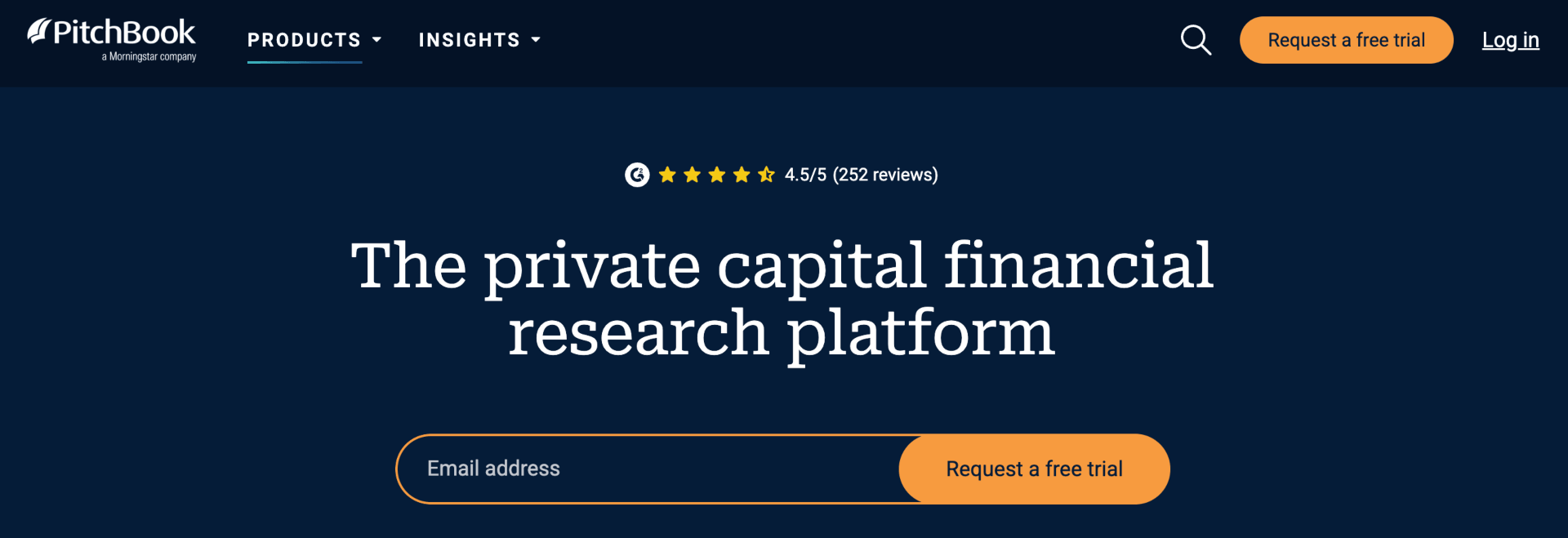
PitchBook is a well-established Crunchbase alternative for private market research, tracking deals, funds, and investors across private equity and venture capital. It suits teams that need deep historical and financial context on private companies before making investment decisions.
Key features:
- Data on millions of companies, deals, funds, and investors
- Screening tools for venture-backed and private equity-backed companies by size, industry, stage, and location
- AI-driven company profile overviews highlighting deal history, financials, and leadership
- API and Data Feed for integrating private market data into internal tools and models
- Integrations with Salesforce, Excel, and AI tools including Claude and ChatGPT
Limitations: PitchBook is built primarily for research workflows, so teams that need raw data at scale for building their own products may need a more infrastructure-focused provider.
CB Insights
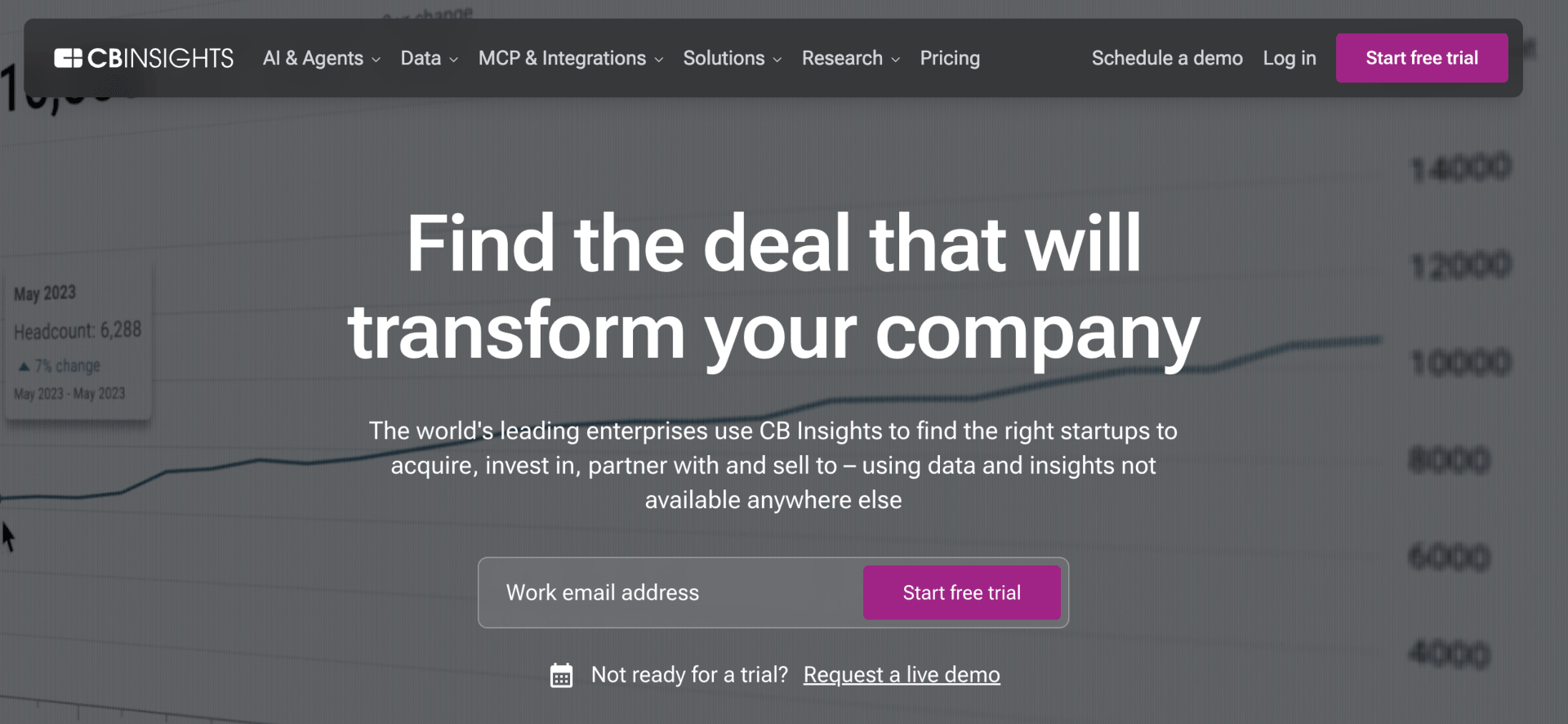
CB Insights is built around predictive intelligence for private companies, helping strategy, investment, and business development teams spot opportunities early. It combines company data with scoring models to flag growth potential before a deal becomes competitive.
Key features:
- Continuous monitoring of 12M companies worldwide
- Mosaic Score – an algorithm that rates a private company's health and growth potential
- Market maps and relationship graphs to visualize private-company activity and trends
- AI agents that generate target lists, investment memos, and scouting reports
- APIs, Snowflake, and CRM integrations for bringing data into existing workflows
Limitations: CB Insights is built around its own scoring models, so teams that need raw, unprocessed data for custom analysis may prefer a more open data infrastructure provider.
Tracxn
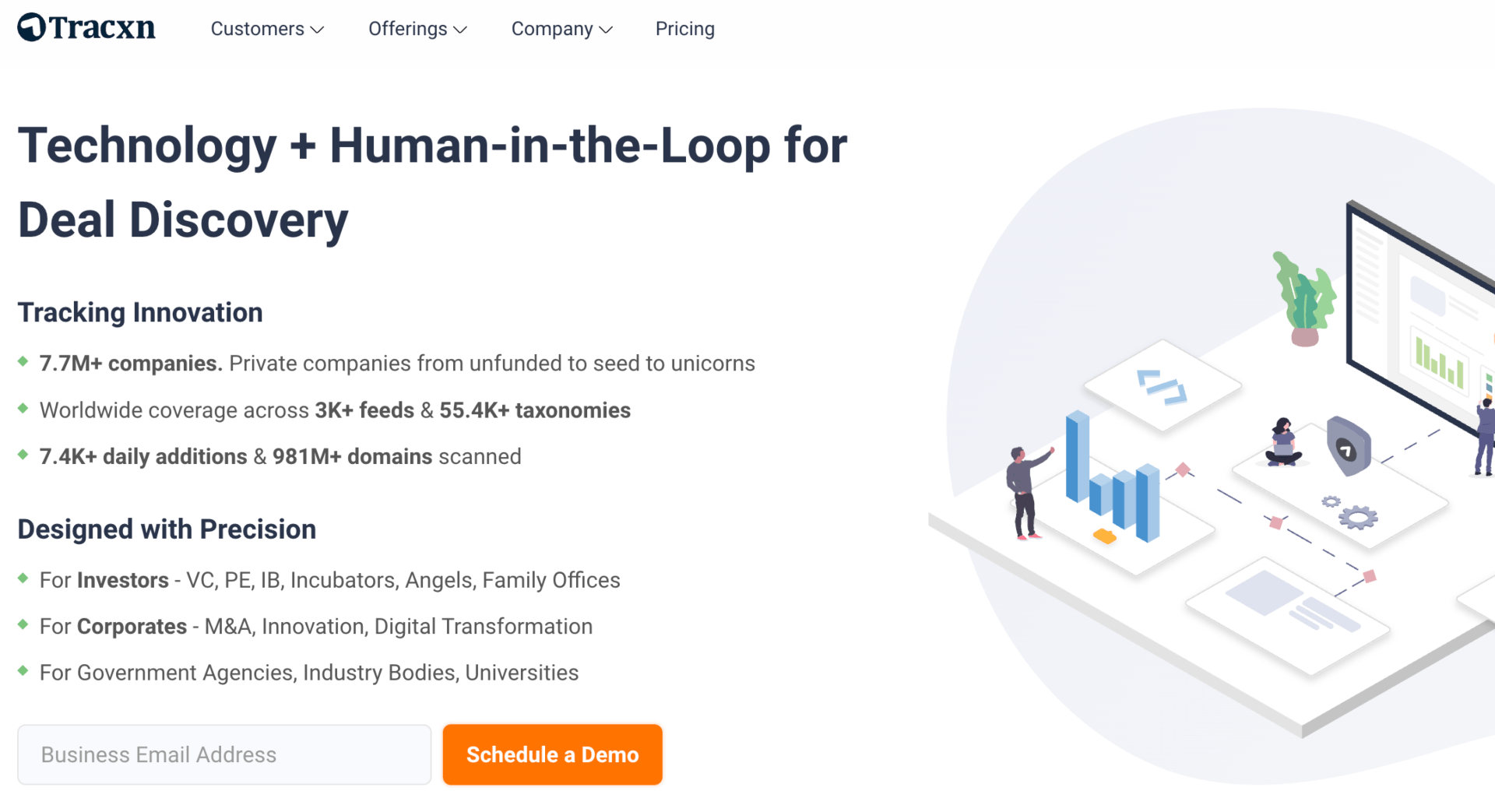
Tracxn is built specifically for private market research, tracking startups and private companies across global sectors. It suits venture capital, private equity, and corporate development teams that need structured data for deal discovery and due diligence.
Key features:
- Tracking of over 7.9M companies worldwide
- Coverage across 3,000+ data feeds spanning industries and sectors
- Tracxn Score, a proprietary rating system for identifying promising private companies
- Customizable dashboards with advanced filters and real-time alerts
- API access for pulling data into internal research workflows
Limitations: Tracxn's research reports rely partly on in-house analyst review, so update speed on niche or emerging sectors can vary compared with fully automated data sources.
Dealroom
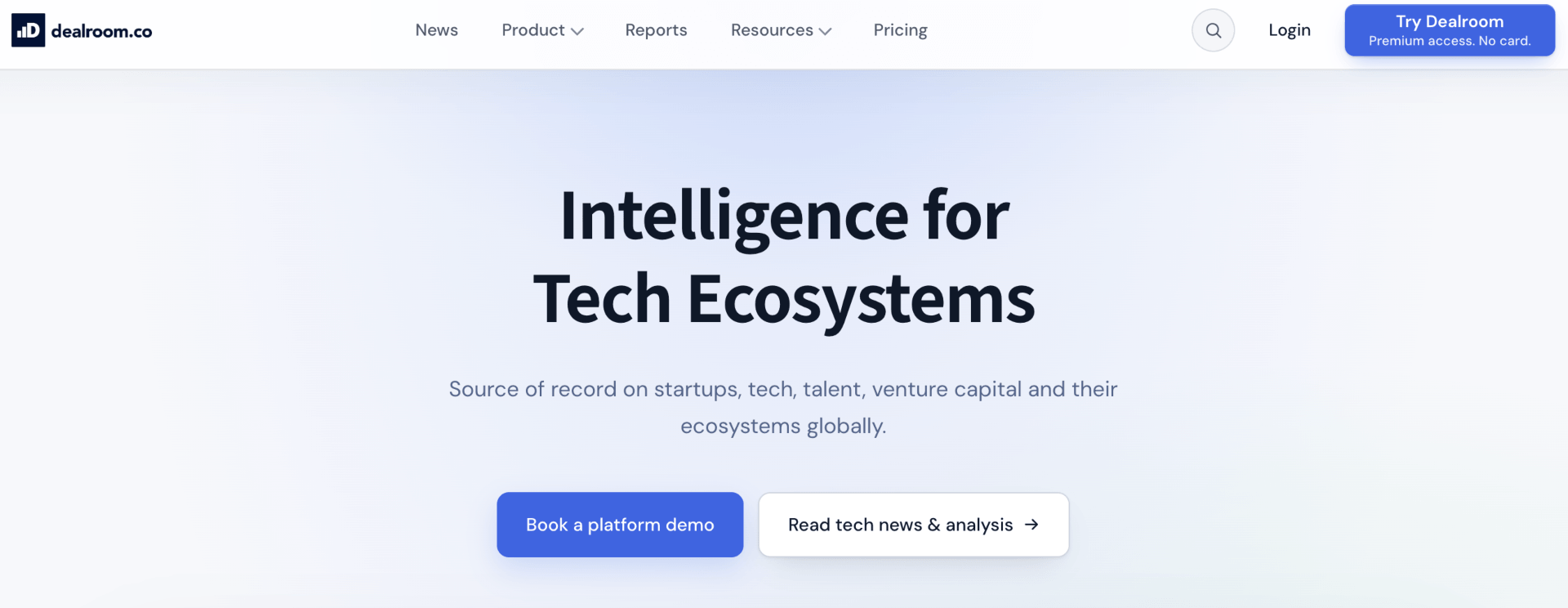
Dealroom is a Crunchbase alternative focused on startup and venture capital intelligence, with a particular strength in European coverage. It suits investors, corporates, and government bodies that track emerging companies and tech ecosystems worldwide.
Key features:
- Data on startups, high-growth companies, and investors across global tech ecosystems
- Partnerships with over 100 governments and ecosystem organizations for exclusive local data
- Verification by a dedicated Intelligence Unit alongside AI-based data aggregation
- API access for connecting Dealroom data into internal business applications
- Chrome extension and ecosystem-mapping tools for tracking companies and investors
Limitations: Dealroom's data depth is strongest in European coverage, so teams focused primarily on the U.S. market may find coverage less comprehensive than region-specific providers.
How to choose a Crunchbase alternative for company data
Choosing the right Crunchbase alternative depends on more than just the size of a provider's database. The details behind how data is collected, structured, and delivered often matter more than raw record counts. Below are a few factors worth checking before you commit to a provider.
- Company data coverage and depth. Look at how many company records a provider offers and how many data fields each record includes, such as firmographics, funding, and headcount.
- Historical data availability. Check whether a provider offers historical data, which helps track how a company has changed over time, not just its current state.
- Data freshness. Confirm how often records are updated. Providers that refresh data continuously give a more current picture than those relying on periodic batch updates.
- APIs, datasets, and delivery options. Decide whether you need a company data API for real-time queries, bulk datasets for large-scale analysis, or both.
- Data processing approach. Providers can present the same underlying information differently. Some remove duplicates, aggregate data from multiple sources, or apply their own scoring models, which can affect how usable the data is for your specific workflow.
Which Crunchbase alternative is right for you?
There's no single best Crunchbase alternative – only the one that fits what you're doing with company data.
If you're building something, you're not evaluating a research interface but a data layer: coverage, field depth, update frequency, and how cleanly records arrive through an API or bulk file. That's where Coresignal and Crustdata fit, and it's the category most teams end up in once a spreadsheet or a browsable platform stops scaling.
If you're prospecting, the contact layer is what matters: ZoomInfo, Apollo, and Lusha all pair firmographics with verified emails and direct dials, and the choice between them comes down to volume, workflow, and budget. If you're researching investments, depth and history – choose PitchBook for financials and deal context, CB Insights and Tracxn for scoring and sector maps, Dealroom for European ecosystems, and Harmonic for finding companies before a round makes them visible.
The practical test is simple – ask what happens to the data after you get it. If a person reads it and makes a decision, you want a platform. If a system consumes it and does something automatically, you want infrastructure.