


.webp)
A nearly 3x increase in customer contacts and $10.5 million in added margin. That's what happened when one of Latin America's largest steel sales operations gave its 1,000+ reps a mobile app that pulled real-time pricing, inventory, and customer data into one place, replacing the handwritten notes and gut calls reps had relied on before. According to McKinsey, the pilot phase alone delivered those results, and about 70% of the sales force adopted the tool within months.
In this article, you'll learn what revenue intelligence is, how it leverages both internal and external data, and why B2B data is essential for improving prioritization, forecasting, and account planning at every stage of the sales cycle.
What is revenue intelligence?
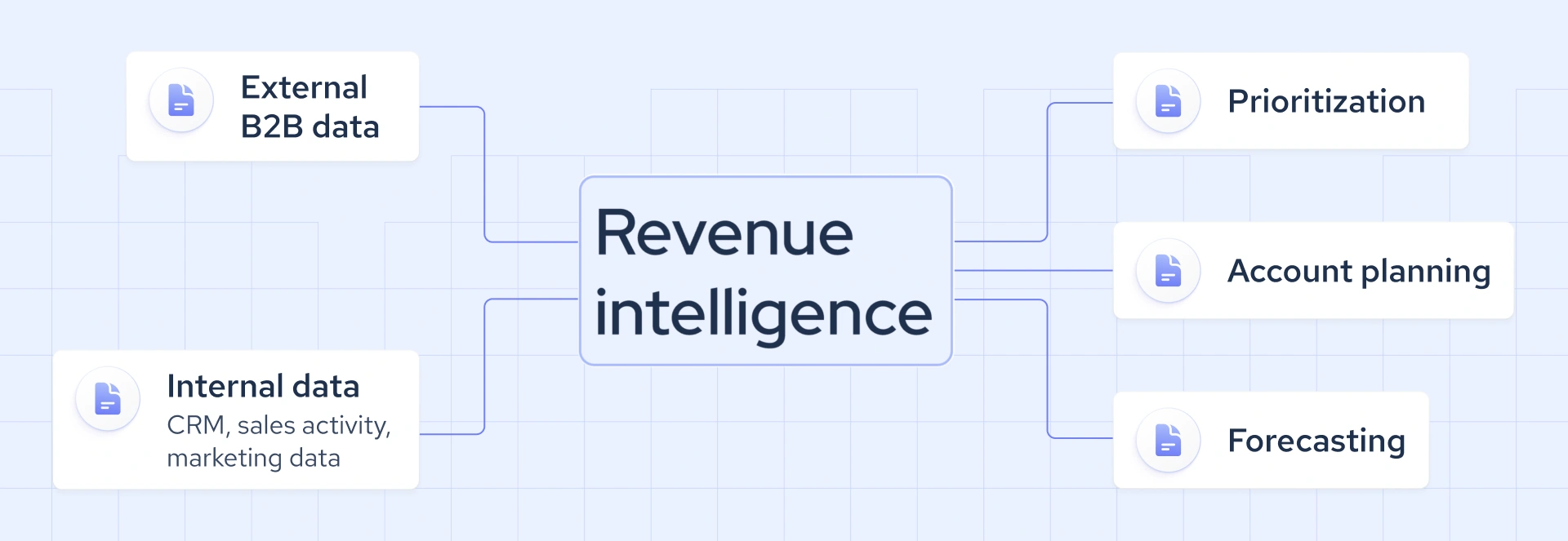
Revenue intelligence is the practice of combining sales insights, marketing, and customer data so revenue teams make decisions based on evidence rather than instinct. It typically draws on internal systems, such as the CRM and sales activity logs, and external data about the accounts and people a business sells to. The goal of revenue intelligence is the same across teams: replace guesswork in prioritization, forecasting, and account planning with a clearer, up-to-date picture of what is happening at each account.
What data powers revenue intelligence?
Revenue intelligence draws on two broad categories of data: internal and external.
- Internal revenue intelligence data comes from the tools a revenue team already uses: CRM records, pipeline and opportunity data, sales activity, calls and emails, customer engagement history, and past transactions.
- External B2B data adds company and market level context that lives outside those systems: company data, employee and workforce data, job posting data, funding data, technographic data, and company activity.
Combining the two gives revenue teams a fuller view of each account.
How does B2B data improve revenue intelligence?
Internal CRM and sales activity data show what has already happened in a deal. On its own, though, this data says little about what's changing at the account itself, since CRM fields are usually updated manually and can go stale between interactions. B2B data can fill that gap by adding company and market context that internal records may not capture, in a handful of concrete ways.
You can get this kind of data from B2B data providers such as Coresignal. We offer continuously updated company, employee, and job posting data that plugs directly into existing CRM and pipeline workflows.
Add external context to CRM and pipeline data
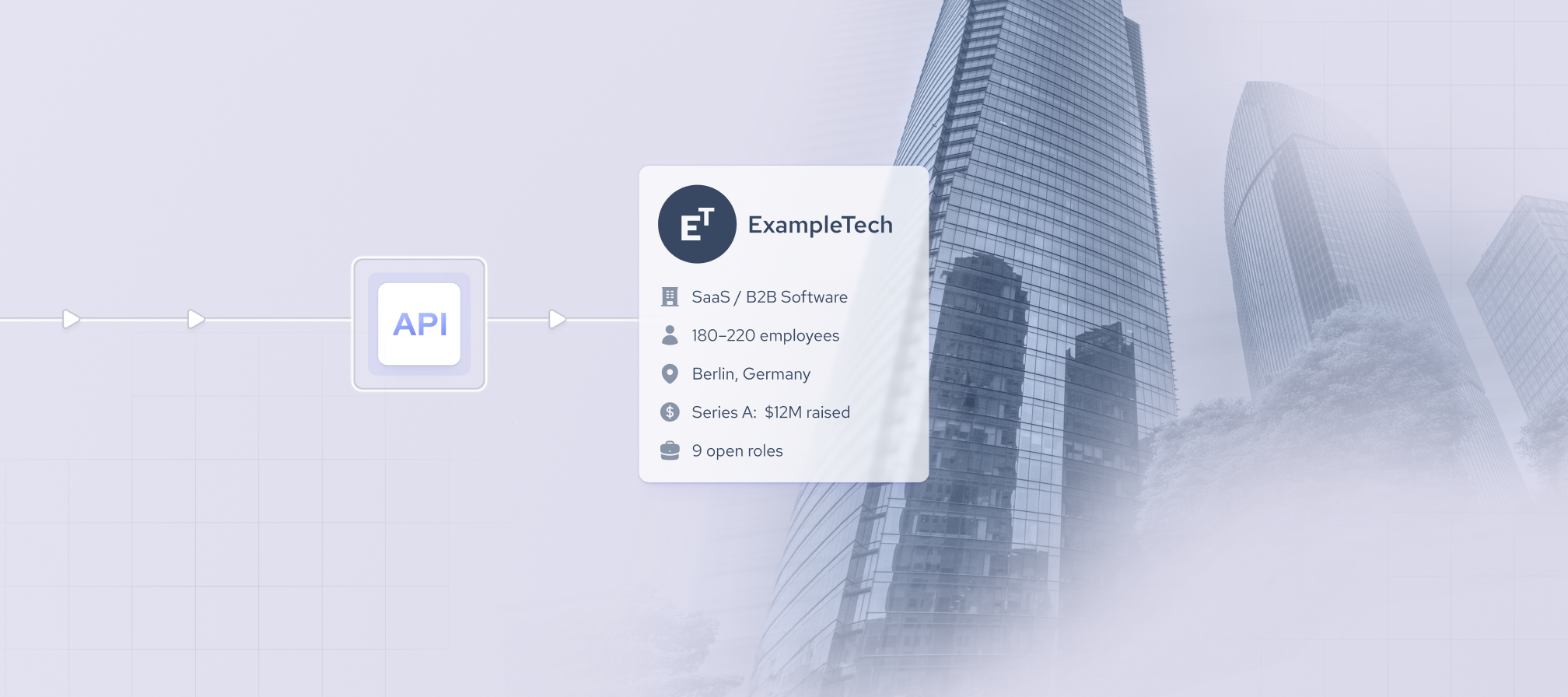
External B2B data can enrich CRM and pipeline records with details a rep would otherwise have to research manually: company size, industry, funding, headcount, recent hiring activity, leadership changes, and the technology a company already uses. Layered onto existing records, this context helps a team understand an account without leaving the CRM.
Improve opportunity prioritization
Up-to-date B2B data helps revenue teams decide which opportunities deserve attention first. Signals like company growth, organizational changes, hiring activity, and funding events give a more current read on whether an account is actually ready to move, rather than relying on deal age or gut feel alone. McKinsey's steel sales case study mentioned earlier is a clear example of this in action: it was the shift from gut calls to real-time pricing, inventory, and account data that drove those results.
Monitor account changes during the sales cycle
Accounts rarely stay static while a deal is in progress. Monitoring changes in company and workforce data, such as headcount growth, new executive hires, department expansion, or a jump in hiring activity, helps revenue teams see how an account is evolving and adjust their approach as the deal moves forward.
Add context to pipeline reviews and forecasting
External B2B data also adds a layer of context to pipeline reviews and forecasting. Changes in hiring, funding, company growth, or leadership can help a team judge whether an opportunity is becoming more or less relevant, rather than relying only on the stage and close date already in the CRM.
Identify expansion and retention opportunities
B2B data supports decisions about existing customers as well as new ones. Headcount growth, new departments, geographic expansion, and acquisitions can all point to accounts that are outgrowing their current contract and may be ready for an expansion conversation.
What sales insights can B2B data add to revenue intelligence?
Combined with internal revenue data, external B2B data supports insights, not just individual signals:
- Account fit: firmographic and technographic data show how closely an account matches the ideal customer profile.
- Growth context: headcount growth, funding, and hiring activity indicate whether a company is expanding or investing, often a clearer signal than annual revenue figures, which can be months out of date for fast-growing companies.
- Organizational priorities: job postings, department growth, and leadership changes reveal which parts of the business are getting more attention.
- Opportunity timing: funding events, geographic expansion, hiring changes, and company announcements help a team decide when an account deserves closer attention.
- Expansion potential: workforce growth, new departments, acquisitions, and regional expansion can surface upsell or cross-sell opportunities.
- Deal context: leadership, hiring, workforce, and technology changes help a team understand what's happening at an account while an opportunity is active.
Which types of B2B data can strengthen revenue intelligence?
The table below shows how each data type supports revenue intelligence with specific Coresignal’s data fields examples.
Most revenue teams combine several of these data types to build the clearest possible account picture.
What makes B2B data useful for revenue intelligence?
Not all B2B data is equally useful. A few qualities decide whether it actually strengthens revenue intelligence:
- Freshness: reflects what's happening now rather than months ago.
- Coverage: spans the companies and people a team actually sells to.
- Historical context: shows whether a trend is sustained or just a one-off blip.
- Structured fields: plug directly into existing tools.
- Entity matching and deduplication: ensure records tie cleanly to the right account.
- Integration readiness: depends on whether a provider offers APIs, compatible data formats, cloud delivery, and integrations with the tools already in a team's workflow.
How can you access B2B data for revenue intelligence at scale?
A growing number of providers offer external B2B data as a layer on top of internal revenue data, and Coresignal is one public data provider built specifically for this kind of access at scale. We provide publicly available company, employee, and job posting data to more than 1,000 clients worldwide.
We make this data available in a few ways, depending on how a team wants to work with it:
- APIs, for on-demand enrichment and workflow integration, with average response times around 176ms.
- Datasets, for large-scale analysis across an entire account list or market.
- Webhooks, for ongoing signal monitoring that flags changes as they happen.
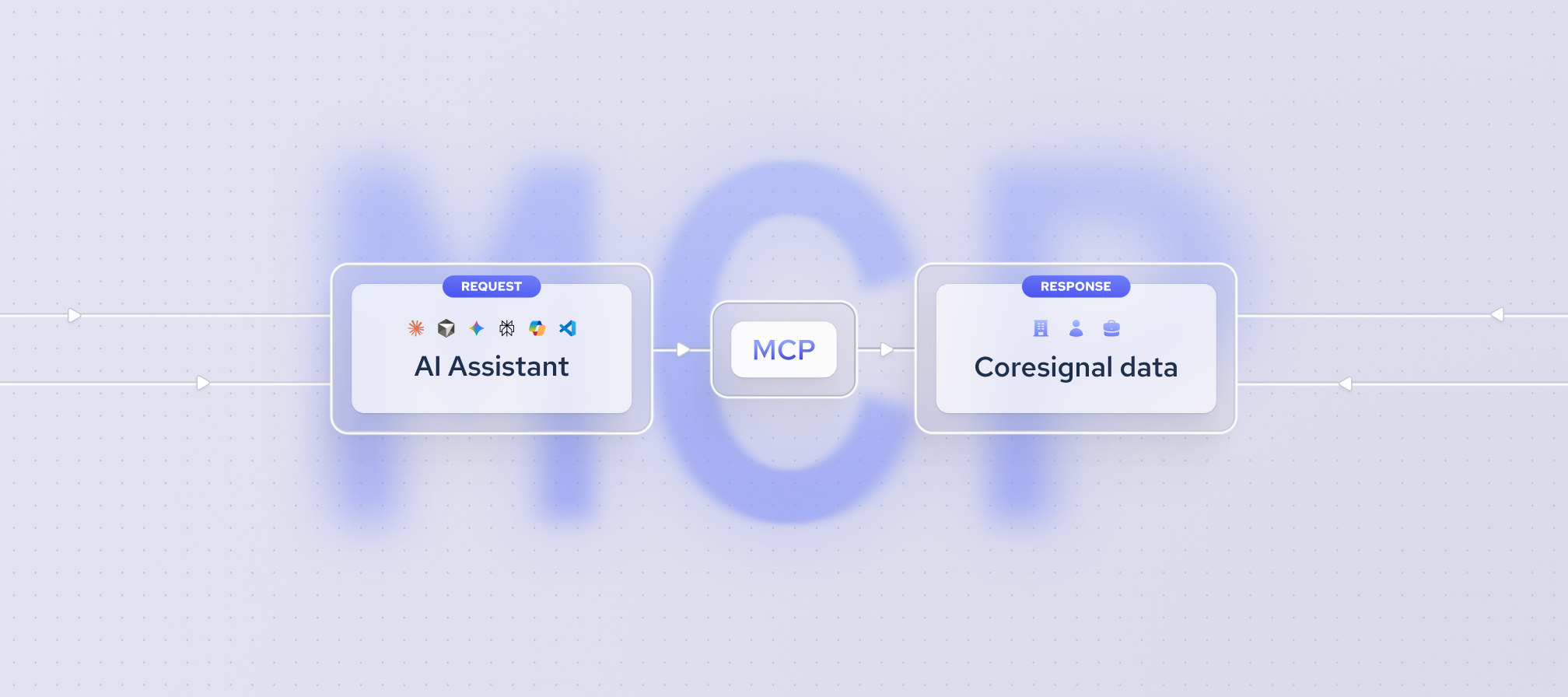
- Agent-ready access, including a natural-language search API and an MCP server, so AI agents and workflows can query company, employee, and job data directly.
Teams that prefer a no-code option can also work with the data through Coresignal's dashboard and its AI Assistant, which supports natural-language queries without engineering support.
Final thoughts
Internal revenue data tells a team what has already happened in a deal. External B2B data adds the company and market context needed to understand what's happening right now, and what's likely to happen next. Together, they give revenue teams a fuller, more current picture for prioritization, forecasting, and account planning, grounded in evidence rather than guesswork.