



Job posting data is a major indicator of companies investing in workforce development, expanding, or restructuring. Even the U.S. Federal Reserve uses the Indeed Job Postings Index to get a read on the current labor market, so why shouldn’t you?
Company career pages, job boards, and ATS platforms all provide pieces of the job data puzzle, and it’s up to you to connect the dots. However, what all these don’t tell you is that job listing data quickly gets outdated, which leads to mixed signals.
Data quality depends entirely on the source, and this guide will help you find structured, deduplicated, multi-source job data from trustworthy providers like Coresignal.
What is multi-source jobs data?
Multi-source job posting data integrates listings from several different sources, most notably job boards, listings, company career pages, applicant tracking system (ATS) platforms, and professional networks.
Most importantly, multi-source jobs data is more valuable than raw scraping, as the info is structured after compilation. While scraping provides inconsistent, often duplicated listings, a multi-source dataset removes repetitive listings and enriches each data input with information verified from multiple sources.
Such data can quickly become stale, so regular, 24/7 updates are necessary to keep it up to date.
Why single-source job posting data creates blind spots
The main issue with single-source job posting data is the array of duplicated records. It narrows the labor market view, as relying on a single source often leads to missed roles and poor market insights. Still, that’s just a part of the problem.
1. Company websites do not always show the full hiring picture
The most common way of collecting hiring signals is through company websites, but even though they seem to tell the whole story, they provide scarce details, insufficient for a detailed market analysis.
For instance, a career page might miss some roles and exclude information on past positions due to a lack of historical records.
Plus, company websites often lack important insights like salary information and other hiring signals.
2. Job boards and ATS platforms add missing market signals
Job posting data from boards and ATS platforms connects the missing dots left behind company websites. It sheds more light on positions in demand, locations, salary ranges, and even applicant information for employee profile analysis.
Together with company websites, these sources lead to more precise tracking of hiring signals.
3. Single-source data can distort analysis
The true cost of a narrow source is reflected in poor workflow results. AI systems may learn from incomplete hiring signals, while HR teams might fail to properly map skills and roles in demand due to a lack of historical records.
Plus, unpredictable gaps, such as companies that are actively hiring but not publishing the roles on corporate websites, further distort the picture, so information verified from multiple sources brings more value to the table.
The quick preview below will show you how different single-source and multi-source data can be:
What makes multi-source jobs data reliable?
While multi-source data is usually more representative than single-source data, it doesn’t automatically provide quality.
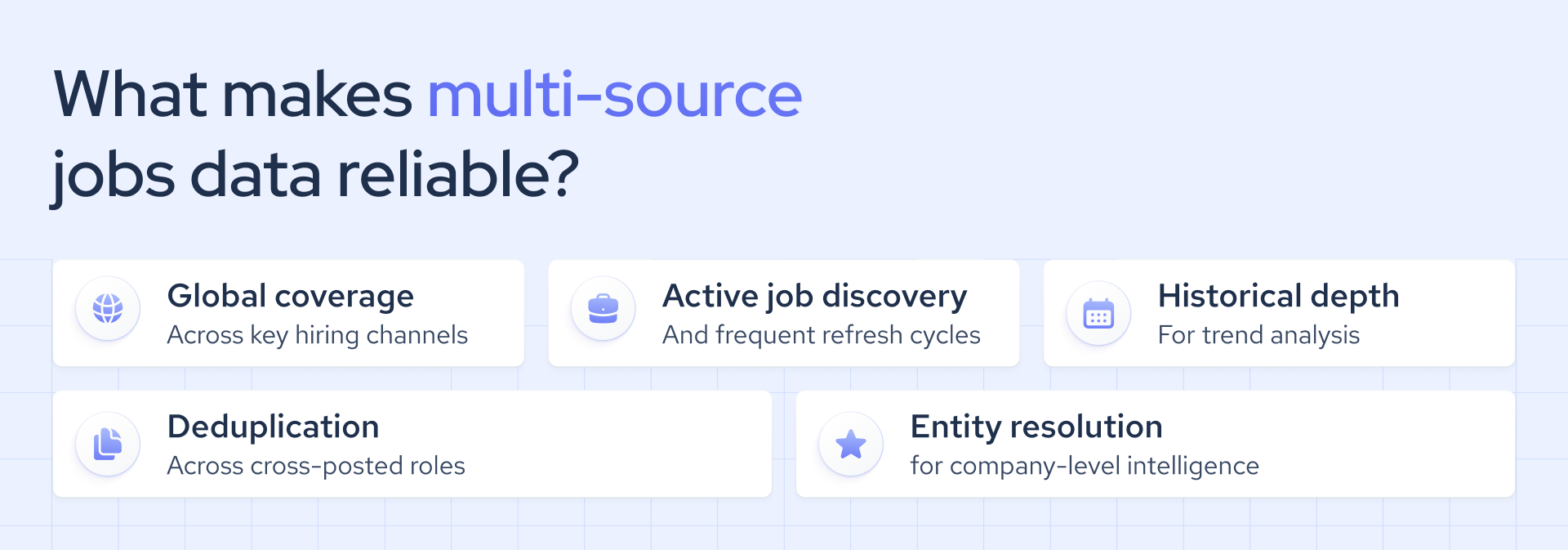
Multi-source jobs data is only valuable when it’s pulled from trustworthy sources, deduplicated, structured, and laid out in a way that matches what’s truly going on inside companies and reflects their hiring patterns.
1. Global coverage across key hiring channels
A good job data provider will not only have multiple sources but also rely on those that are relevant for your use case.
Job boards imply demand and provide some basic salary and location details, while company career pages reveal more about the roles themselves.
ATS platforms feature postings that might not be found elsewhere, and all those signals combined point to important patterns when analyzing industries, regions, and multi-country companies.
2. Active job discovery and refresh cycles
Stale job posting data only gives you a distorted picture of the hiring demand, especially in the case of early-closed postings and those that are left hanging on the internet for far too long.
The labor market changes as the roles get filled, postings expire, and employers update their listings. That’s why you need daily-updated information for proper sales intent analysis, labor market monitoring, and AI system training based on actual and current signals. Job posting data is one source of labor market data and can also be combined with traditional labor market statistics to provide broader market context.
3. Historical depth for trend analysis
Job listing data needs to be updated and current to reveal hiring trends, but historical records add another dimension necessary for identifying and analyzing recurring patterns. They reveal information behind hiring cycles, seasonal spikes, and long-term demand.
At Coresignal, historical jobs records span from 2020 onwards, containing active and expired listings across all sources.
4. Deduplication across cross-posted roles
Without deduplication, a single job listing could appear as multiple ads across different sources. That leads to inflated hiring demand that doesn’t show the true market conditions. It sends all the wrong signals for trend analysis, salary analysis, and company-level hiring efforts, which is why it’s crucial to use a deduplicated dataset when analyzing such trends.
5. Entity resolution for company-level intelligence
Job posting data requires entity resolution for proper company-level intelligence and insights. It represents the listing attached to a real-world company, rather than just showcasing it as yet another posting.
Problems occur when the same job ads are posted under different company names, domains, subsidiaries, sub-brands, and ATS listings without clear company information. Entity resolution helps HR tech teams create complete profiles and talent intelligence maps.
It also leads to clean identity intelligence that AI systems require for proper machine learning. Plus, it gives execs a representative view of the sales funnel and forecasting by eliminating duplicate records or wrong listings as a result of spelling errors and typos.
Why multi-source jobs data matters for different use cases
Job posting data isn’t only relevant to recruitment boards. With daily job data deliveries, companies can figure out how the demand is changing and pinpoint the shift within a certain company. There’s a lot more to it, so here’s how it suits different use cases:
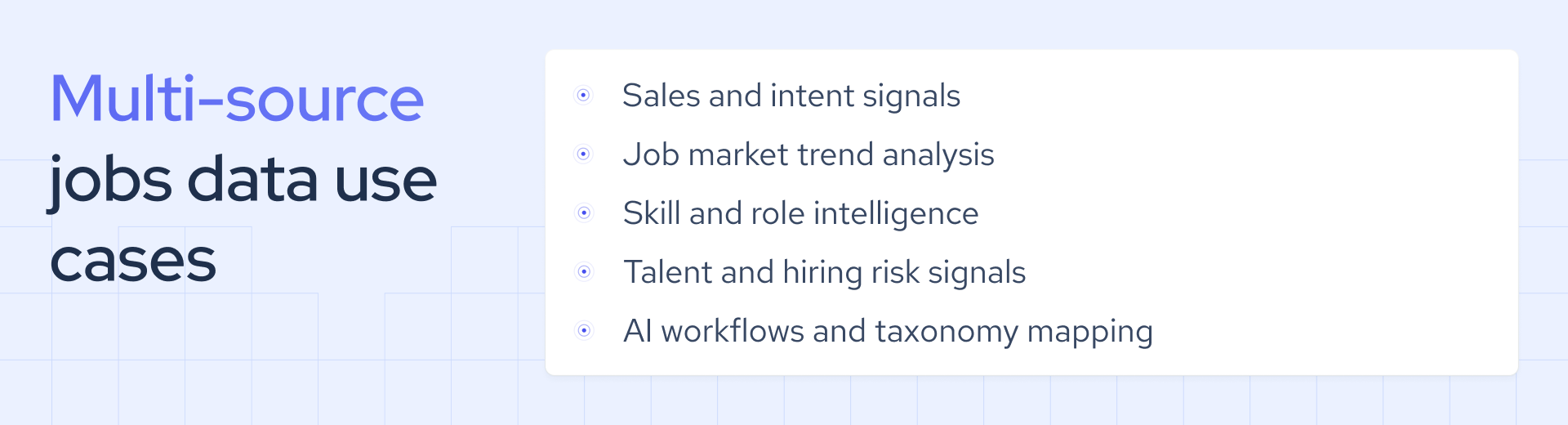
- Sales and intent signals: Depending on the hiring roles, teams can assess strategic priorities, budgeting, and operational needs of a company.
- Job market trend analysis: Small details behind job posting data reveal where the demand is heading, and historical depth showing the role, industry, location, and other aspects provides the necessary information for accurate analysis.
- Skill and role intelligence: Job descriptions point to skills in demand, and job role listings reveal key metrics for competitive intelligence.
- Talent and hiring risk signals: Repetitive postings and long-open roles give mixed signals to HR teams, which use historical data to pinpoint long-term hiring patterns and potential risks.
- AI workflows and taxonomy mapping: AI models are trained on clear inputs, including company-level signals with normalized titles and skills. Deduplicated data boosts the output quality and leads to better decisions made by agents based on that data.
How to evaluate the quality of multi-source jobs data
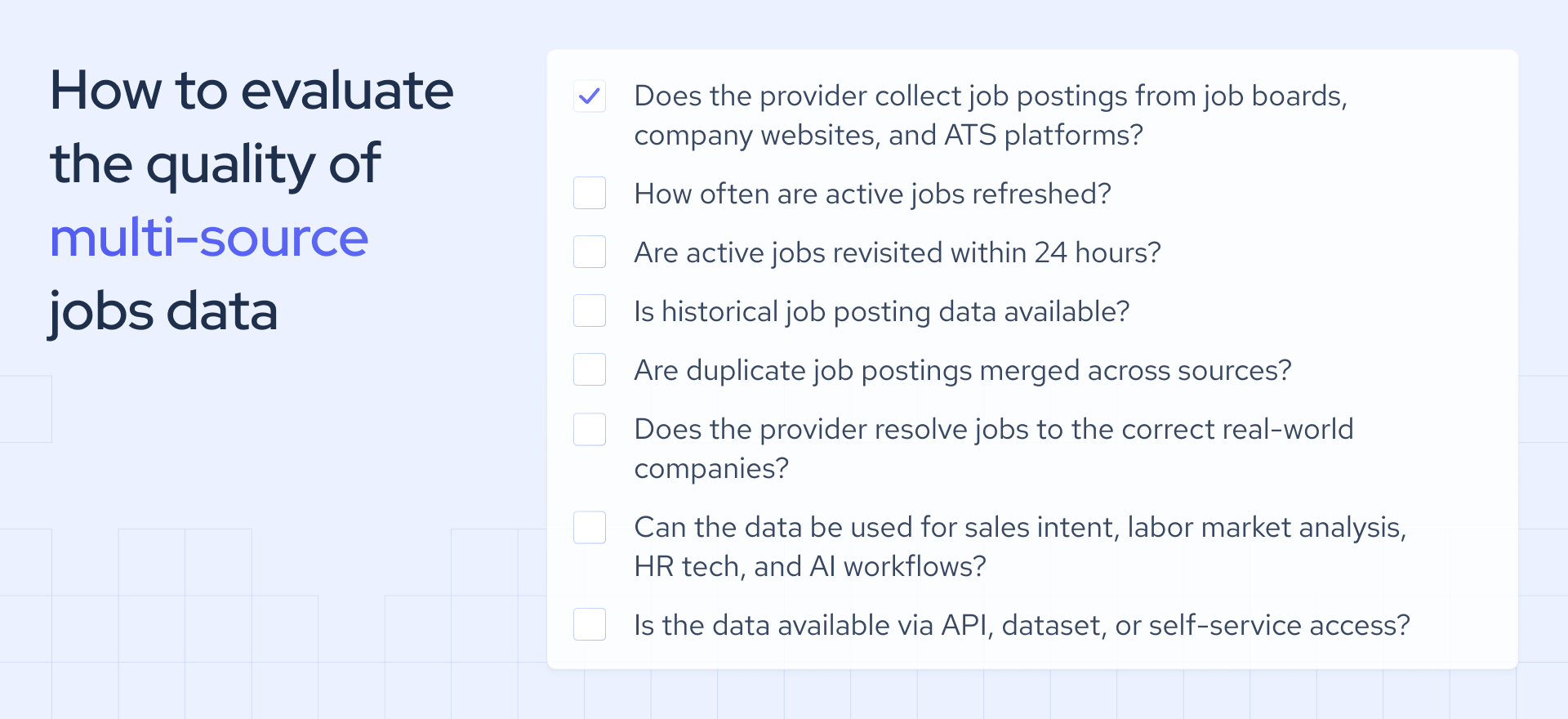
Not all multi-source data providers are equal, and the quality of their datasets mainly depends on freshness, sources, and deduplication. Here’s our quick guide with essential questions to ask when looking for the right partner:
- Does the provider collect job postings from job boards, company websites, and ATS platforms?
- How often are active jobs refreshed?
- Are active jobs revisited within 24 hours?
- Is historical job posting data available?
- Are duplicate job postings merged across sources?
- Does the provider resolve jobs to the correct real-world companies?
- Can the data be used for sales intent, labor market analysis, HR tech, and AI workflows?
- Is the data available via API, dataset, or self-service access?
How Coresignal approaches multi-source jobs data
Coresignal frames the data collection approach based on the key requirements like data coverage, freshness, deduplication, and historical depth. Instead of just zeroing in on volume, the focus is on data quality.
You can check the full multi-source jobs dataset announcement to get an overview of Coresignal’s multi-source dataset and see how it works, but here’s what it’s based on in a nutshell:
- Over 450 million job posting records
- Over 70 million active job postings
- Historical coverage since 2020
- Multi-source data from job boards, company websites, and ATS
- 24/7 discovery
- Every active job revisited within 24h
- Around 1.3 million jobs added per day
- Entity resolution
- Detailed overview of the company context
- Real-time jobs API, datasets, and self-service dashboard
How Coresignal compares with other jobs data providers
Coresignal makes it to the list of the best job posting data providers with detailed coverage, data-fetching from multiple reliable sources, and daily updates.
Here’s how it stacks up with the other providers:
- The Coresignal vs PredictLeads comparison: PredictLeads breaks down company-level signals suitable for sales intelligence analysis.
- The Coresignal vs Mantiks comparison: Mantiks is a job board with multiple delivery options and historical depth similar to Coresignal’s job market datasets.
- The Coresignal vs TheirStack comparison: TheirStack is more of an AI-focused solution with emphasis on developer workflows.
- The Coresignal vs Fantastic Jobs comparison: Fantastic Jobs offers similar self-service jobs data solutions and APIs to Coresignal.
- The Coresignal vs LinkUp comparison: LinkUp uses a more website-focused model compared to the multi-source jobs data at Coresignal.
Final thoughts
Overall, job posting and job market data can reveal a lot about hiring trends, corporate budgeting, and skills in demand, as long as the right dataset or an API is being used.
Single-source data won’t suffice for advanced AI model training, workforce analytics, and sales market intelligence, whereas multi-source data provides a bigger picture. It’s more complete and more historically accurate, and most importantly, it gives you a steady view of the labor market as it is currently.