


Hiring moves fast. Companies are reshaping their workforces daily, and for recruiters, market researchers, and sales intelligence teams, keeping up with the latest trends becomes a difference between closing and losing.
Having access to the right and fresh jobs data changes everything.
According to the JOLTS survey from the US Bureau of Labor Statistics, there were over 6.8 million job openings in February 2026 in the US alone.
Each of those postings is thoroughly documented in databases that can be accessed through reliable jobs data providers. Signals from job posting databases help job seekers find the right position and allow employers access to an adequate talent pool.
Technological advancements enable HR departments and sales intelligence teams to use jobs data for AI-powered applicant matching, and the common thread is dependable data. Find the perfect job data provider for your use case with a top list of vendors that stand out with data freshness, enrichment, and multi-source coverage.
Quick comparison of the top job posting data providers
There are a number of factors you’ll need to consider to find the right job data provider. Here’s a quick summary of how my top picks weigh up in those key categories:
| Provider | Job posting records | Freshness | AI-readiness | Data formats | Delivery methods | Pricing model | Elasticsearch |
|---|---|---|---|---|---|---|---|
| Coresignal | 475M+ | Fresh data with real-time updates | Yes | AI-readable data formats, JSON, CSV, and Parquet | Job datasets, API | Database API and dataset pricing plans | Yes |
| Bright Data | 117.5M+ | Fresh data | Yes | JSON, CSV, Parquet | Job datasets, API | Database API and dataset pricing plans | Yes |
| People Data Labs (In beta) | 37M+ | Daily updates | Yes | JSON, Parquet | API | API pricing plans | Yes |
| Revelio Labs | 5B+ | Fresh data with real-time updates | Yes | Parquet, CSV | API, analytics dashboard | API and dashboard pricing plans | No |
| Xverum | 10M+ | Fresh data with real-time updates | Yes | JSON, Parquet | Datasets, API | Database API and dataset pricing plans | No |
| JobsPikr | 1B+ | Fresh data with real-time updates | Yes | JSON, CSV | API, data files | API pricing models | Yes |
What is a job posting data provider?
A job data provider is a company that documents job openings and information about them. Vendors convert scattered and lengthy job postings into clean and structured datasets.
Once the data is collected from various sources, it’s deduplicated, enriched, structured, and packed into a ready-to-use format. Most providers deliver job posting data via APIs or as datasets, and the type of information they provide includes:
- Job titles and descriptions: Standardized job titles, full role descriptions, and an overview of qualifications
- Company information: Employer profiling, including hiring company name, industry, and office locations
- Locations and remote status: Detailed role description based on remote work availability
- Salary ranges: Overview of minimum and maximum salaries, bonuses, commissions, and incentives
- Skills: In-demand skills, skill gap information, and industry-related qualifications
- Seniority: Seniority level information by role and position
- Job requirements: Educational requirements, certifications, and skills
- Posting dates and status: Up-to-date posting status updates and job posting availability.
Structured data is then used by HR departments, recruiting teams, sales intelligence teams, analysts, and investors. Though the use cases vary, one thing is certain: fresh, structured, and ready-to-use data is much easier to integrate into workflows than manually scanning job postings.
Why companies use job posting data
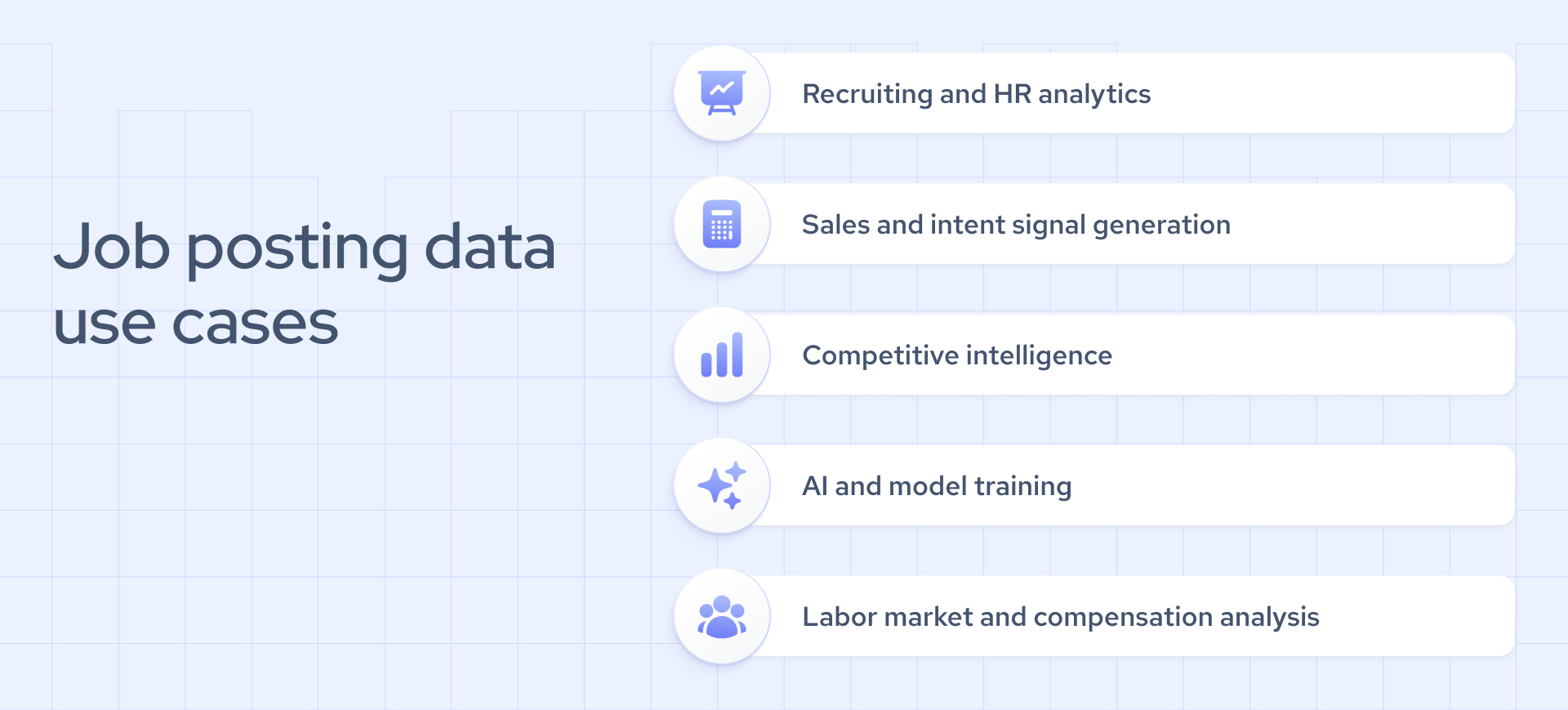
Jobs data provides various benefits to companies, and these are the main use cases:
- Recruiting and HR analytics: HR departments use jobs data to identify in-demand skills and pinpoint skill gaps.
- Sales and intent signal generation: Job postings data is one of the main growth indicators, so companies use it to find B2B partners that are a potential fit for their services and products offered.
- Competitive intelligence: Hiring indicators and trends provided by job data help companies keep track of their competitors' growth potential.
- AI and model training: Data vendors who offer AI-ready models provide model training companies with ready-to-use datasets.
- Labor market and compensation analysis: Companies can also set competitive compensation by going through expected salary rates in job ads and openings.
How to get job posting data: API vs datasets
Providers like Coresignal offer multiple job posting data delivery methods, and APIs and datasets are the most commonly used types. Each option serves a different purpose: bulk datasets suit large-scale analysis and AI model training, while APIs provide dynamic, real-time updates.
Companies looking into live job boards, hiring trends, and sales intelligence signals mainly take the jobs API route. On the flip side, datasets are not updated in real-time, and they’re mostly intended for one-time use.
How to evaluate a job data provider
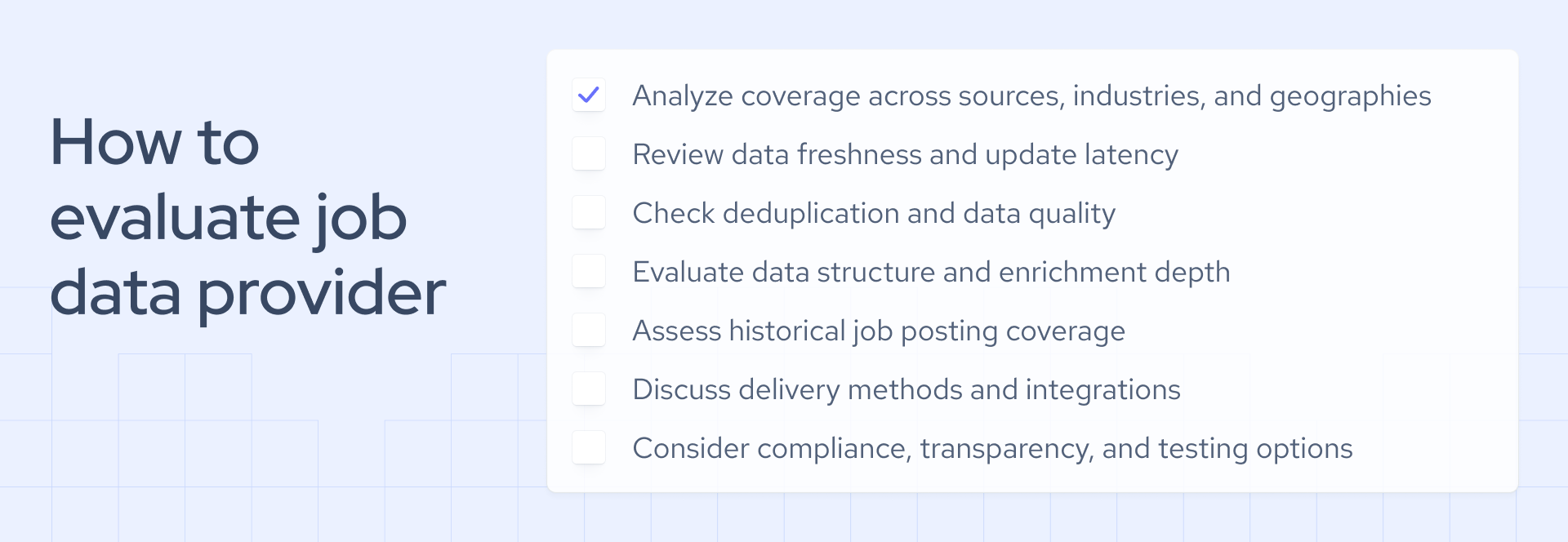
The value of a job data provider is reflected in the quality of the data itself. Of course, everything depends on your use case, but generally, here is a lis t of the things to keep in mind while choosing a provider.
First, providers that bring multi-source coverage across various industries and locations would always simplify your time to market.
You’ll then want to look into the freshness and update frequency. Some providers update their APIs and datasets in real time or daily, while others might freshen up their data weekly monthy.
Data quality is also crucial. Look for providers that handle data structuring, cleaning, and deduplication on their end, removing redundant listings and making datasets more usable.
Other things you’ll want to check are data structure and enrichment depth, historical coverage, and delivery methods. Also, look into data compliance laws, transparency, and API testing availability.
Top jobs posting data providers in 2026: comparing market leaders
To help you pick the right job postings data provider for your needs, take a look at a summary of the 6 best vendors in 2026.
Coresignal
Coresignal is the best job posting data provider overall, with listings from professional networks and the most comprehensive Multi-Source Jobs API. It covers over 475M+ listings, with real-time updates visible through the responsive API.
- Best for: Deduplicated, multi-source records for accurate job market analysis
- Key strengths: Detailed information about the hiring company and recruiter, AI-ready datasets, over 500,000 job listings added daily
- Potential limitations: Limited free plan credits
- Data access and delivery: API access, AI-ready datasets
- Pricing: Starting at $49/month for API access with a free trial
Bright Data
Bright Data spans is primarily a scraping infrastructure provider that also offers 117.5M job listings. It's a good option for technical teams that build fully custom datasets in terms of refresh rates, number of records, and delivery format.
- Best for: Market analysis based on static datasets
- Key strengths: Custom data collection tools and APIs, dataset bundles
- Potential limitations: Limited job posting data depth
- Data access and delivery: API access, datasets
- Pricing: Custom pricing starting at $250/month as the minimum order
People Data Labs
People Data Labs has recently started offering job postings data, the product is now in beta. The API-first approach makes it a good pick for custom candidate matching and tracking hiring signals, while on-demand datasets suit sales intelligence and AI development purposes.
- Best for: HR tech and sales intelligence teams
- Key strengths: API-based data enrichment, professional profile base, bulk data access
- Potential limitations: Limited historical data
- Data access and delivery: API
- Pricing: Starts at $98/month for API access, free trial
Revelio Labs
With over 4.1B profiles from over 440 thousand websites, Revelio Labs is a good job data provider with an intuitive dashboard. It allows you to explore workforce composition by headcount, age, seniority, salary, sentiment, roles, geography, and many other factors. The dashboard also lets you identify company hiring trends and track workforce changes in real time.
- Best for: Company headcount tracking
- Key strengths: Salary data analytics, company screening assist
- Potential limitations: Mainly suitable for enterprise-level companies
- Data access and delivery: API, analytics dashboard
- Pricing: On-demand pricing
Xverum
Xverum tracks more than 10M global job postings and roles, featuring a daily refresh cycle. It’s a good pick for enrichment workflows and building data pipelines with daily hiring intelligence filters that help you spot opportunities ahead of the competitors.
- Best for: Custom data enrichment, built-in GDPR and CCPA compliance, developer-friendly API
- Key strengths: Over 10M job listings scanned daily
- Potential limitations: Higher pricing tailored for comprehensive enterprise datasets
- Data access and delivery: API
- Pricing: Custom pricing based on a quote
JobsPikr
JobsPikr sources data from over 1B records, and ready to use through a responsive API with daily updates. It also provides a complete job market intelligence platform with data files suitable for geographic talent mapping, skill and role insights, and a competitor hiring tracker.
- Best for: Companies looking for fresh data with deep filtering options
- Key strengths: Over 1M job signals pulled daily, 5-year historical coverage
- Potential limitations: Steep API learning curve
- Data access and delivery: API, data files
- Pricing: Starts at $79/month
Which job data provider is best for your use case?
Coresignal is the best jobs data provider overall if you’re looking for deduplicated, multi-source data for analytics. For teams building custom scraping pipelines, Bright Data makes a solid alternative, with enterprise-level scraping infrastructure.
If you’re looking for easier data access, Revelio Labs has a analytics dashboard. JobsPikr is the one to go with for workforce intelligence. Xverum would be a good pick for job market research.
Common mistakes buyers make when choosing a job data vendor
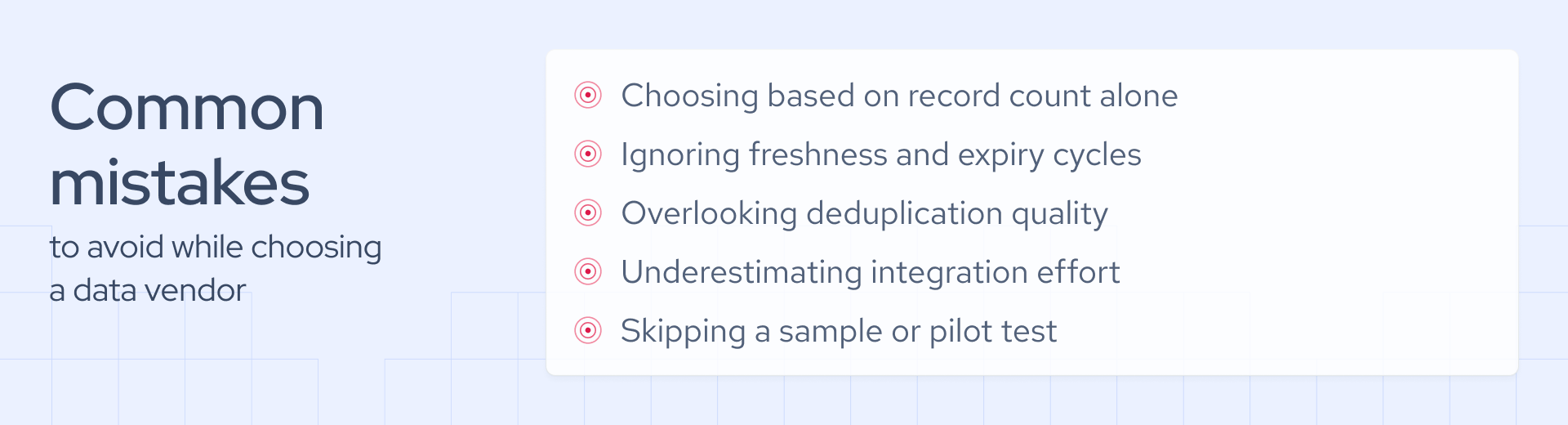
One of the biggest mistakes you can make when choosing a job postings data vendor is to pick purely based on the record count. If the data isn’t deduplicated, normalized, and enriched, its true value significantly drops, especially for AI systems that need structured job posting data rather than raw job ads.
Always look for fresh data with real-time updates, and don’t overlook the integration complexity.
Also, never skip a sample and always look for free trial opportunities.
What to ask before buying job posting data
With so many things to focus on when choosing a vendor, it’s easy to overlook important questions. Keep the following in mind to find a suitable provider for your business needs:
- What are your primary sources?
- How often is the data updated?
- How do you handle duplicates?
- What fields are standardized or enriched?
- Can I test the data before committing?
Final thoughts
The choice is ultimately up to you: pick providers with real-time data APIs like Coresignal for research and analytics, or use workforce composition dashboards of Revelio Labs for company headcount tracking. Feel free to check this more detailed comparison of job data providers if you’re still weighing your options.