

You have plenty of candidates in your hiring pipeline, but your shortlist is still empty.
If you work in recruitment, workforce analytics, or HR, you are likely asking the same question: which roles are candidates and employers focusing on right now?
The US unemployment rate hit 4.0% in 2024. The challenge is not a lack of job seekers. Instead, demand for talent is uneven. Without reliable data, it is difficult to see where talent is concentrated or which roles are truly competitive.
In this guide, you will learn how to use publicly available data from job listings to answer this pressing question: What jobs will be in demand in 2026?
Top sources for job market data
Understanding the job market is critical not only for job seekers but also for recruiters and policymakers. If you are on a mission to find in-demand jobs, you should get used to checking reliable sources with fresh data that can help identify industries with growth potential.
One prominent source that should be the starting point is the Bureau of Labor Statistics (BLS), a goldmine of US labor market data. It offers comprehensive insights into employment rates, industry trends, and projections about the most in-demand jobs.
Also, keep in mind that global organizations such as the World Economic Forum (WEF) publish the Future of Jobs Report 2025, identifying long-term trends in the job market and most in-demand jobs. Additionally, many governments maintain official labor portals with employment statistics and analyses.
If you are looking for localized or title-specific job listings, professional networks and online job boards are a good place to start. But searching these sources by hand is often slow and inefficient. A better approach is to use a third-party data provider, such as Coresignal. We collect job data from job boards, company websites, and applicant tracking systems. Our process includes deduplication and entity resolution, which means we identify and merge records that refer to the same real-world entity, even if the data is messy or incomplete. This ensures you get accurate, consolidated job listings from multiple sources.
Step-by-step guide to extract jobs on demand in any market
Finding reliable data on in-demand jobs starts with a clear, strategic approach. Below, you'll find a step-by-step guide to explore in-demand jobs from Coresignal’s global 451M+ job record database using the self-service platform.
Step 1: Identify the target market, define the geographic region and industry of interest
Once you have a clear direction, you should register for Coresignal's platform and start your 7 day free trial (no credit card required):
Step 2: Access jobs data on the self-service platform
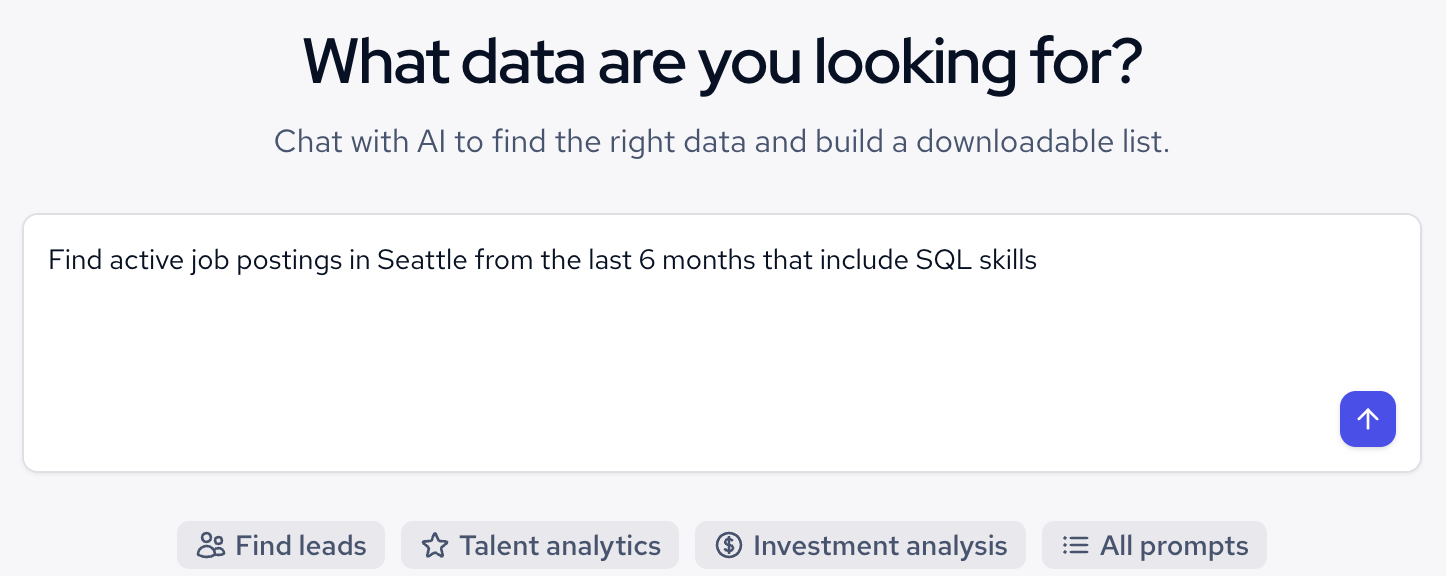
In the dashboard, select AI Data Assistant from the left menu. Use the chatbot to explore the Multi-Source Jobs API. Type your prompt in plain English and describe the data you want to get.
Let’s say you need to find all active job postings in Seattle from the last 6 months that include SQL skills, because these skills are on demand lately. Since Coresignal’s jobs database features over 70 million active job postings and each listing is refreshed every 24 hours, you always have access to the most up-to-date data.
You should type that exactly into the data search prompt:
Step 3: Apply filters to identify market demand signals
After entering your search prompt, you’ll instantly get a preview of 100 records. Then you can refine the search in the chat to narrow your criteria, pick additional data fields to enrich the top results, enrich individual records, or the entire list:

Step 3: Export job posting data for analysis
After you run your search and add the firmographic details you need, review a sample data record. This helps ensure the information is accurate before you export it. When you're ready, click the Download data button. Double-check your request, then confirm by clicking Download. Once your download link is ready, you can export the data in JSONL format for your analytics team.
Key aspects of quality job demand analysis
Analyzing labor market trends helps determine which industries are thriving and what jobs are in demand. This involves looking at job postings and identifying overarching growth patterns, including skill requirements, regional variations, emerging industries, and seasonality. You can do this by analyzing Coresignal’s historical job records since 2020 and see which skills employers consistently require and which ones are now considered unique advantages.
Job demand analysis entails examining the following critical aspects:
- Skill requirements: Job postings reveal the competencies and skills employers prioritize. Understanding these requirements is crucial for finding the most in-demand jobs.
- Geographic differences: While big cities will probably have a higher demand for specialists overall, states focused on particular industries will have higher job availability in specific sectors.
- Emerging industries: Sectors like technology, renewable energy, and healthcare will likely dominate the market in the future.
- Seasonality: Some roles experience peak demand during specific times of the year, such as retail jobs during the holiday season.
How to monitor job market trends
Keeping a close watch on job market trends ensures you stay ahead of industry shifts.
One effective approach is subscribing to industry reports such as the BLS Occupational Outlook Handbook or WEF's Future of Jobs reports mentioned above. These publications provide reliable data on jobs in demand and long-term trends.
Engaging with professional networks also enables real-time insights into hiring trends and the current job market. Additionally, analyzing online data through tools like Google Trends can reveal how frequently search terms such as "most in-demand jobs" or "what jobs are in demand" are used.
Staying up to date on company expansions, mergers, and layoffs is essential for understanding market trends. With Coresignal’s data, you can track these changes as they happen. Our 24/7 data discovery ensures you always have access to the latest information.
Ready to uncover deeper labor market signals?
Whether you're building a recruitment platform, conducting workforce analysis, or tracking hiring trends, job posting data holds tremendous potential.
Here are key insights you can gain from jobs data when identifying roles in demand:
- Demand velocity. By tracking how quickly listings for a specific role appear and how long they remain open, you can see if demand is rising or slowing down. If a role keeps showing up across many companies, it points to ongoing demand rather than a single hiring need.
- Skill prioritization shifts. Job descriptions show which skills employers require and which they simply prefer. By comparing how often certain skills appear over time, you can spot which abilities are now essential and which are becoming unique advantages.
- Geographic concentration. Filtering job postings by location helps you see where hiring for a specific role is most active. This insight supports workforce planning, relocation strategies, and finding talent markets that may be underserved.
- Seniority and role evolution. Changes in job titles and seniority levels reveal how roles are evolving within organizations. For example, if you see more senior or lead-level postings for a role that used to be entry-level, it signals a shift in market expectations.
- Competitive intelligence. Tracking which companies are hiring for certain roles, and how many positions they post, gives you early insight into competitor growth, product plans, or new market moves before they are widely known.
Thus, whether you're testing our data for the first time or validating its fit for your use case, you can explore freely before making any decisions.