



Historical job postings show how companies hire, expand, restructure, and respond to market changes over time. For investors, recruiters, market researchers, sales teams, and workforce analysts, they can reveal hiring momentum, skill demand, geographic expansion, and business priorities that are no longer visible in active listings.
The challenge is that historical job data is fragmented and difficult to preserve. Most job boards and company career pages remove expired listings, while single-source datasets often provide incomplete coverage, and limited context around the role, company, and hiring activity itself.
This guide explains how to find historical job postings, archived job postings, removed listings, and old job descriptions. It also explores how multi-source historical jobs data can support talent intelligence, investment research, labor market analysis, sales intelligence, and competitive monitoring.

Get jobs data at scale
Set up a meeting with our team, and get access to fresh jobs data.
Why look for old jobs?
Historical job postings data is structured information about job ads that were active in the past. It can include job titles, descriptions, companies, locations, posting and expiration dates, salary information when available, and metadata about where the role was published. By reviewing job posting data, organizations can:
- Track hiring trends to identify when and where companies scaled operations.
- Reveal expansion plans through roles in new markets or verticals.
- Evaluate leadership moves by analyzing former C-suite or VP-level openings.
- Validate investment signals by correlating past hiring activity with funding rounds.
- Benchmark competitors by comparing past role requirements, skills, and team structure.
If you're in HR tech, investment, or market intelligence, archived job postings are often more revealing than current ones, as they show where a company was heading, not just where it is now.
Why standard job boards are not enough
Standard job boards are designed for active recruiting, not long-term historical analysis. Most platforms remove expired listings once a position is filled or taken down, which makes older job postings difficult to retrieve reliably over time.
Company career pages create another limitation because they usually show only a portion of a company’s hiring activity. Many organizations distribute roles across multiple channels, including applicant tracking systems, external job boards, recruiting platforms, and regional hiring sites. Relying on a single source often results in incomplete coverage.
Even when the same role appears publicly, job boards and company websites frequently display different versions of the posting. Titles, descriptions, locations, salary information, and publication dates may vary between sources. The same opening can also appear multiple times across platforms, creating duplicate records that distort hiring analysis and trend tracking.
Without continuous archiving, cross-source aggregation, and deduplication, it becomes difficult to reliably analyze historical hiring activity. Organizations trying to track workforce expansion, hiring demand, compensation trends, or skill adoption over time need historical jobs data that preserves expired listings and resolves duplicate postings into consistent records.
Standard job listings vs. multi-source jobs data
Standard job listings and multi-source jobs data both provide information about hiring activity, but they differ significantly in coverage, historical depth, and data quality. Standard job listings usually come from a single source, such as a company career page or job board.
Multi-source jobs data combines postings from job boards, company websites, and applicant tracking system (ATS) platforms into one deduplicated dataset with broader coverage, historical archives, and richer hiring context. Below is a summary of how the two differ in various aspects.
How to find old job postings?
Finding old job postings does not have to rely on manual searches, incomplete archives, or large-scale scraping. The most reliable approach is to use historical jobs data that preserves expired listings across multiple public sources. When comparing job posting data providers, look at historical depth, source coverage, deduplication, delivery methods, and whether the data supports your intended use case.
Use a historical jobs database
Coresignal’s jobs dataset includes 452M+ historical and fresh job postings collected from job boards, company websites, and ATS platforms worldwide. The dataset includes coverage from 2020 onward and helps organizations analyze hiring activity across companies, industries, regions, and time periods.
Access job postings through a Jobs API
For teams that need programmatic access, Coresignal’s Jobs API supports searches by company, keyword, location, employment type, posting date, and other structured fields. The API can be used for talent intelligence platforms, analytics workflows, sales intelligence systems, and AI applications that require fresh jobs data.
Use bulk jobs datasets for analytics and AI
Bulk jobs datasets are better suited for historical analysis, labor market research, taxonomy mapping, and machine learning workflows. Coresignal provides structured jobs data in JSONL and Parquet formats, making it straightforward to integrate with data warehouses, analytics platforms, and AI pipelines. Teams building their own products on top of multi-source jobs data can also access it programmatically through the Agentic Search API, which accepts natural language queries and returns structured records – without requiring SQL or custom filtering logic.
The dataset includes:
- Job titles and descriptions
- Salary information when available
- Employment type and seniority
- Company and location data
- Posting and expiration dates
- Source metadata and historical timestamps
Historical jobs data can be used to reconstruct hiring timelines, analyze workforce demand, identify emerging skills, track company growth, check tech stack adoption, and monitor long-term labor market trends.
Combine jobs, company, and employee data
Historical job postings become more valuable when combined with company and employee data. Teams can connect hiring activity with headcount growth, funding events, geographic expansion, workforce changes, and employee movement patterns to generate deeper market and business insights.
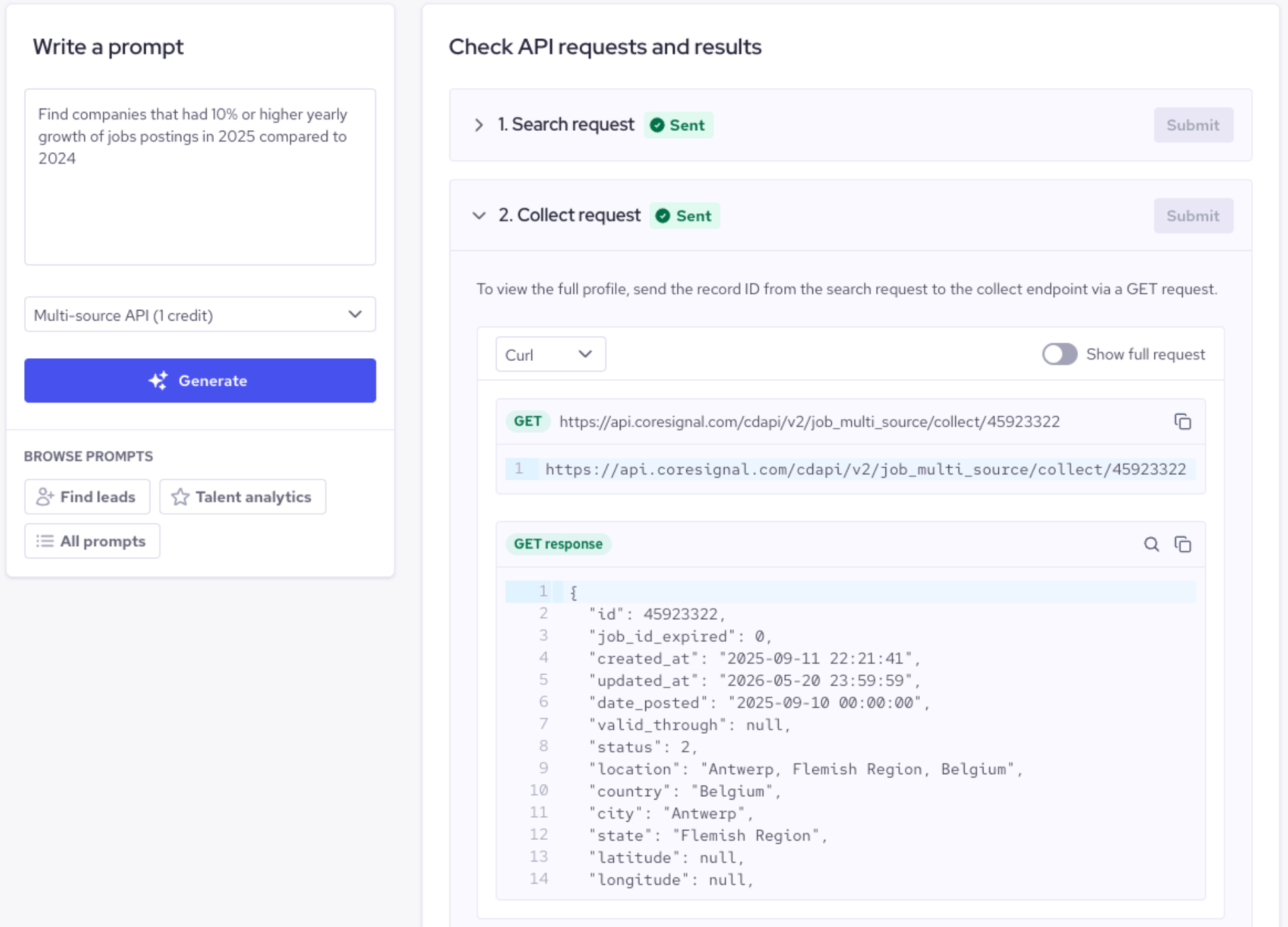
To explore changes in job posting counts, register for a free account on our self-service platform, navigate to Company APIs, and enter your prompt.
How Coresignal collects, structures, and delivers historical jobs data
Historical jobs data is only useful when it is complete, deduplicated, continuously refreshed, and preserved over time. Many archived job listing sources rely on a single platform or incomplete snapshots, which can lead to missing roles, duplicate postings, and limited historical visibility.
- Data scale. Coresignal collects multi-source jobs data from public job boards, company career pages, and ATS platforms worldwide. The dataset includes 452M+ job postings with historical coverage dating back to 2020, helping organizations analyze hiring activity across companies, industries, locations, and time periods.
- Data cleanliness and enrichment. To improve data quality, Coresignal applies entity resolution to identify and merge duplicate records that refer to the same role across different sources. This creates cleaner canonical job records and provides a more accurate view of hiring activity over time.
- 24/7 dataset updates. Job discovery runs continuously, with new jobs discovered daily and active postings revisited within 24 hours to capture updates, removals, and status changes. The dataset includes 80+ structured fields, including job titles, descriptions, locations, employment types, salary information when available, timestamps, and source metadata.
Historical jobs data is available through the Jobs API for real-time access and through bulk JSONL and Parquet datasets for analytics, enrichment workflows, and AI systems.
Why entity resolution matters
Entity resolution in jobs data is the process of identifying and merging records that refer to the same real-world job across different sources, even when those records have different titles, URLs, descriptions, or metadata.
Without entity resolution:
- The same role may appear multiple times across job boards, company websites, and ATS platforms
- Cross-posted listings can inflate hiring activity and job counts
- Slight title or description differences create fragmented records
- Historical hiring analysis becomes less reliable
- AI models and analytics pipelines receive noisier data
With entity resolution:
- Duplicate postings are merged into canonical job records
- Hiring activity becomes easier to analyze over time
- Historical jobs data becomes cleaner and more consistent
- Multi-source datasets provide more accurate labor market signals
Historical job postings data use cases
Old job listings do more than tell you what roles a company used to hire for. They reveal patterns, priorities, and signals you won’t find in press releases or organizational charts. Here’s how different teams use historical job data to drive smarter decisions:
1. AI and machine learning: build and improve intelligent systems
- Train LLMs and machine learning models on structured historical jobs data
- Extract and normalize skills, titles, seniority levels, and occupation taxonomies
- Improve semantic search, recommendation systems, and hiring intelligence tools
- Detect long-term workforce and technology trends across industries and regions
Example: A model trained on historical job postings can identify emerging skills, normalize inconsistent job titles, or improve semantic matching between candidates and roles.
2. Investment research: validate signals before investing
- Identify headcount spikes or team expansions following funding rounds
- Track hiring for strategic roles like VPs, engineering leads, or GTM teams
- Benchmark portfolio companies against hiring trends in competing firms
Example: A Series A startup hiring a dozen engineers in under two months might be gearing up for a major product release or a pivot.
3. HR tech: improve sourcing and workforce analytics
- Train models on historical job data to predict future hiring needs
- Map skill evolution to help employers upskill or reskill teams
- Optimize job matching algorithms based on past success patterns
Example: You can analyze how “data science” roles evolved from requiring R to demanding Python experience.
4. Sales and marketing intelligence: identify buying intent
- Use past hiring for sales, marketing, or operations roles as a proxy for scaling
- Spot companies building new functions (e.g., “RevOps,” “DevSecOps”)
- Trigger outbound campaigns when teams grow in target markets
Example: A sudden uptick in demand generation may signal upcoming tool purchases or CRM transitions.
5. Labor market research: benchmark industries or regions
- Analyze long-term demand for specific skills across verticals
- Track where companies expand (or contract) hiring by geography
- Evaluate employer demand vs. workforce supply at scale
Example: Compare how remote-first hiring for product roles grew in fintech vs. edtech from 2020 to 2024.
Why combine historical and active job postings data?
Historical job postings show how hiring changed over time, while active job postings reflect current workforce demand. Combining both creates a more complete view of company growth, hiring velocity, skill adoption, and market direction.
Coresignal’s jobs dataset includes 452M+ active job postings, with every active listing revisited regularly to update and enrich. Combined, active and historical jobs data can help organizations:
- Compare current hiring activity against past trends
- Detect sudden expansion or contraction in specific teams
- Identify emerging technologies or skills earlier
- Measure long-term workforce and compensation changes
- Build more accurate forecasting, analytics, and AI models
For example, active postings may show that a company is currently hiring AI engineers, while historical data can reveal whether that demand is new, accelerating, or part of a longer-term hiring strategy.
Find old jobs and turn them into market intelligence
Expired job postings offer insights into company strategy, momentum, and market direction. Whether you're an investor validating growth, a recruiter tracking hiring shifts, or a product leader building intelligence tools, old job listings offer valuable, structured data fields.
With Coresignal’s historical job posting datasets, you gain more than access but also context. And in a fast-moving, skills-driven economy, context gives you a competitive edge.
Get jobs data at scale
Set up a meeting with our team, and get access to fresh jobs data.