If your sales intelligence platform surfaces outdated job titles, it will likely start losing users quickly. Data-driven products depend on external B2B data, and the provider determines their quality, freshness, cost, and which features are possible.
Choosing a B2B data API for a product isn’t the same as picking a CRM enrichment tool. In this article, we’ll walk through what to look for, compare six leading providers side by side, and help you choose the one that best fits the product you’re building.
What is a B2B data API
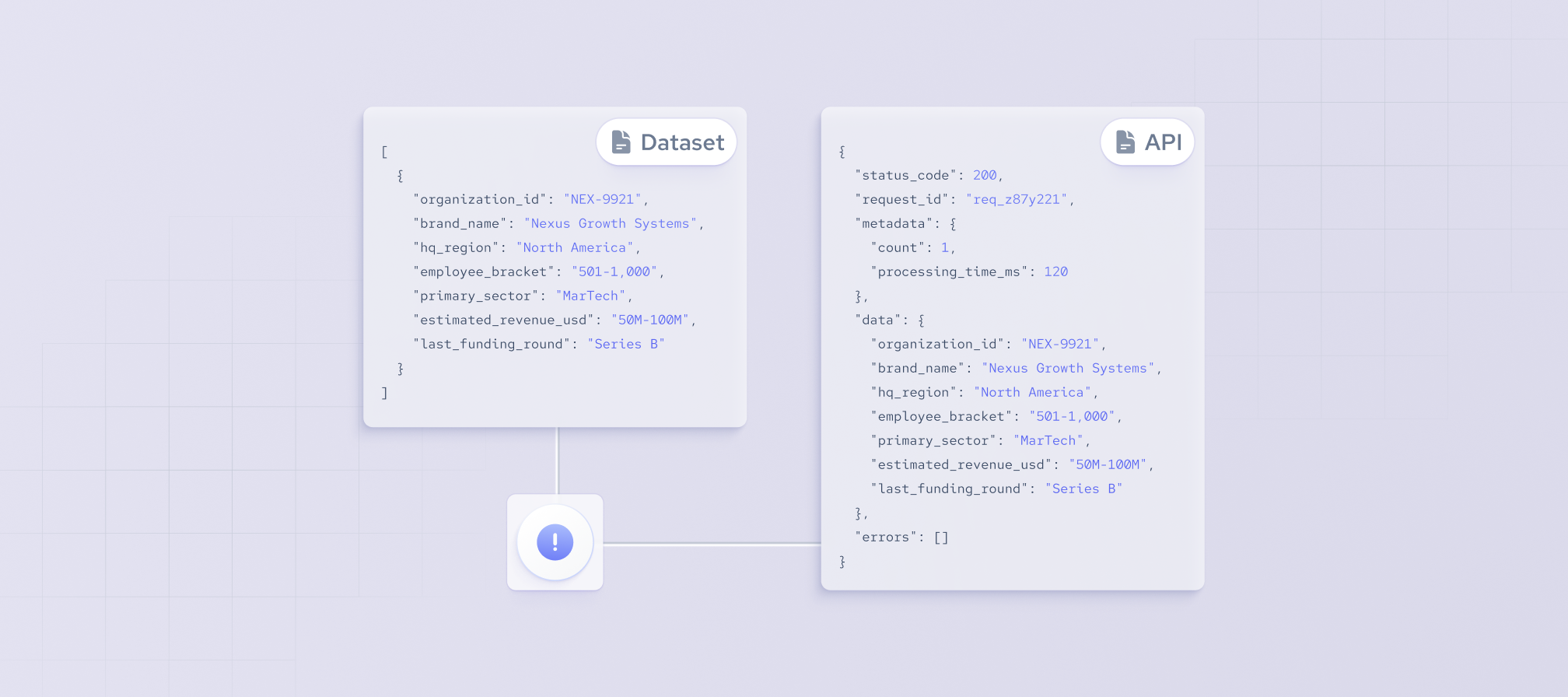
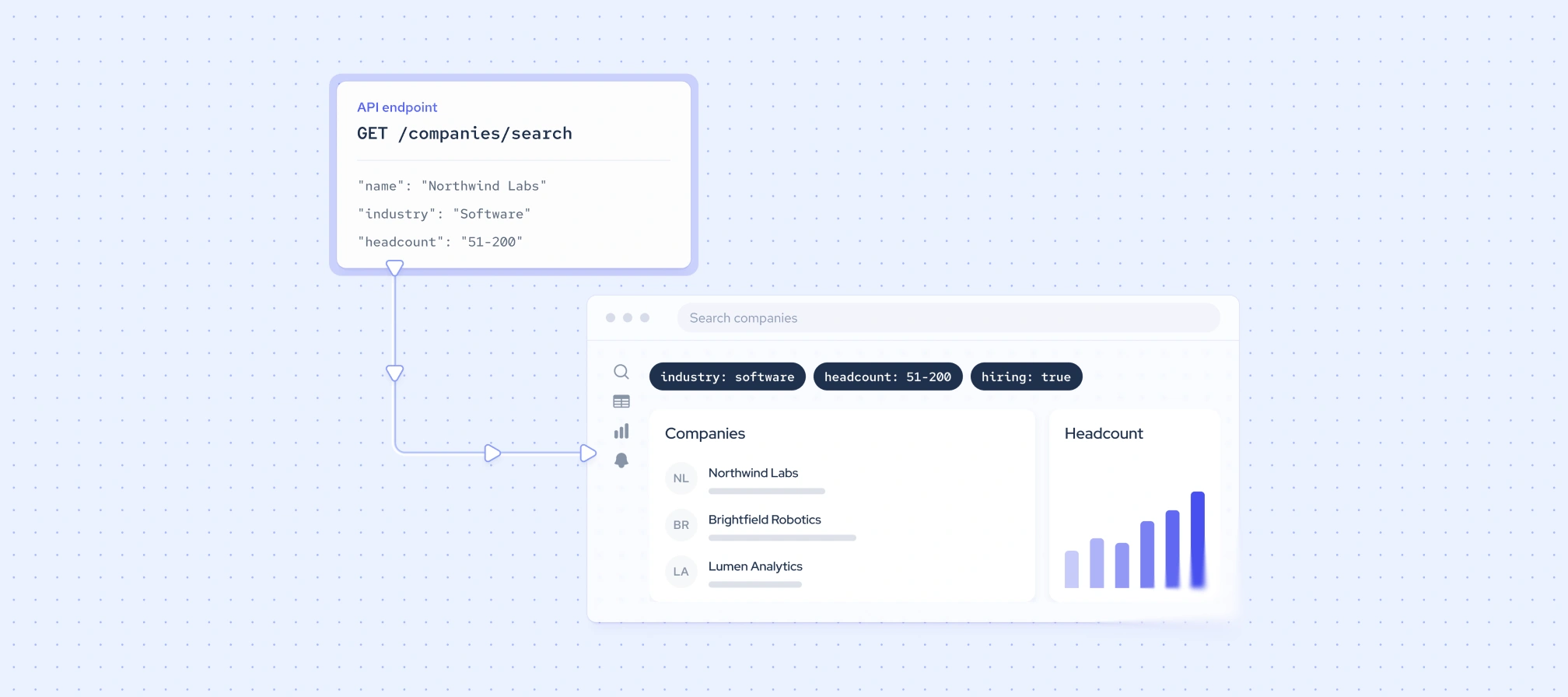
A B2B data API is an interface that lets software programmatically access business data, such as company firmographics, employee profiles, job postings, and other details, so that teams can integrate fresh, structured information directly into their products, workflows, or analytics.
What to look for in a B2B data API for building products
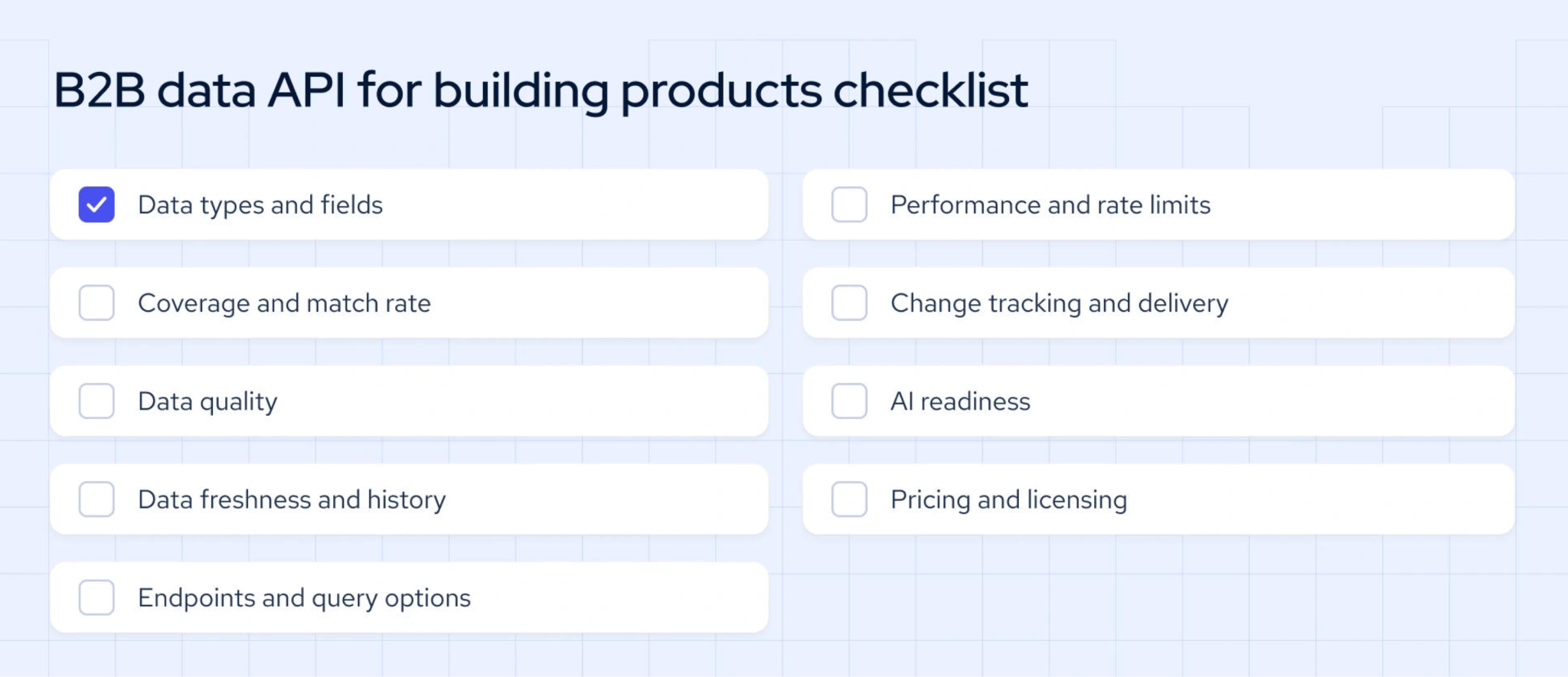
In data-driven product development, the API’s data and technical capabilities directly shape what the product can do and how reliably it runs. The table below summarizes key aspects to keep in mind when comparing and choosing B2B data APIs.
The categories discussed in the table can also serve as a checklist when choosing business data APIs best suited for your product needs.
B2B data APIs to build your product on
Below are the top six providers to help you find the best data API for your use case.
1. Coresignal: best for building data products and AI applications on multi-source B2B data
Coresignal's APIs provide quality company, employee, and job posting data. The records come from multiple web sources and are merged into one deduplicated profile per entity.
Data available through the APIs:
- Company data: 72M+ company records with 500+ fields such as firmographics, funding, and headcount changes
- Employee data: 915M+ employee records with 300+ fields such as job titles, experience, and seniority
- Jobs data: 486M+ job postings with 85+ fields
- Historical data: Company and Employee data available since 2016, historical job listings since 2020
Key API capabilities:
- Search: sorts records with hundreds of filters or Elasticsearch DSL queries
- Agentic search: turns plain-language prompts into structured queries
- Collect: retrieves up to 10,000 records per request
- Enrich: adds data to existing records by website domain or record ID
- Real-time employee API: fetches employee data at the time of the request
- Monitors: alerts set via webhooks, notifying when tracked records change
Developer experience and integration model: Coresignal's API returns results in 176 ms on average. You can also connect it in several ways, including calling the REST API directly, plugging in AI agents through the MCP server, using no-code tools like n8n, Zapier, and Clay, or getting data delivered straight to Snowflake, Databricks, Google Cloud, Azure, or Amazon S3.
Pricing: starts at $49 (free trial available).
Limitations: no built-in sales engagement or outreach tools.
Best for: sales intelligence, HR tech, investment research, or AI agent products.
2. People Data Labs: for enrichment features in CRM and recruiting products
People Data Labs (PDL) provides workforce data to companies that would otherwise have to build it themselves.
Data available through APIs:
- Person data: Approx. 3B records with work history, education, and skills
- Company data: 70M+ profiles, covering size, industry, and headcount
- Job posting data: 28.8M+ records, covering industry, location, and skills
Key API capabilities:
- Enrich: get a fuller person record from an email, name, or profile URL
- Search: query records with filters or Elasticsearch-style queries
- Bulk enrichment: get up to 100 records per request
Developer experience and integration model: with PDL, you can query data with SQL or Elasticsearch, and test against sandbox APIs that use synthetic data. If needed, the data can be delivered via Snowflake and Databricks shares instead of API calls.
Pricing: starts at $98/month (free trial available).
Limitations: job postings API is still in beta.
Best for: building HR tech, sales and marketing tools, or AI products.
3. Crunchbase: for investment and funding intelligence products
Crunchbase's API provides private company data, with funding rounds, investors, and acquisitions as its main strength.
Data available through the APIs:
- Fundamentals: historical firmographic and financial data
- Insights data: AI-powered analysis of a company’s investors and competitors
- Predictions data: AI-powered forecasts of future funding and growth
Key API capabilities:
- Search: search endpoints for organizations, people, and funding rounds
- Deleted Entities: track removed records to keep your data in sync
Developer experience and integration model: Crunchbase offers a REST API that includes entity lookups and search. It also supports bulk CSV export and includes API Starter Playbooks for workflows like ICP targeting and deal sourcing.
Pricing: custom. API access requires an enterprise license and a sales conversation. There is no free API tier or trial.
Limitations: request limits may slow down bulk jobs.
Best for: Investment, venture, and sales intelligence products.
4. Crustdata: for real-time enrichment at lower volumes
Crustdata is a good fit for teams in need of fresh data on a specific set of people or companies, rather than bulk collection.
Data available through APIs:
- People data: 1B+ profiles with 60+ filters, including seniority, function, and recent job changes
- Company data: 60M+ company profiles with 95+ filters, including growth, funding, and hiring
- Job posting data: real-time job postings with 30+ data points
Key API capabilities:
- Real-time enrichment: fetches the latest data live from the web
- Live search: finds people matching filters in real time
- Enrich: returns up to 25 indexed profiles
- Watcher: alerts on job, funding, and headcount changes
Developer experience and integration model: like several other providers on the list, Crustdata provides a REST API that can be called directly. It can also connect to Claude, ChatGPT, Cursor, or its own agents through the MCP server, Crustdata CLI, or the Claude Code and Codex plugins.
Pricing: search starts at 0.03 credits per result; accounts are self-serve so you can get an API key the same day, and every new account starts with $20 in free credits.
Limitations: no clear compliance details.
Best for: AI SDRs, recruiting tools, and sales workflows.
5. Autobound: for embedding business signals in products
Autobound is designed for teams looking to embed business signals in their products. It includes business events, like funding rounds and leadership changes, that you can turn into filters or lead scoring in your product.
Data available through APIs:
- Signal data: 700+ signal types across 35 feeds, including hiring trends and job changes
Key API capabilities:
- Search: finds companies or contacts by signal type and date range
- Enrich: appends records with additional information
- Webhooks: notifies when a new signal is detected
Developer experience and integration model: Autobound gives instant access to self-serve API keys. It also connects via an MCP server and offers scheduled exports to Google Cloud Storage.
Pricing: starts at $19 (free trial available).
Limitations: bulk delivery is limited to Google Cloud Storage.
Best for: sales engagement tools, AI SDRs, and CRMs.
6. Explorium: for AI SDRs and sales agents
Explorium is built for teams building AI SDRs and sales agents that need one data source to find, research, and qualify prospects.
Data available through APIs:
- Business data: 146M+ company profiles with firmographics and tech stack
- Prospects data: 767M+ people profiles with seniority and contact details
- Events: business and prospect event monitoring
Key API capabilities:
- Match: resolves a company or prospect to a unique ID
- Enrich: adds data to existing records
- Webhooks: tracks job, funding, and tech stack changes
Developer experience and integration model: Explorium offers a REST API with sync and async batch requests, a remote MCP server, and native Claude and ChatGPT connectors.
Pricing: unclear.
Limitations: firmographics refresh only monthly/quarterly.
Best for: AI SDRs and sales agents.
Which B2B data API fits your product?
Business data API providers differ in data and capabilities. The table below compares B2B data APIs for data-driven products.
Choosing the right B2B data API for your product
A data-driven product strategy starts with the features you want to build. Check which providers cover the data types, regions, and freshness your features need, test match rates on a sample, review licensing, and model costs at scale. If your product needs multi-source company, employee, and job data with AI-ready access, Coresignal is a strong place to start.