

Imagine this: you craft a perfect sales pitch, use the most effective communication strategies to catch your prospect's attention, only to get a response that they don't have the budget or have already bought a similar product. Frustrating, but more often than not, the problem isn't the pitch but the data behind it.
According to the Economic Rents and the Contours of Conflict in the Data-driven Economy report, big data drives value in three main ways: it helps established industries operate more efficiently and cut costs, enables the creation of new products that can disrupt existing markets, and opens the door to entirely new industries. Firmographic data is central to each of these. It allows teams to improve their operations, build more intelligent products, and strengthen the business intelligence that supports modern B2B decision-making.
However, not all firmographic data is equal. Coverage can differ widely depending on the region, industry, or company size you are targeting. Data quickly loses relevance as companies restructure, get acquired, or close down. Thus, not every provider can deliver the accurate insights needed for your specific market.
This article explains what firmographic data includes, how top teams use it in sales, marketing, investment, and compliance, and what to look for when choosing a firmographic data provider.
What is firmographic data, and why does it matter in 2026
Firmographic data is company-level information that helps you describe and segment businesses, much like demographics do for people.
Firmographic data is important for companies for several reasons:
- Easier market segmentation. It lets you segment your market based on variables such as industry, location, size, structure, or performance.
- Improved lead generation and better targeting. Based on firmographic segmentation, you can identify and prioritize accounts that match your ideal customer profile before you even reach out.
- More accurate market analysis. B2B firmographic data helps you build a clear view of your addressable market, understand the competition, and spot new growth opportunities.
Companies that buy firmographic data gain a structured, scalable foundation for making smarter decisions about who or what to target, how to prioritize, and where to grow.
What firmographic data actually tells you about companies
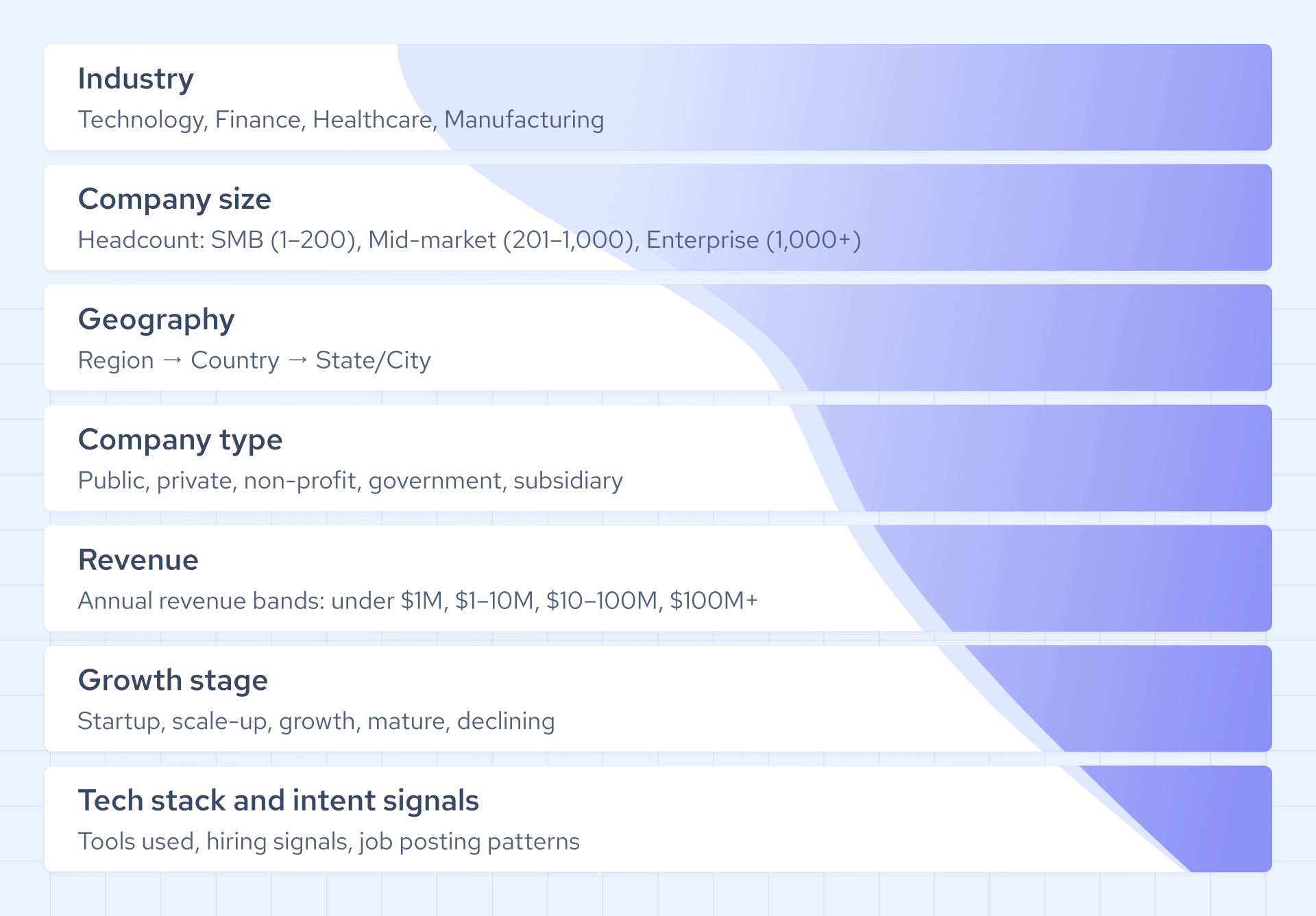
Firmographic data usually includes the following attributes:
- Industry. It is one of the most important filters for identifying relevant prospects. For example, if you offer compliance software, fintech companies are likely to be strong leads, while food trucks are not. Classifying companies by industry from the start helps keep your pipeline focused and free of irrelevant opportunities. This way, you spend less time sorting through leads that don't fit your goals.
- Company size directly impacts the complexity of your sales process. A 30-person startup typically involves a single decision-maker and a short sales cycle. In contrast, an enterprise company may require approval from a procurement committee and extend the cycle. Understanding this distinction early ensures your team applies the right approach and avoids misaligned strategies that can cost you the deal.
- Revenue data helps you determine whether a prospect has the budget for your solution. For instance, pitching an enterprise-tier product to a company with $2 million in annual revenue is unlikely to succeed. Using revenue as a filter ensures your expectations for deal size remain realistic and aligned with the prospect’s capacity.
- Geographic location shapes language requirements, regulatory considerations, and whether your product can be offered in a given market. It also highlights gaps in your data coverage. For example, if your database lacks depth in the DACH region, your German campaign will struggle to perform, regardless of the quality of your messaging.
- Ownership structure reveals who holds decision-making authority. Subsidiaries often lack independent budget control, while private companies follow different procurement processes. Misunderstanding ownership can result in wasted effort targeting the wrong stakeholders.
- Funding status is a strong buying signal. If a company has just closed a Series B funding round, it has fresh capital and is likely open to new vendors.
- Growth signals, such as fast headcount increases, sudden layoffs, and new offices, show a company is about to need your solution, often before they start searching. If you act on these signals, you’ll reach prospects before your competitors.
- Technology stack tells you what a company already has, what they're likely missing, and whether your product will integrate with or compete against their existing setup.
- Employee data, like attrition rates and headcount, helps you spot what’s really happening. High turnover in a sales team could mean trouble or a company rebuilding. Either way, it shapes how you start the conversation.
Where firmographic data comes from
Firmographic data comes from a range of sources, each adding unique details to the overall picture:
- Public business registries offer legally filed details on company structure, ownership, and financials. This information is highly reliable because companies must keep it accurate. However, registries usually cover a limited range of data and are not updated often.
- Company websites and job boards provide data that registries cannot, such as current product offerings, open roles, office locations, and technology references.
- Social and professional networks provide many of the real-time firmographic signals. You can find employee counts, department structures, leadership changes, and funding announcements here faster than anywhere else. The main trade-off is reliability, as this data is self-reported and often inconsistent.
- Third-party firmographic data providers collect and standardize data from all these sources. They clean, deduplicate, and enrich the information to create structured, ready-to-use datasets. For most B2B teams, using a provider is the most practical option because building and maintaining this infrastructure in-house is costly and consumes a lot of time.
How companies use firmographic data in practice
Teams rely on B2B firmographic data to drive results across several key areas:
- Investment intelligence. Investors and data analysts group and target companies by size, industry, category, founding year, headcount growth, and other relevant data fields. This way, they can quickly find high-potential targets that align with their investment strategies.
- Lead enrichment. Sales and RevOps use firmographic data to target companies in relevant areas that meet their ICP clients' criteria. After they identify a target, they can use firmographics to enrich their existing database and improve accuracy. Enriched records lead to better scoring, sharper segmentation, and sales reps who enter conversations already prepared with the right context.
- Firmographic targeting. Sales and marketing teams use firmographic attributes to assess target-market potential and refine their strategies by leveraging product, industry, and location data, understanding their target audience, and qualifying new leads.
- Market research. Product and marketing teams rely on firmographic data to track shifts in the competitive landscape over time, informing territory planning and market sizing. It shows how many companies operate in an industry, how they are distributed by size and location, and how the landscape changes over time.
- Company screening and segmentation. Compliance, procurement, and partnerships teams rely on firmographic data to screen companies before starting a relationship. Checking ownership structure, jurisdiction, and operational status helps reduce risk. The same data powers segmentation, so accounts are routed to the right team, playbook, or pricing tier as soon as they enter your pipeline.
How to get firmographic data with Coresignal
You can start working with firmographic data right away by accessing it for free on Coresignal’s dashboard. To begin your analysis, you’ll need an active Coresignal account. If you don’t have one yet, sign up with your business email for a 7-day free trial and receive 2,000 credits for free.
Then you can start your data research:
Step 1: On Coresignal’s dashboard, find Data Search. Type your prompt in simple English: just explain what kind of data you are interested in. For example:

Step 2: After entering your search prompt, you’ll instantly get a preview of 100 records. Then you can refine the search in the chat to narrow your criteria, pick additional data fields to enrich the top results, enrich individual records, or the entire list:

Step 3: Once you've run your search and added the firmographic details you need, review a sample data record to ensure everything looks correct. Then, export the data for your analytics team. Click the Download data button, check your request, and confirm by clicking Download. When your link is ready, download the data in JSONL format.
.png)
Why data freshness matters in firmographic data
To understand why B2B firmographic data must be fresh, think of a company as a living organism. It’s always changing. Companies hire employees, undergo layoffs, shift their business models, expand into new markets, or even close down, sometimes in just a few months, weeks, or days. Firmographic data that was accurate at the time of collection can quickly become outdated. Six months later, it may be misleading. After a year, it can even cause harm.
Working with stale B2B firmographic data has real consequences:
- Loss of revenue. Targeting the wrong companies or reaching out at the wrong time leads to lost revenue. With more accurate, up-to-date data, your team can focus on the right opportunities and improve results.
- Missed opportunities. Missing signals of fresh hiring, expansion, or funding means your team can’t react to market changes quickly. Timely data helps you spot new opportunities before competitors do.
- Wasted sales and marketing spend. Outdated contacts, poor-fit leads, and mistimed campaigns waste sales and marketing budgets. Better segmentation with current data prevents these costly mistakes.
- Lower AI model quality. Inconsistent or unreliable training data lowers AI model quality.
Data freshness is essential, not optional. While it may appear secondary when evaluating data providers, it should be a primary factor in your decision.
Choosing a firmographic data provider: what actually matters
- Data coverage. A huge database means little if the data misses your target region, skips smaller companies, or ignores key industries. Always confirm that the provider covers the exact segments, geographies, and company sizes you need. If the database doesn't include your market, its size doesn't matter.
Question for a provider: Can you show me coverage statistics for my specific market? - Data accuracy. The best way to check accuracy is to compare a sample of the data to companies you know well, including your own. If the provider gets these wrong, be skeptical about the rest.
Question for a provider: Can I test a sample before committing? - Data freshness. Companies change quickly, and stale data can lead to missed opportunities or bad decisions. Ask providers how often they update records, whether updates happen when something changes or just on a set schedule, and how long it takes for real-world changes to show up in the database.
Question for a provider: When a company goes through a funding round, leadership change, or layoff, how quickly does that appear in your database, and how is that update triggered? - Delivery method. If you need real-time data for AI applications, bulk CSV exports won't work. If you only need a monthly refresh, a fast API is unnecessary. Make sure the delivery method matches your workflow. Use real-time APIs for live applications, webhooks for event-driven systems, and bulk datasets for research or model training.
Question for a provider: Does your API support real-time responses? - Support and documentation. Clear API docs, good query examples, responsive support, or a dedicated account manager can help you get value faster.
Question for a provider: Is your documentation and query logic publicly accessible, or does it require a signed contract to access? - Pricing transparency. It should be straightforward enough to calculate the real cost before signing a contract. Some providers advertise low per-record costs that increase significantly once you factor in additional charges for fields like experience descriptions, skills data, or enrichment attributes that other providers include by default. If a provider can't answer those questions clearly upfront, that opacity will follow you throughout the relationship.
Question for a provider: What is and isn't included at each tier, and how are credits counted? - Fit for your use case. A provider built for sales prospecting might not work for investment research or AI training. The data attributes, update frequency, and accuracy you need will depend on your goals. Define your main use case before you start evaluating, and test the provider against your actual workflow, not just generic benchmarks.
Question for a provider: What does your data look like for companies in my specific segment?
Top firmographic data providers in 2026
Coresignal
Overview: Coresignal specializes in structured company, employee, and job data collected exclusively from public sources.
Best for: Enrichment, targeting, investment research, and AI model training.
Key strengths:
- 176 ms API average response time
- Data collection is ethical and stays in line with privacy guidelines
- Data access via natural language search: no engineering resources required to get started
- Free trial with 2,000 credits, no credit card required
Potential limitations: No built-in sales engagement or outreach tools.
Data access and delivery: API, datasets.
Pricing: Database APIs start at $49/month; datasets start at $1,000/month.
Bright Data
Overview: Bright Data is a web scraping platform that sells ready-to-use datasets as an additional offering. It helps teams reliably collect, process, and scale public web data.
Best for: Web scraping, managing custom data pipelines.
Key strengths:
- Instant scraper APIs and proxy infrastructure
- Automated data quality validation checks
- Universal compatibility with all AI/ML workflows
Potential limitations: Custom scraping requires engineering resources for implementation and maintenance.
Data access and delivery: Scraping APIs, ready-to-use datasets.
Pricing: APIs start at $1/1k requests, $5/GB; datasets start at $250/100k rec.; proxy infrastructure starts at $0.9/IP.
ZoomInfo
Overview: ZoomInfo is a contact-level data provider that helps businesses find, engage, and win customers, offering a large database of company and contact records alongside intent data, CRM integrations, and GTM workflow tools. If you are evaluating whether a GTM platform or a data infrastructure provider better fits your workflow, it is worth comparing Coresignal and ZoomInfo across data freshness, APIs, contact data, employee data, and AI readiness.
Best for: Accelerating pipeline generation and revenue growth.
Key strengths:
- Global contact (emails, mobile numbers, direct dial numbers) data
- CRM integrations with Salesforce, HubSpot, Marketo, and others
- Brings together company and contact data, buying intent signals, and workflow automation
Potential limitations: The database offers strong coverage in North America. If your team needs data from other regions, it's important to consider whether this solution aligns with your goals.
Data access and delivery: APIs, CRM integrations.
Pricing: Not publicly available.
Apollo
Overview: Apollo is a unified AI sales platform that combines a B2B contact database with outreach automation tools.
Best for: Outbound, inbound sales, data enrichment, and deal execution.
Key strengths:
- Workflow automations, AI-powered, multichannel campaigns
- Verified emails and phone numbers for faster reach
- Pipeline boards, real-time deal alerts
Potential limitations: Primarily designed for sales prospecting; limited utility for investment research or AI data infrastructure.
Data access and delivery: API.
Pricing: Features by solutions start from $49 per user per month, billed annually, with 30,000 credits.
Cognism
Overview: Cognism is a B2B sales intelligence platform with a strong focus on European compliance and verified contact data.
Best for: Revenue teams requiring extensive European coverage and phone-verified data.
Key strengths:
- Compliance-first approach to data collection
- Phone-verified cell phone numbers
- AI-powered search functionality, allowing users to identify prospects using natural language or voice prompts
Potential limitations: Coverage is weaker outside EU markets.
Data access and delivery: API or scheduled delivery.
Pricing: Not publicly available.
Dun & Bradstreet
Overview: Dun & Bradstreet maintains solid business databases, which empower companies to make critical data-driven decisions that drive business performance.
Best for: Accelerating sales, managing risks, navigating compliance.
Key strengths:
- Data quality checks each month, ensuring accuracy and reliability
- 30+ years of experience
- Historical data for long-term performance analysis and trend forecasting
Potential limitations: Limited contact-level data for sales prospecting.
Data access and delivery: Flat files or APIs.
Pricing: Small business products start at $15.00.
Final thoughts: choosing the right firmographic data
Firmographic data describes companies the way demographics describe people. It covers key details like industry, size, revenue, location, ownership, funding, and growth signals. But companies are always changing. They hire, restructure, get acquired, or close down. Data that was accurate when collected can quickly become outdated. That’s why buying firmographic data isn’t a one-time event.
The best data providers offer broad, relevant coverage for your market. They keep their data accurate and let you verify it, instead of asking you to take it on faith. They refresh their data often enough to match your workflow. They also deliver records that are deduplicated, normalized, and ready to use, so you don’t need to spend extra time on engineering. Format matters as well. You might need flat files, APIs, or both, depending on whether you’re doing batch processing, real-time enrichment, or something in between.
Coresignal offers two delivery options to fit your needs. You can get API access with a 176 ms response time for real-time use cases. Bulk datasets are available for research and model training. There’s also a self-service platform for teams that want to explore and download data without engineering help.
Firmographic data is only one piece of the broader company data landscape. If you’re considering providers for other data types, such as employee or job data, take a look at our overview of company data providers.