



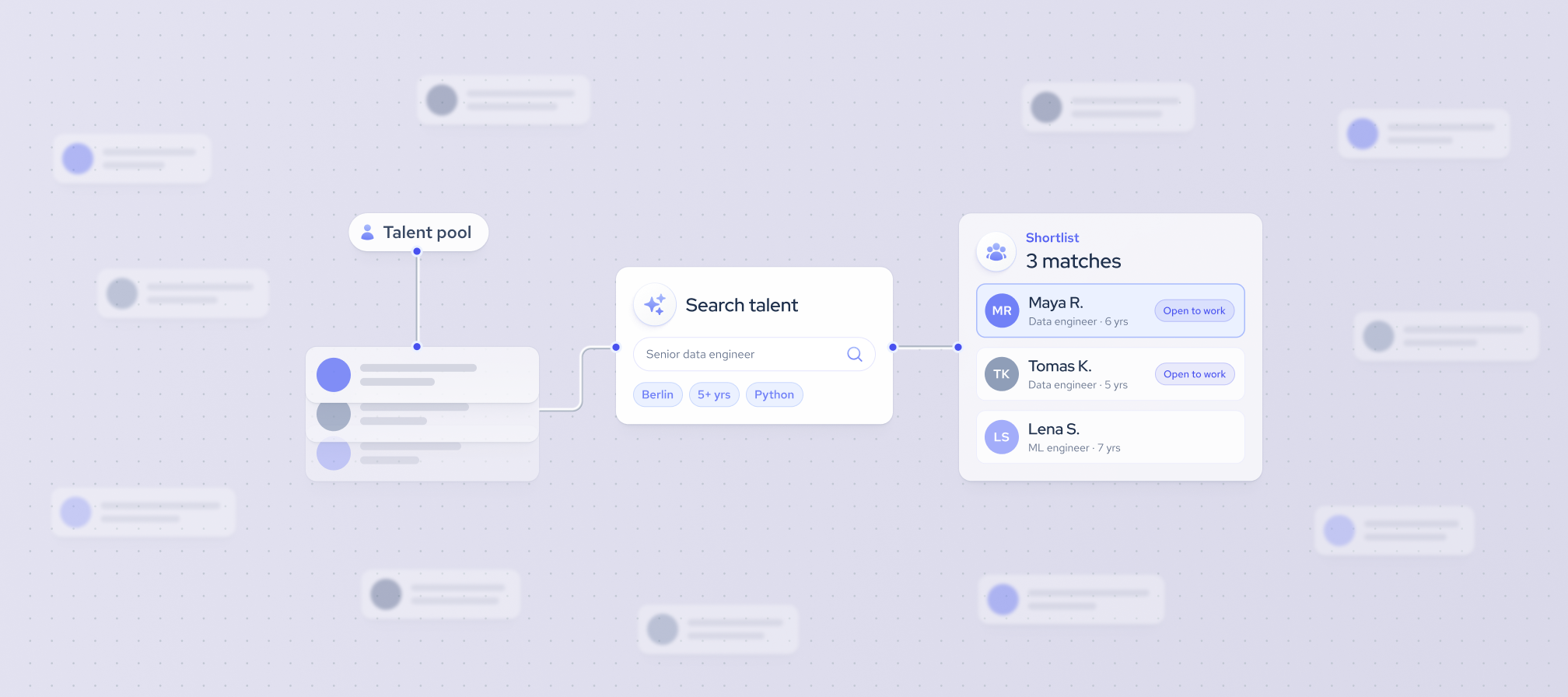
The best candidate for your next open role probably isn't scrolling job boards right now. They're busy doing great work somewhere else, and they won't see your posting unless you find them first.
That's why sourcing has become so important in recruitment. Instead of waiting for applications to slowly come in, sourcing lets you build a pipeline of qualified people before you even need them.
Below, we break down what talent sourcing is, where to find strong candidates, the six steps of the process, and the strategies and tools that help recruiting teams hire faster and smarter.
What is talent sourcing?
Talent sourcing is a process of finding, researching, and contacting qualified candidates for your current and future business needs. Ideally, this process happens even when the company doesn’t have open positions yet, so it has a pool of qualified candidates when one opens.
This proactive approach helps recruiters find people with the right skills and experience and move them into the hiring pipeline as qualified candidates.
Why is talent sourcing important?
Posting a job and waiting for applicants is becoming an outdated approach, especially if you’re hiring for skilled roles. Many of the best people are already employed and not checking job boards. Sourcing reaches them directly, broadens the pool, and builds a pipeline that shortens time-to-fill. Data makes sourcing far more precise, yet Gartner found only 31% of recruiting teams use labor market data to inform their talent strategy. That leaves an advantage for teams using employee data to map where qualified talent sits.
Main talent sources for finding candidates
The best talent sources depend on the role. A senior engineer, a sales leader, and a designer rarely turn up in the same places. Most sourcing teams combine several of the following.
1. Internal talent and past applicants
Start with people you already know. Employees ready for a new role need less onboarding, and runners-up from earlier searches already know your company. Checking these before going external is often the fastest route to a shortlist.
2. Professional networks
Professional networking platforms remain the default for most sourcers because profiles list titles, skills, and career history. The downside is that the most visible candidates receive the most recruiter messages, so outreach has to stand out.
3. Technical and creative communities
For engineers, look at open-source contributions and answers on developer Q&A forums. For designers, look at their portfolios on design platforms. These communities show real work rather than self-reported skills, which makes it easier to judge quality before reaching out.
4. Niche job boards
Industry-specific boards, such as those for healthcare, cybersecurity, or remote work, attract smaller but more relevant audiences than general job sites. They work best for specialized roles where general postings attract mostly unqualified applicants.
5. Employee data providers
Employee data providers bring together professional profiles from across the web into searchable datasets and APIs. Instead of searching one platform at a time, providers like Coresignal offer multi-source employee data that you can filter by title, skills, seniority, tenure, and location, and spot people who recently changed jobs or whose teams are shrinking.
Benefits of leveraging talent sourcing
Sourcing in recruitment changes hiring from reacting to applications to planning ahead. Instead of waiting to see who applies, recruiting teams decide who they want to reach and go after them. The main benefits:
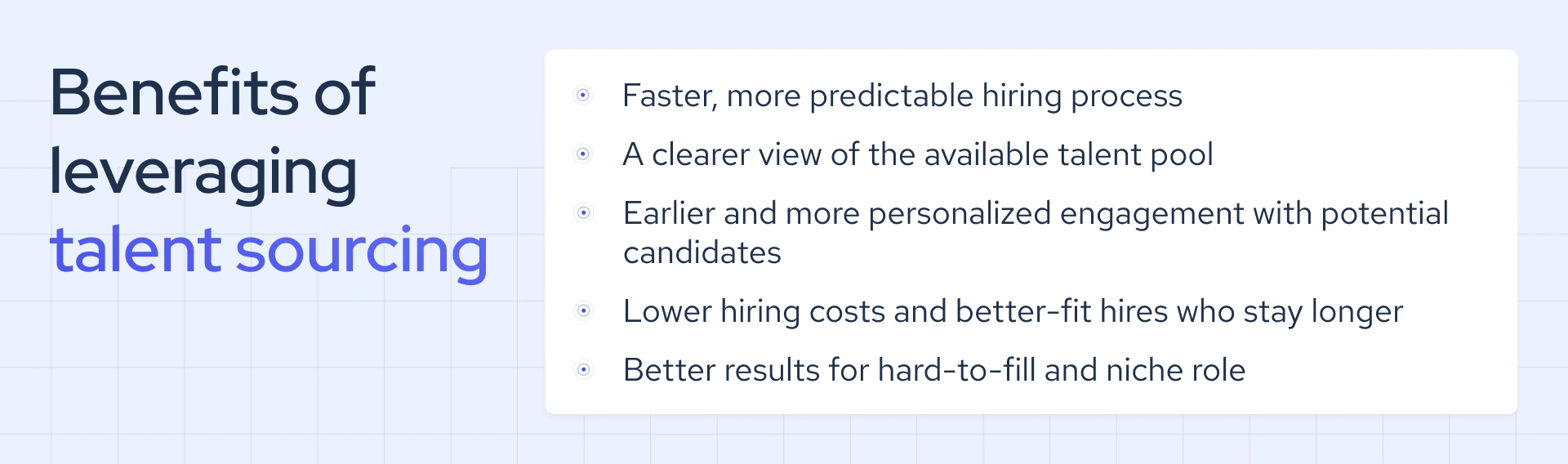
- Faster, more predictable hiring process. When a role opens, sourcing teams already have a shortlist of people they've identified and researched. Hiring timelines depend less on luck and more on a predictable process.
- A clearer view of the available talent pool. Sourcing shows where qualified people work, which skills are common or rare, and how competitive a market is. That helps set realistic requirements, salaries, and location strategy before the search starts.
- Earlier and more personalized engagement with potential candidates. Recruiters can contact people before a role is urgent and tailor outreach to each person's background and career path. That builds relationships, not just one-off messages, and makes candidates more likely to respond.
- Lower hiring costs and better-fit hires who stay longer. A strong pipeline reduces reliance on agency fees and paid job ads. Choosing from a wider, well-researched pool also leads to better fits, which means less turnover and fewer repeat searches.
- Better results for hard-to-fill and niche roles. For specialized skills, the right people rarely apply on their own. Sourcing finds them where they are, whether in professional networks, technical communities, or employee data.
Talent sourcing strategies and best practices
A strong talent sourcing strategy combines several proven tactics rather than relying on a single channel. Here are best practices worth building into your process:
- Define the ideal candidate profile. Agree on must-have skills, experience, and dealbreakers with the hiring manager before searching.
- Use Boolean and X-ray search. Precise search strings surface profiles that basic keyword searches miss.
- Target passive candidates with employee data. Use tools like Coresignal to power your candidate search, filtering by title, skills, seniority, tenure, and location to find candidates who fit.
- Use AI-assisted sourcing tools. Let AI handle matching and shortlisting so recruiters can focus on outreach.
- Rediscover past applicants. Runners-up already in your ATS are often the fastest hires.
- Build a structured referral program. Make referring easy, share open roles regularly, and reward successful hires.
- Source from communities. Platforms like GitHub and niche forums show candidates' actual work.
- Watch talent movement signals. Layoffs, funding rounds, and leadership changes often mean people are open to moving.
- Build diversity into sourcing. Broaden channels and review search criteria for unnecessary filters that narrow the pool.
- Measure and refine. Track response rates, source-of-hire, and time-to-fill to see which channels deliver.
The six steps in the talent sourcing process
Sourcing works best as a repeatable process rather than a one-off search for each new role. Here are six steps for successful talent sourcing.
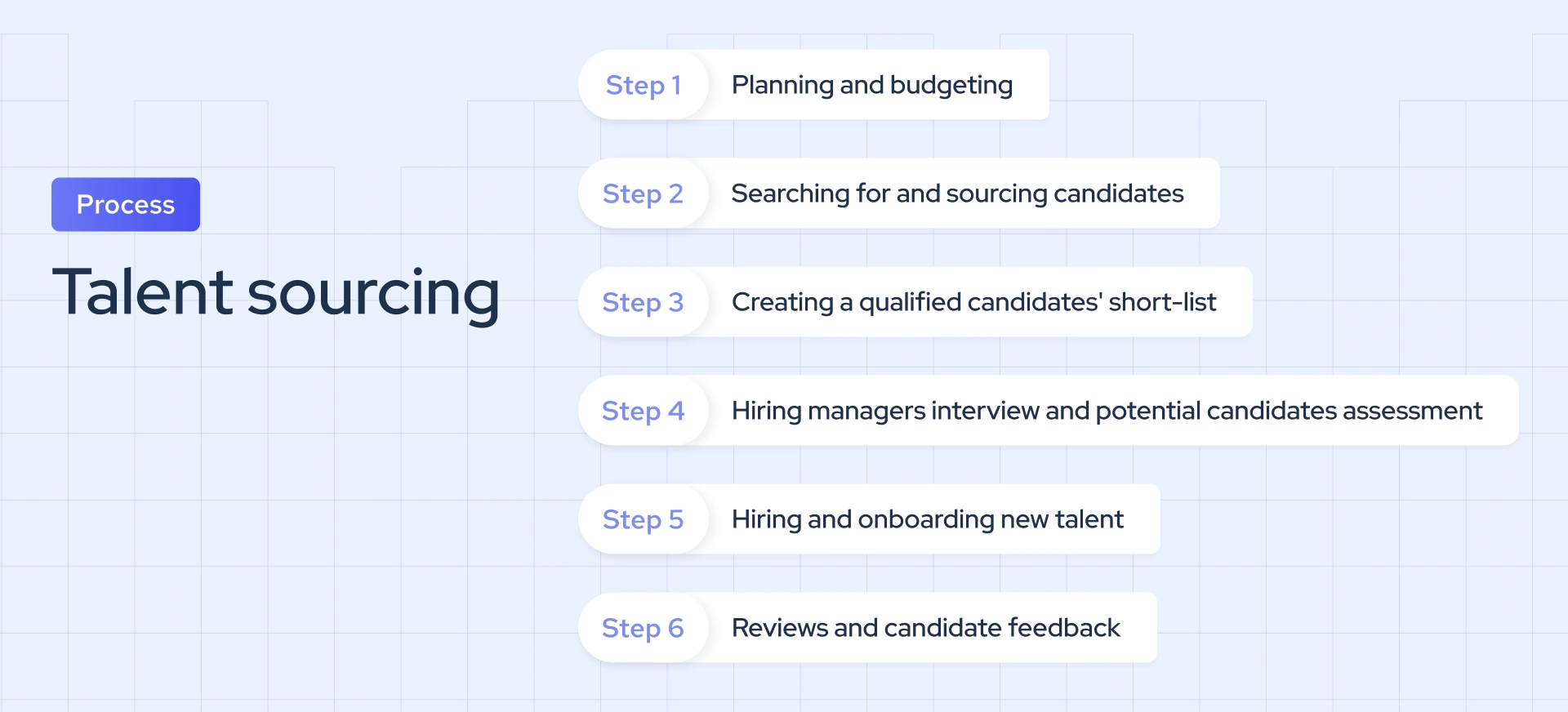
1. Planning and budgeting
Before posting a position, hiring teams should have a clear budget and ideal candidate profile for the positions they are looking to fill.
2. Searching for and sourcing candidates
Combine channels, including rediscovering past applicants in your Applicant Tracking System (ATS), searching professional networks and communities, and filtering employee data by skills, title, and tenure. Many companies use multiple sourcing strategies to speed up hiring.
3. Creating a qualified candidates' short-list
After applications have been submitted, resumes have been collected, or software has identified potential candidates, recruiters must then create a candidate shortlist.
A shortlist should include a fair amount of potential candidates, from a variety of different backgrounds to ensure that all aspects of the role are being screened for in the interviewing process.
4. Hiring managers interview and assess potential candidates
This step typically requires the most time in the talent sourcing lifecycle, as interviewees and employers have to coordinate sometimes multiple rounds of interviews.
They check the qualified talent, soft skills, necessary skills, and check the information against the ideal candidate persona.
A recent hiring trend has found that virtual interviews are on the rise and here to stay, at least for first-round interviews, due to the impacts of COVID-19.
5. Hiring and onboarding new talent
Once an offer is accepted, the company must onboard new talent. This may include additional company-specific training, general role-based training (such as learning modules), and a substantial amount of legal and financial paperwork.
6. Reviews and candidate feedback
The talent sourcing process doesn’t end with a successful hire. To become more efficient and effective in talent sourcing, employers should ask new hires for feedback on the process and provide feedback to qualified applicants who weren’t hired.
This builds trust between the company and new hires and maintains a professional networking connection with highly qualified candidates who weren't hired.
Talent sourcing solutions and tools
Most teams build their sourcing stack from several tools. An applicant tracking system or recruiting CRM keeps candidates and past applicants in one place, while sourcing platforms and AI assistants speed up search, matching, and outreach.
All of these tools depend on accurate, current candidate data, which is where data providers like Coresignal come in. Its fresh employee data shows who has the right skills, who recently changed jobs, and other relevant information, so recruiters reach the right people sooner.
Sourcing vs. acquisition vs. recruitment
Talent sourcing, recruitment, and talent acquisition are often used interchangeably, but they cover different parts of the hiring process. Sourcing is the first stage: finding and engaging people, many of whom never applied. Recruitment takes over once candidates are interested and turns them into hires through screening, interviews, and offers. Talent acquisition is the broader strategy that covers both, from workforce planning and employer branding to deciding where and how to hire.