





.jpg)
The startup world is incredibly competitive. In fact, the failure rates of most startups are very high. In recent years, according to Carta, 90% of seed-level startups fail.This figure is staggering and many entrepreneurs eventually find it impossible to overcome this fate.
Sometimes, to protect a new product and to set their own pace for development, people decide to launch a startup operating in a temporary state of secrecy.
This state is called stealth mode. When operating in this mode, the startup aims to avoid the spotlight until it's ready to become public.
In this article, we will explain how it works, the reasons behind going into stealth mode, and the benefits as well as the challenges of operating this way.
What is a Stealth Mode Startup?
A stealth startup is a startup company operating in silent mode, in other words, avoiding public attention and announcements about its products.
Stealth mode is a temporary state of secrecy that ends when the company decides to become more visible and public, usually when the product is already developed and ready to launch.
The secrecy requirement also applies to the employees and other people connected to the project – many companies working this way have non-disclosure agreements and other rules to protect the technology and ideas.
There are 3 types of stealth mode: total stealth mode, partial, and in-company stealth mode.
Total stealth mode
A total stealth mode startup is a new company that starts and operates in secrecy until the launch. And it's not about just the public eye. Some companies would even go as far as not having any website or public profile during this stage. In contrast, other stealth startups simply avoid public announcements about their products and media attention.
Partial stealth mode
Partial stealth mode is when a startup has some public presence while keeping key details about its product, funding, customers, or operations confidential. Unlike total stealth mode, the company may have a website, recruit publicly, or engage with selected users and investors while protecting the parts of the business it does not want competitors to see.
In-company stealth mode
The term “in-company stealth mode” describes an existing business developing a new idea or product in secret. In this case, companies take various measures to keep that project a secret like dedicating human resources specifically to that project or using codenames for the new products.
Another difference between this and total stealth mode is that sometimes the development of a new product is also concealed internally, not only hidden from the public and the media.
Total vs. partial stealth mode startup types overview
Startups operating in stealth mode use different levels of secrecy to protect their business ideas, intellectual property, and strategic plans. The two primary types of stealth mode are total stealth mode and partial stealth mode, each with its own advantages and challenges.
Why do startups launch in stealth mode?
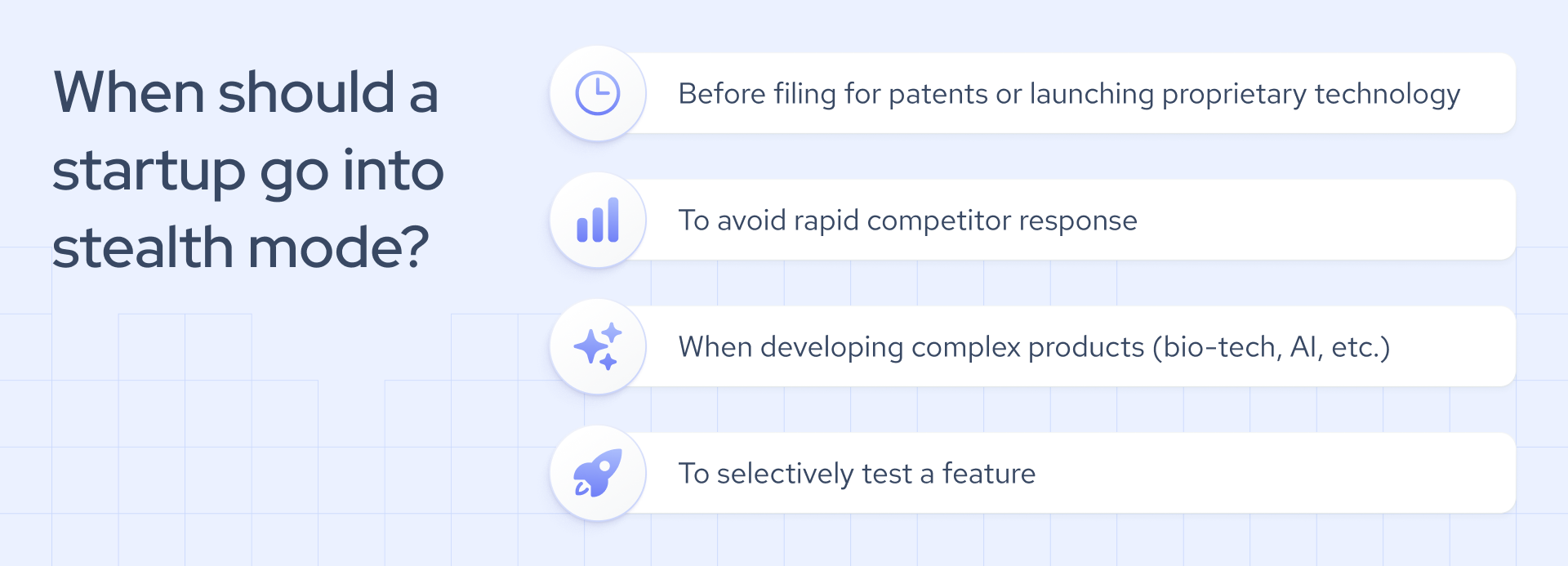
Startups may choose to operate in stealth mode when limiting public visibility helps protect sensitive work or gives the team more control before launch. Common reasons include:
- Protecting sensitive technology or intellectual property. A stealth mode startup may avoid publicly sharing details about its product, technical approach, or business model while development is still underway.
- Keeping a new product or initiative confidential. A startup or an existing company may stay in stealth mode while developing a new product, feature, or internal project to avoid alerting competitors before it is ready to launch.
- Allowing more time for complex development. Some products require long development cycles, extensive testing, regulatory preparation, or significant technical work. Operating in stealth mode can give teams more time to refine the product before attracting broader attention.
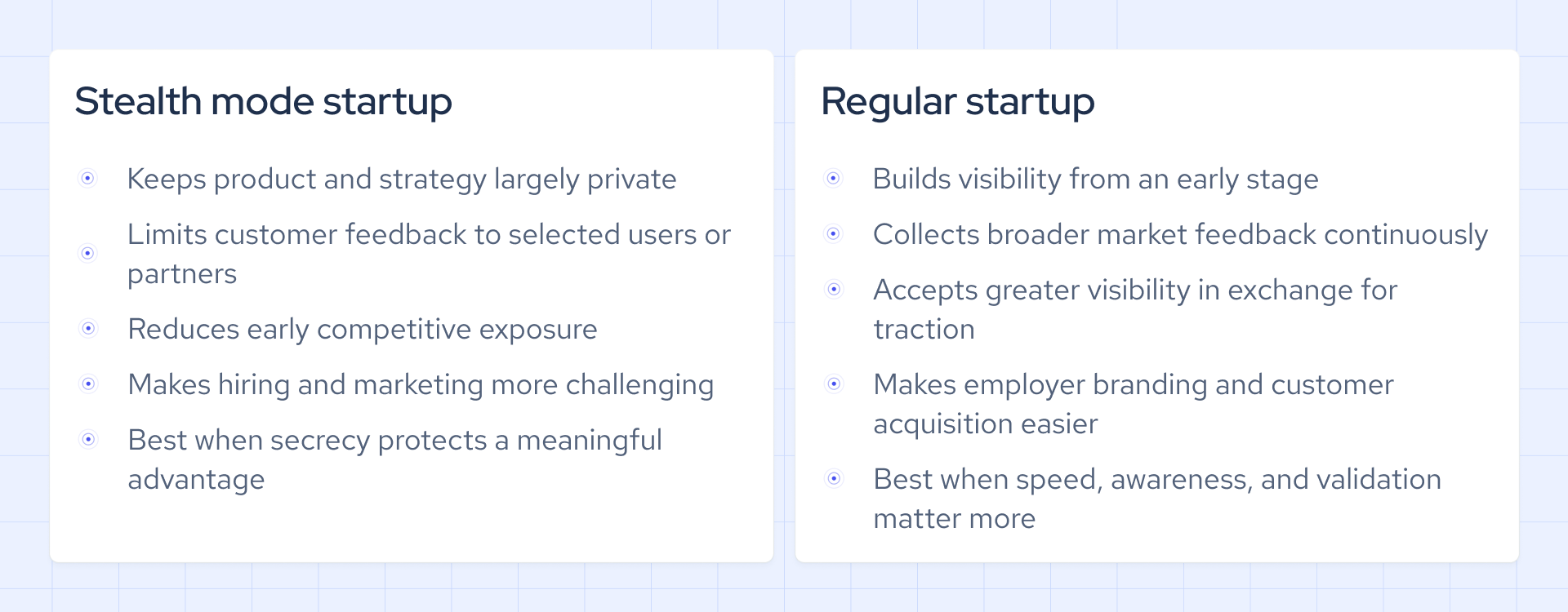
Many startups benefit from early visibility because it can support customer feedback, hiring, marketing, partnerships, and investor discovery. A company in stealth mode intentionally limits some of that exposure for a period of time in exchange for greater confidentiality and control.
That trade-off can offer clear advantages, but it can also make customer validation, recruiting, fundraising, and market awareness more difficult.
Stealth mode startup benefits
The main benefits of stealth mode typically relate to protecting sensitive work, reducing outside pressure during development, and managing public exposure more deliberately.
Intellectual property protection
The main benefit of business operating in stealth mode is protecting intellectual property, which is especially important to those working with unique new projects.
Not having too much public information about the product prevents the idea from being copied and keeps it secret from the competitors.
Focus on the product
Stealth mode allows companies to set their own pace and launch when they are ready, without pressure from the outside.
Disclosing information about the project in the very early stages can also result in a premature dismissal of a good idea.
While it's essential to see what attention your product is getting, from client feedback to the media, it can be quite distracting and even demotivating. Not having to deal with it allows the teams to focus on the product's strategy and development.
Moreover, stealth mode startups don't need extra resources for marketing.
Control over public timing and messaging
When the startup is eventually ready to launch, it can start with a strategic campaign, manage its public image and build its reputation from scratch without a negative trail of public failures from the early stages of the project affecting it.
Stealth mode startup drawbacks
Stealth mode can also limit some of the advantages that come with early visibility.
Lack of feedback
Keeping the product development secret makes testing and getting feedback harder. After all, even if the product seems to be in high demand, after you target customers, you might come to conclusion that the audience does not respond to it as expected.
Gathering feedback in the early stages makes it easier to decide what works and what doesn't. That's why stealth mode startups often rely on input and consultations with experts, stakeholders, investors or innovative testing methods.
Early feedback is a great help for companies still looking for the right market fit.
There are tools and methods for startups in stealth mode to test their products, however, it's not the same as being able to monitor the feedback they get organically.
Challenges attracting funding
The secrecy of stealth mode startups makes finding and attracting investors challenging. Usually, you can find a lot of information about a new startup. They have public websites, disclose funding information, show their teams, share feedback from customers, tell their story publicly, and more.
From the startup side, it's harder to approach and convince investors without client feedback or publicity. It's harder to discover these companies, determine if they are reliable, and do any research on them. All of these reasons limit their funding opportunities.
However, even though the process is more challenging, some projects operating in secret manage to secure impressive funding deals without public activities.
Limited public visibility
While stealth mode provides the benefit of being able to manage public image more easily, it also means that before the official launch and becoming more public, the company didn't attract much organic attention.
Because of this, the launch campaigns and the activities after the official launch, such as writing their own press releases and getting mentions in the press, require more resources and effort from the marketing and PR teams compared to those startups that gain attention and become known while still developing their products.
Hiring challenges
Limited public information can make it harder for a stealth mode startup to attract candidates. When details about the company, product, or mission are difficult to find, potential employees have less context to evaluate the opportunity, while reduced employer visibility can make the startup harder to discover in the first place.
How to fund a stealth mode startup?
Stealth mode startups can use many of the same funding sources as other early-stage companies, including angel investors, venture capital firms, accelerators, and founder funding. However, limited public information about the company, product, or traction can make investor discovery, evaluation, and due diligence more challenging.
To address this, founders often share more detailed information privately with selected investors while using confidentiality agreements or controlled disclosures where appropriate.
Venture capital (VC) & angel investors
Venture capital firms and angel investors can be important funding sources for stealth startups. Experienced investors may be willing to back a company based on factors such as the founding team, market opportunity, and problem being addressed, even when little information is publicly available.
Fundraising in stealth mode often involves selective disclosure. Founders may share high-level information initially and provide more sensitive product, technology, or competitive details later in the process. Confidentiality arrangements, including non-disclosure agreements (NDAs), may be used in some situations when particularly sensitive information is involved, although practices vary by investor and deal.
Self-funding (bootstrapping) the startup
Another strategy is self-funding (bootstrapping), where founders finance the company using personal savings, revenue from consulting work, or early customer pre-sales. Bootstrapping allows startups to operate without external pressure, giving them full control over their strategy and timeline. While this approach helps maintain secrecy, it also limits resources, making it difficult to scale quickly.
Government grants & research funding
For deep-tech, AI, and research-driven startups, government grants and research funding can provide non-dilutive capital. Programs like SBIR (Small Business Innovation Research) grants, EU Horizon grants, and defense contracts offer funding for startups developing groundbreaking innovations in fields like biotech, cybersecurity, and artificial intelligence. These funding sources allow startups to grow while maintaining operational secrecy.
Strategic corporate partnerships & industry investments
In some cases, stealth startups secure funding through corporate partnerships and industry investments. Large companies often invest in early-stage startups working on innovations that align with their long-term strategy. This can provide not only funding but also access to industry expertise, infrastructure, and market validation. However, such partnerships require careful negotiation to protect the startup’s intellectual property and independence.
Ultimately, the best funding approach depends on the startup’s industry, growth stage, and secrecy needs. Many successful stealth mode startups combine multiple funding strategies, starting with bootstrapping, securing government grants, and later raising capital from selective investors who understand the value of confidentiality. A well-planned funding strategy ensures that the startup remains financially stable while maintaining its competitive edge in the market.
Stealth startup examples
Stealth mode is used across different industries, from bio-tech to AI and 3D technology. These examples show how companies can spend months or years developing products privately before revealing more about their technology, funding, or market plans.
Lumirithmic
In 2022, UK-based 3D technology startup Lumirithmic exited stealth mode after two years. The company emerged from stealth with its desktop 3D facial appearance capture technology, developed for applications including gaming, entertainment, beauty technology, and virtual experiences.
Ultima Genomics
California-based biotechnology company Ultima Genomics emerged from stealth mode in 2022 after operating in a temporary state of secrecy for 6 years. When it became public, the company announced a genome-sequencing platform alongside approximately $600 million in funding from investors including Andreessen Horowitz, Founders Fund, and Khosla Ventures.
Hailo Technologies
Israeli AI chip startup Hailo Technologies exited stealth mode in 2018. The company revealed its technology publicly while announcing a $12.5 million Series A funding round, illustrating how a stealth mode startup can coordinate its public debut with both product and funding news.
These examples also show that there is no single way to operate in stealth mode. Some companies use it for a relatively short development period, while others remain private for several years before revealing their product and broader company profile.
How can you find stealth mode startups with Coresignal?
Stealth startups limit their public visibility, but they can still leave useful signals across company and professional data. Coresignal’s startup data helps investors identify both newly launched companies and startups that may still be operating in stealth mode.
A practical approach is to look for signals such as newly formed companies, founder activity, early hiring, employee growth, or changes in professional profiles before a startup becomes widely known. These signals can support investment intelligence workflows by helping investors discover emerging companies earlier and evaluate them with additional context.
Because the dataset is regularly updated and continues to grow, investors can monitor new signals over time instead of relying only on public announcements.

Don't miss the next unicorn
Use startup data to discover promising startup founders and their companies in
time.
How to transition out of stealth mode successfully?
Exiting stealth mode is a critical milestone for any startup. After months or even years of operating in secrecy, transitioning to a public launch requires careful planning to ensure a smooth and impactful entry into the market. A poorly executed transition can lead to customer confusion, missed opportunities, or competitive disadvantages, while a well-planned strategy can generate excitement, attract investors, and establish a strong market presence.
Determine the right timing for your launch
The first step in coming out of stealth mode is deciding when the company is ready for greater visibility. The product, team, infrastructure, customer support, and marketing should be prepared for the level of attention and user activity the launch is expected to generate.
If the startup depends on external funding, this may also be the right time to secure additional capital and plan for growth. A staggered launch with beta users or selected early adopters can help test demand, gather feedback, and refine the offering before a broader release.
Plan your public communication & marketing strategy
A strong PR and marketing strategy is essential when transitioning out of stealth mode. Startups should craft a compelling narrative that explains why they were in stealth mode, what makes their product unique, and how they plan to disrupt the market. Engaging with media outlets, launching a teaser campaign, and leveraging influencer endorsements can help build anticipation. Establishing a robust online presence including a well-designed website, social media channels, and thought leadership content ensures credibility and visibility from day one.
Manage customer expectations & product scaling
Finally, managing customer expectations and scaling operations smoothly is crucial. A sudden influx of users or media attention can put pressure on infrastructure, customer support, and product functionality. Startups should monitor early feedback, be prepared to address potential issues quickly, and continue innovating post-launch to stay competitive. The transition out of stealth mode is not just about revealing a product – it’s about establishing trust, proving market fit, and laying the foundation for long-term success.
Conclusion
Stealth mode can be useful when a startup needs more control over what it reveals during early development, but it also comes with clear trade-offs. Limiting visibility may help protect sensitive technology, reduce competitive exposure, and give teams more space to focus, while also making customer feedback, hiring, fundraising, and market awareness more difficult.
For some startups, a period in stealth mode can be a practical part of the launch strategy. The right approach depends on the product, market, competitive environment, and how much secrecy is genuinely useful before the company is ready for broader visibility.


