

.jpg)
AI usage is experiencing major growth. According to the McKinsey Global Survey, roughly a third of high-performing organizations are investing more than 20% of their digital budget in AI. But the reliability of those tools still depends on the information these businesses feed them; without high-quality AI-ready data, these are just modern gimmicks.
What is AI-ready data?
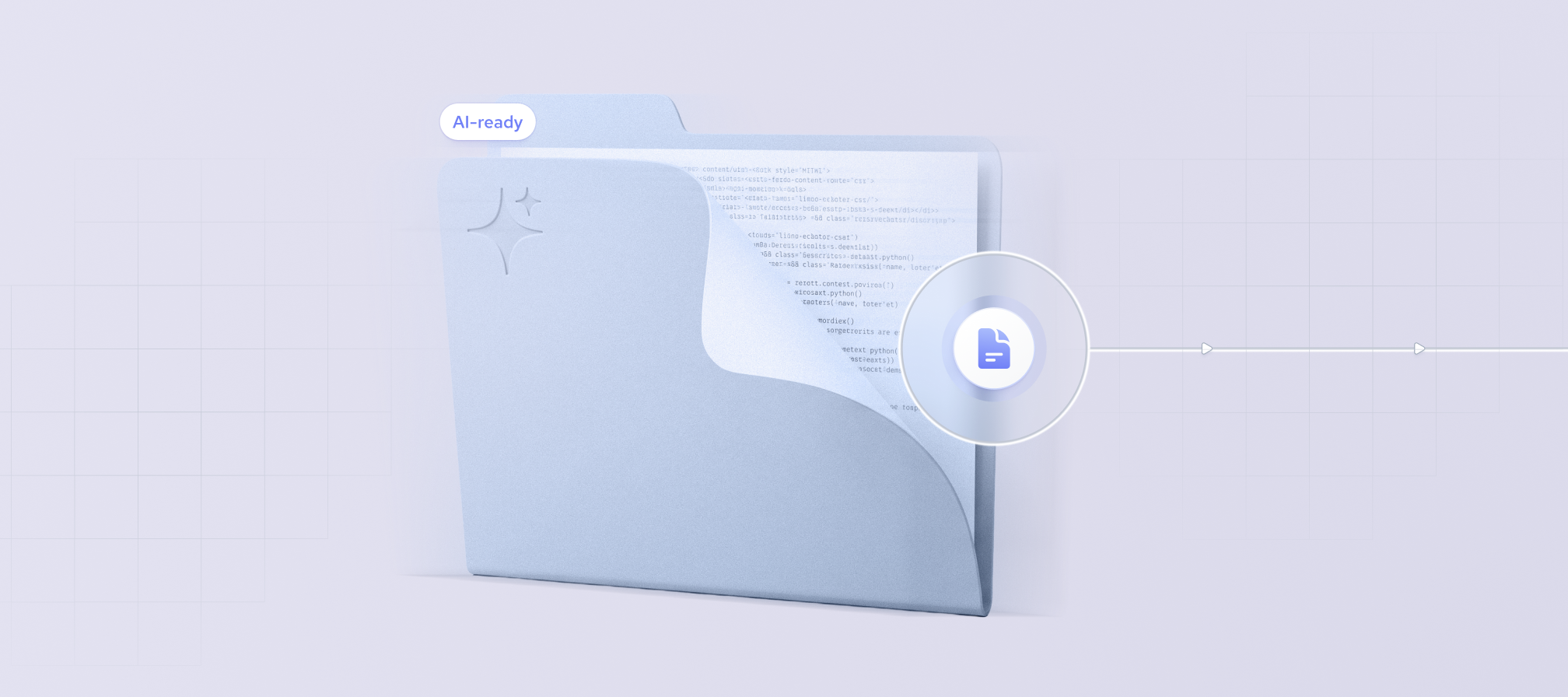
AI-ready data is information that has been organized, cleaned, enriched, deduplicated, and contextualized so that artificial intelligence (AI) tools and machine learning (ML) models can access it reliably, process it without confusion, and interpret it at scale.
Unlike traditional data designed for analysis by humans, data for AI must be machine-readable. In other words, it needs to be heavily optimized to the exact ways AI and ML systems ingest and process information.
Why does AI-ready data matter?
Remember the GIGO (garbage in, garbage out) principle? In my experience, it applies heavily to AI applications. Simply put, without properly prepared and structured data, the output of your AI projects and initiatives is likely to suffer and produce very flawed results.
When you start with accurate, complete, and consistent information, you get benefits like:
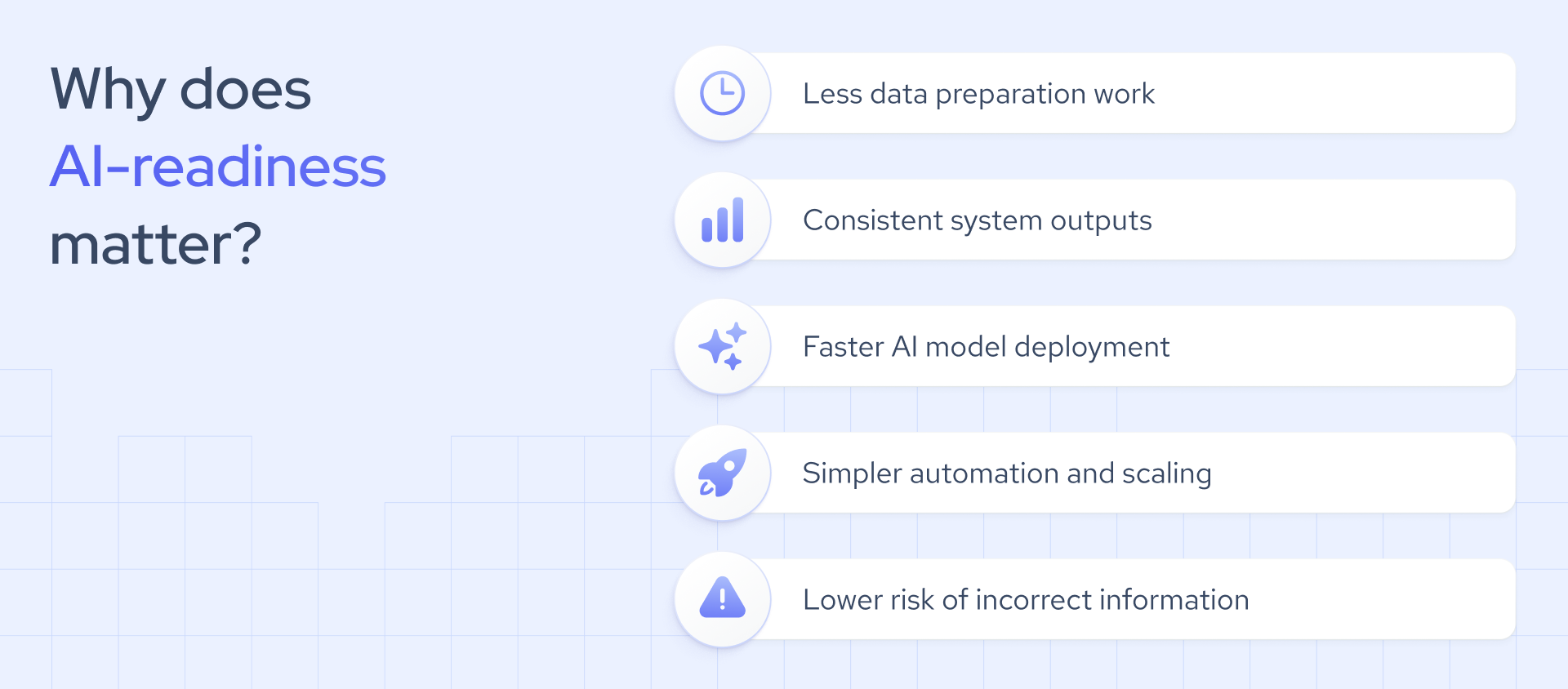
- Less data preparation work: Pre-prepared, structured data for AI agents can save significant time, as teams don’t have to manually clean, format, and validate the information before feeding it to an AI model.
- Consistent system outputs: AI initiatives that use clean and structured data as a starting point consistently yield more accurate and reliable results, leading to better overall model performance.
- Faster AI model deployment: Going from experimentation to implementation is much quicker when your AI solutions don’t have to spend extra time accessing, digesting, and interpreting unstructured, incomplete, or inconsistent data.
- Simpler automation and scaling: Prepare it properly once and manage it regularly, and AI-ready data can be reused over and over again. That includes scaling smaller initiatives, starting new projects, and automating existing ones.
- Lower risk of incorrect information: Systems that make predictions based on unreliable information will yield inaccurate and biased results. That’s not the case when you have pre-prepared, high-quality AI data by your side.
What data is AI-ready?
Information that looks tidy at first glance isn’t necessarily ready for AI algorithms. For a machine learning system to use it effectively, data must first meet several requirements, including being:
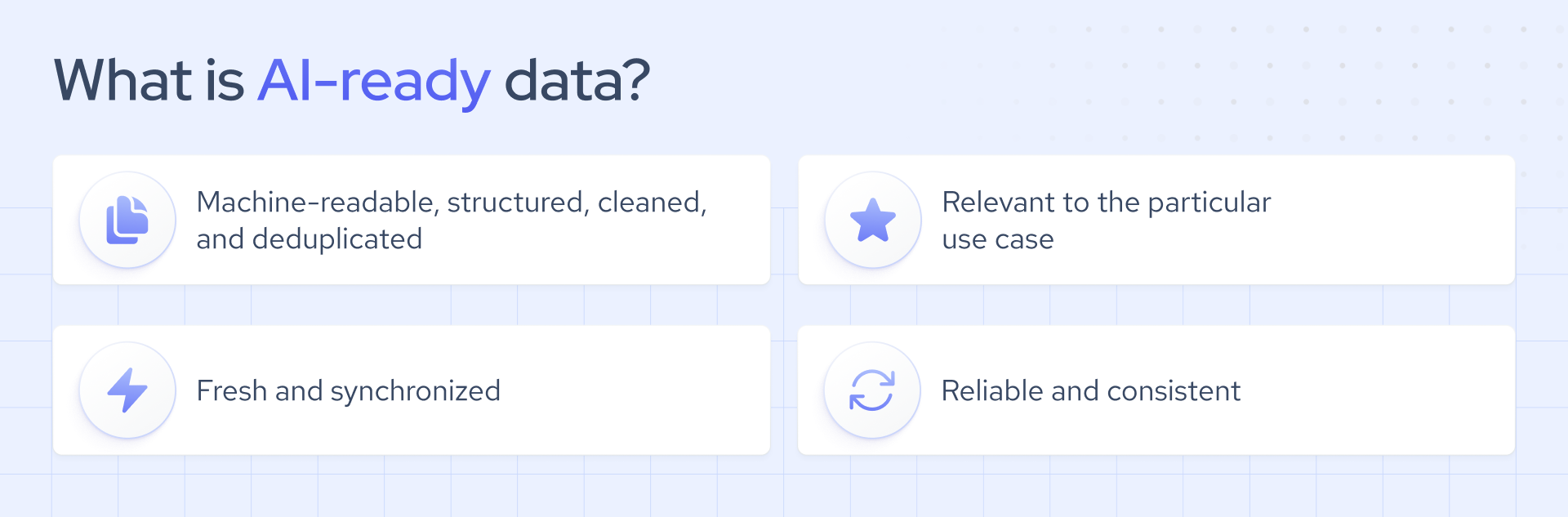
- Machine-readable and structured: Cleaning things up isn’t enough; data also has to be standardized into formats that AI systems can parse without unnecessary conversions. That often includes JSON, JSONL, CSV, and Parquet files, as well as vector databases.
- Relevant to the particular use case: Training a machine learning model requires one approach; data for AI agents demands another. In any case, the information should align with the intended use case and be accompanied by metadata that AI can understand.
- Fresh and synchronized: The scenario you’re using AI-ready data for also impacts the required level of freshness. Some applications can get away with a fresh dataset; others require real-time access to current information that only a data API can provide.
- Reliable and consistent: Whether it’s company, employee, job, or social post records, the quality of data AI systems ingest also matters. Information should be structured, normalized, complete, accurate, and deduplicated. Enriched records are also a plus.
What are the main ways to make your data AI-ready?
After spending years in the industry, I can confidently say most companies rely on three methods to prepare data for AI applications. So, let’s immediately take a look at how to make your data AI-ready and why it matters to go with a strategy that matches your specific needs.
You can either:
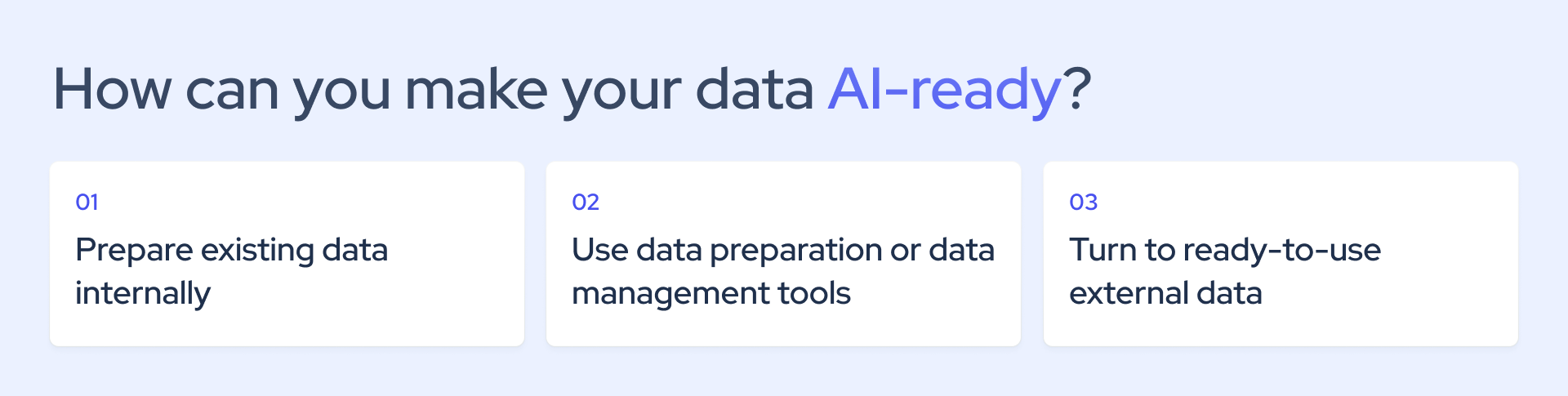
- Prepare existing data internally: Some teams opt to manually collect, clean, structure, and standardize datasets. This approach gives you complete control over how you customize and adapt data for AI agents and similar purposes, but it also requires the most time and staffing. There’s also maintenance to keep in mind.
- Use data preparation or data management tools: Dedicated software that automates deduplication and normalization can also help with getting data ready for AI. It’s a great solution for internal teams that don’t require complete control over customization and don’t want to expand headcount, because it saves substantial time during preparation.
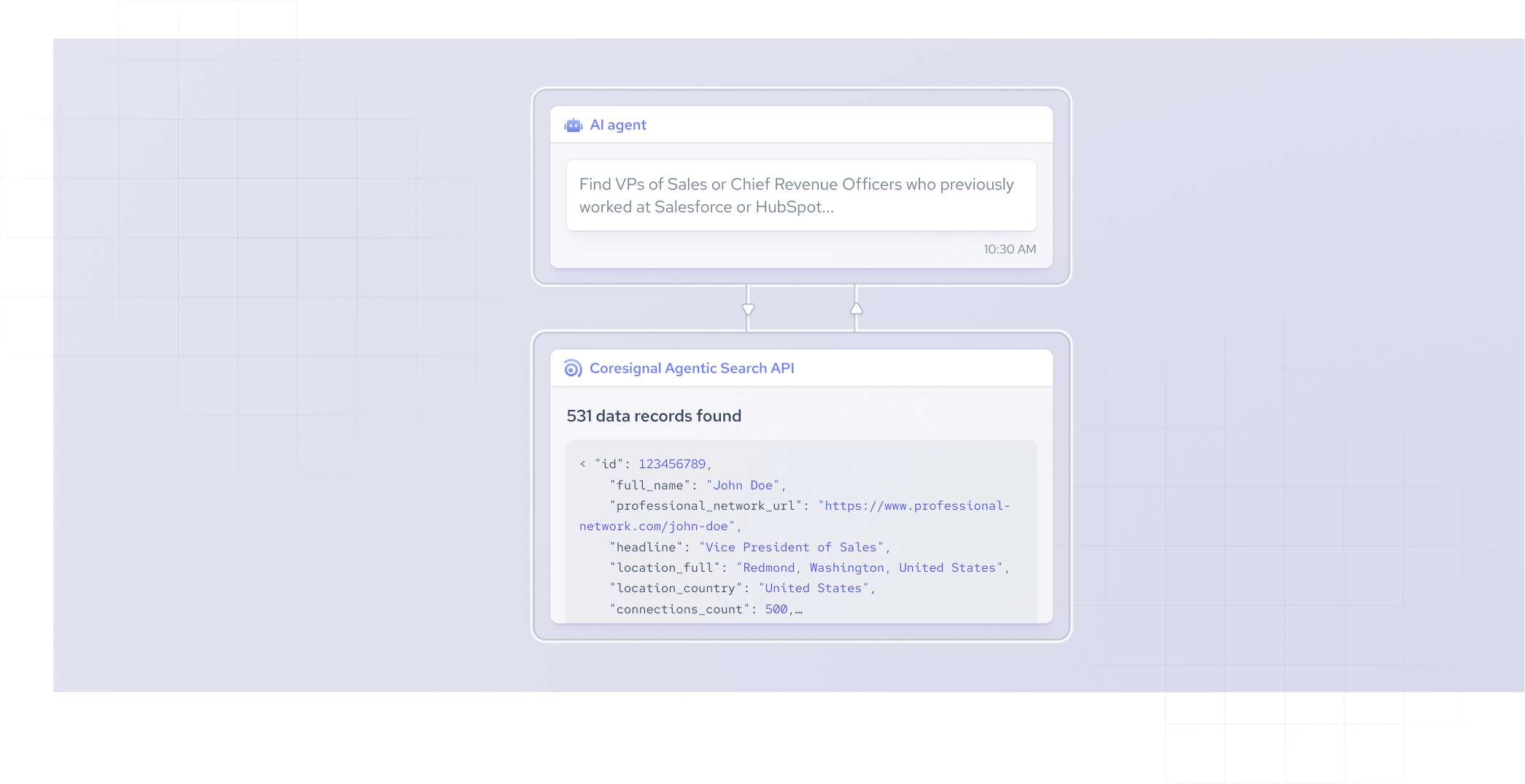
- Turn to ready-to-use external data: Organizations can also bypass the whole internal preparation step and rely on AI-ready data providers instead. Coresignal is a prime example of an AI data platform that offers fresh data, including company, employee, job, and social post records available through datasets, APIs, Agentic Search, or MCP.
What are examples of AI-ready data?
Once data for AI systems meets readiness standards, its value becomes immense. But the exact workflows you can use it for depend primarily on how it’s structured and how accurate, up-to-date, and accessible it is for AI systems:
- An online store’s catalog with structured fields, categories, and attributes across thousands of SKUs could significantly improve search and recommendation systems.
- A CRM database with cleaned and deduplicated customer and company records and a consistent schema would allow sales and marketing tools to view the same picture.
- A well-organized knowledge center with clear labels and metadata can help RAG systems retrieve the exact information needed instead of loosely related content.
- An AI data platform with fresh B2B data, such as Coresignal, which offers structured, deduplicated company, employee, and job records, might power agentic AI workflows.
- Cleaned-up historical business data that follows a consistent format could be used to train AI models, analyze trends, and forecast future outcomes.
What are the main use cases for AI-ready data?
AI-ready data has countless applications. It can reliably power anything from smaller startup applications to massive enterprise innovations across multiple industries. Here are a few examples of where it’s commonly used:
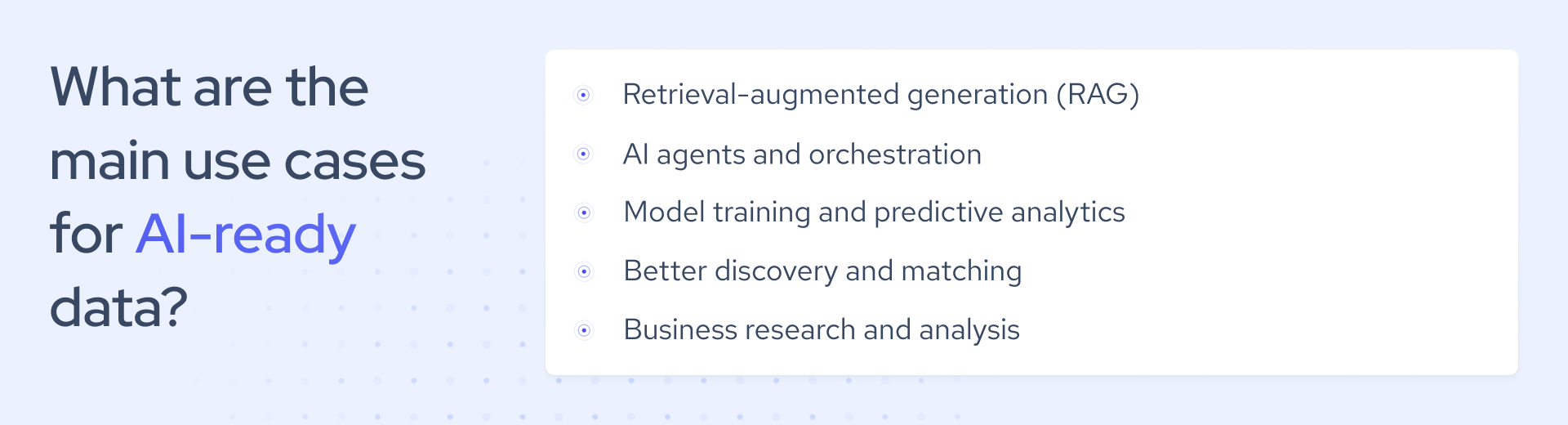
- Retrieval-augmented generation (RAG): Clean, structured, well-organized, and semantically enriched enterprise AI-ready data fed into large language models (LLMs) can substantially improve the quality of responses these tools generate.
- AI agents and orchestration: Data with stable schemas and clean metadata allows AI agents to gather information, compare sources, and identify connected entities far more efficiently. It can also improve the agent’s decision-making capabilities and actions.
- Model training and predictive analytics: Historical data is the foundation for training AI models that forecast future outcomes. When that info is consistent and accurate, these tools become much better at identifying patterns, which grows their predictive abilities.
- Better discovery and matching: Search and recommendation tools can also benefit from specialized data for AI systems. This allows them to understand the relationships among products, services, companies, and people, thereby yielding better results.
- Business research and analysis: Teams that combine modern machine learning systems with structured, normalized, deduplicated, and enriched AI-ready data can analyze businesses, customers, and markets much more efficiently.
Final thoughts
Modern AI systems can’t function with just about any type of data. To be reliable and generate accurate outputs, these tools must first receive structured, contextualized inputs. That’s exactly what AI-ready data is: consistent, reliable, accurate, and easily accessible information.
But getting data ready for AI is just as important as whether it’ll be used for RAG systems, agentic workflows, or model training. Some teams do it entirely manually. Others combine internal preparation with automation software. And some rely on external data providers.
Coresignal was built for those who opt for the third option. Our AI-ready B2B data is available as one-time downloadable datasets or with real-time access via APIs, Agentic Search, and MCP, so you can skip the whole preparation step and get structured, cleaned, and deduplicated company, professional, and job records for whatever AI workflows you’ve got in mind.