



Accurate information is essential for driving business growth and powering today’s AI-driven tools. When you work with structured, reliable labor market data, it becomes much easier to build effective hiring prediction engines and develop workforce intelligence solutions that deliver real results.
On the other hand, relying on stale or inaccurate data can quickly undermine your efforts and leave your business trailing behind competitors who use up-to-date information.
According to the latest labor market research, the global AI training dataset market evaluated at $3.59 billion in 2025 alone, and it’s predicted to grow even more: from USD 4.44 billion in 2026 to USD 23.18 billion by 2034. In such a rapidly growing market, it has become increasingly difficult for companies to obtain the right job postings data and datasets. Raw data from job ads is inadequate for training modern AI models, which require structured information rather than scraped or duplicated data.
Unlike job ads written to attract candidates, structured job postings data records provide everything an AI model needs to analyze a role profile, from the job title and description to required skills, seniority level, and compensation benchmarks. All these hiring signals help build business intelligence tools that companies use to gain competitive intelligence and forecast trends.
Why raw job ads fail in AI model training
There’s a reason AI models trained on raw, unstructured data tend to fail in the business world. The quality of your data directly determines how well your model performs. Relying on raw data often results in poor inputs and unreliable outcomes. Here’s why:
- No historical tracking. Without historical data, you can’t spot labor market trends or identify which skills are in demand.
- Duplicates. Job postings for the same position often appear across several different sources and platforms. This can send mixed signals to the AI, leading to inconsistent performance.
- Inconsistent formatting. Job ads rarely follow a single format. These differences make it harder for models to process and compare information accurately.
- Job title chaos. The same role can have different titles across platforms. Without standardization, models struggle to group and compare job data.
- Missing fields. Many job ads leave out key details like seniority, salary, location, or company information. When data is missing, models have to guess, which leads to inconsistent outputs.
- Lack of normalization. Without structured data, models treat synonyms as separate skills. This fragments skill matching and reduces accuracy.
- Skills, title, and location mismatches. Inaccurate data often means skills, titles, or locations don’t match across listings. This makes it harder to draw reliable insights.
What makes job posting data AI-ready?
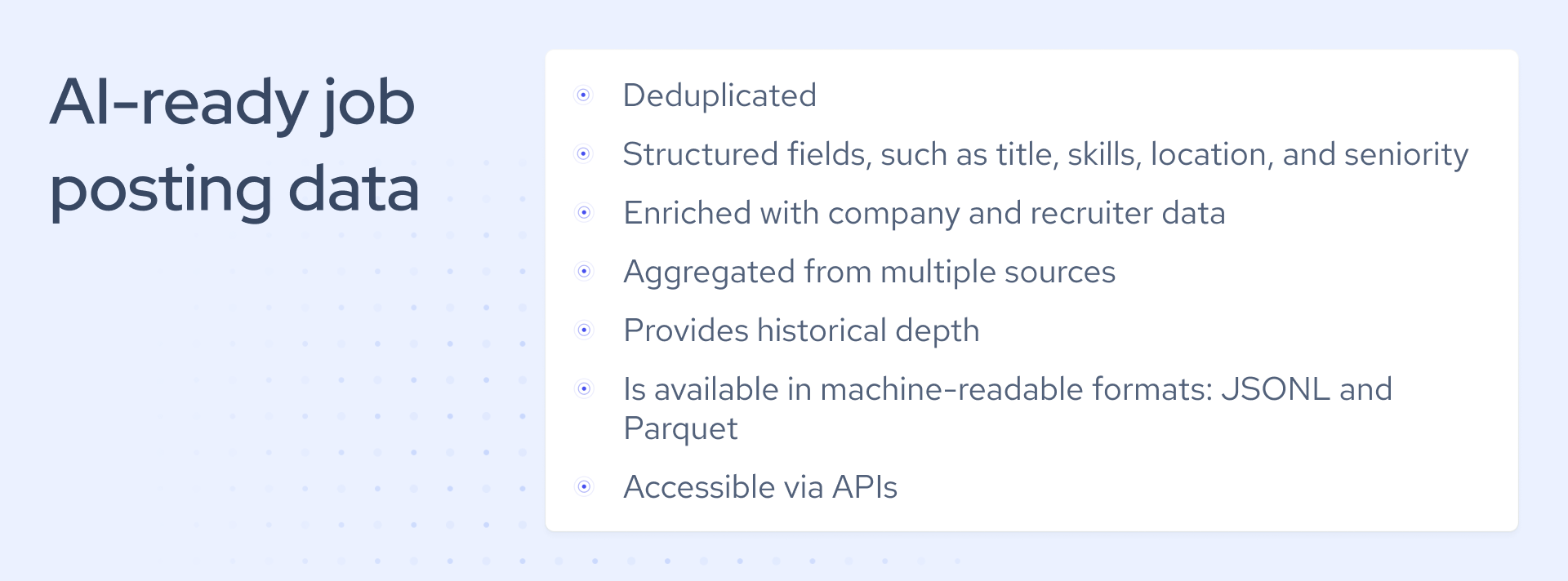
Job posting data is AI-ready when it meets key standards for deduplication, normalization, and structure. AI-ready data must be deduplicated and include structured fields such as title, skills, location, seniority level, and compensation level. It also needs to be enriched with additional job description details and context about the recruiter's company.
For the best AI-training results, you should consider structured job postings data and datasets. Multi-source aggregation helps consolidate records and reduce blind spots. For timely pattern recognition, you also need to focus on historical depth.
Job posting data is also often presented in machine-readable formats, such as JSONL and Parquet. Look for job posting data providers with API access for convenient data pulling, and focus on vendors with real-time updates and frequent revalidation.
What high-quality AI-ready job posting data looks like in practice
The quality of your data is critical to AI model performance. Not all providers define quality the same way. Many focus on delivering large volumes of data; however, what truly matters for AI is data that is fresh, deduplicated, consistent, historically deep, and regularly re-validated.
Coresignal's jobs dataset shows what high-quality data looks like in practice. It offers global coverage with millions of job records from multiple sources.
Historical depth is another key factor. Coresignal's historical job posting data goes back to 2020. This allows teams to train models on multi-year patterns instead of relying on single snapshots. As a result, you can achieve more reliable labor market forecasts and stronger historical analytics that single-period data cannot provide.
Deduplication is essential for data integrity. If the same job posting shows up on different job boards, Coresignal ensures it is mapped and and appears only once in the dataset. We merge these records into a single, accurate listing. This process cleans up messy or inconsistent data, so your AI models learn from real-world signals, not duplicate or inflated records.
Core AI use cases powered by job posting data
Securing accurate B2B data for AI training provides structured information about companies and professionals. From there, it’s all about how you use it, and here are some common application examples:
- Job matching and recommendation engines: Talent platforms use job posting data to train models that match suitable applicants to open positions, often with personalized AI-powered recommendations.
- Salary prediction and compensation intelligence: Enterprises can benchmark compensation ranges using data from other companies’ listings.
- Hiring demand forecasting: Job posting datasets also hint at hiring patterns and signals that companies can use for growth planning and identifying labor market trends.
- Skill demand prediction: Workforce planning and business intelligence tools use job posting data to identify skill gaps and pinpoint skills likely to be in demand over multi-year periods.
- Sales intelligence and buying intent detection: Hiring signals also hint at purchase intent, enabling trained AI models to predict the adoption of new technology based on hiring patterns.
- Competitive and market intelligence: Structured job posting data is used for competitor tracking based on hiring signals. It also helps better plan market entry decisions and regional expansion based on market movements and shifts in hiring patterns.
Traditional infrastructure vs AI-ready infrastructure
AI models require specific types of job posting datasets for proper training. These datasets are based on the parameters that AI models can track and render, such as deduplication, normalization, and historical job posting data.
The AI-ready infrastructure also requires real-time access for continuous model revisions and a flexible output schema in readable formats such as JSONL and Parquet. These are also some of the reasons why the API format makes more sense than static datasets for this purpose, as it provides automated, real-time updates and better scalability. Semantic search is also crucial, as it uses NLP and contextual intelligence when pulling data.
On the flip side, traditional datasets rely on batch updates, which may or may not occur on a weekly or monthly basis, since it all depends on the provider. CSV-only delivery is also a significant difference, as it tends to be inefficient for large-scale data handling, not to mention its poor searchability.
How to evaluate job posting data for AI projects
Before making the final decision on which data provider to lean on, this checklist can help you narrow it down:
- How often is data updated?
- How are duplicates handled?
- Is the data multi-source?
- Is enrichment included?
- Is historical job posting data available?
- Are formats AI-friendly?
- Can teams test the data?
Ideally, you want to find a vendor with daily job posting additions, active re-validation and deduplication, and multi-source aggregation. Make sure there’s at least a year or two of historical data depth and that data delivery formats are AI-compatible for easier model training.
Ethical data sourcing for AI models
Data compliance and ethical sourcing are crucial for staying within the lines of legal collection and practices. If an AI model is trained based on improperly sourced data, it might carry a legal risk, putting your business’s reputation on the line.
That’s why it’s extremely important to use vendors like Coresignal that collect data exclusively from publicly available sources. This way, you won’t have to worry about any private or sensitive data getting into the mix.
Final thoughts: why job posting data is becoming core AI infrastructure
AI systems now play a central role in business decision-making. To deliver accurate insights, these models require real-world examples and timely signals from job postings data. Access to job posting data with real-time updates provides a significant advantage over static, duplicated job ad information.
With AI-ready job posting data, your team no longer needs to spend hours downloading static job boards or dealing with inconsistent, unstructured, and duplicated information. Access to structured, up-to-date data is becoming the standard, and providers such as Coresignal deliver the reliability and coverage required for effective AI applications.