




Secondary data helps organizations make faster, more informed decisions without collecting information from scratch. Businesses use it to analyze markets, monitor competitors, identify sales opportunities, train AI models, and support strategic planning, while researchers rely on it to validate findings and explore existing trends.
Unlike primary data, which is collected specifically for a research project, secondary data has already been gathered by another organization or individual for a different purpose. When evaluated carefully, it provides a cost-effective and time-efficient way to answer research questions and uncover valuable insights.
This guide explains what secondary data is, why it's important, its main advantages and disadvantages, common sources, and how businesses can use it effectively.
What is secondary data?
Secondary data is information that has already been collected, recorded, and published by another organization or individual for a different purpose. Unlike primary data, which is gathered firsthand to answer a specific research question, secondary data already exists and is reused for new analyses.
Secondary data is typically the result of someone else's primary research and can be obtained through public or commercial channels. Secondary data collection focuses on sourcing and evaluating existing information rather than generating new data. Common examples include government statistics, academic research, company records, and large-scale web data.
Primary data vs. secondary data
The main difference between primary and secondary data is how and why it was collected. Primary data is gathered firsthand to answer a specific research question, while secondary data already exists and is reused for a new purpose.
Primary research can produce both qualitative and quantitative data, depending on the collection method. Secondary data is more commonly associated with structured quantitative sources, such as government records or business datasets, but it can also include qualitative information used in business-relevant analysis, including market research and customer feedback.
Why secondary data matters for business
Secondary data plays an important role in helping businesses make informed decisions without starting every research initiative from scratch. By leveraging existing information, organizations can uncover valuable insights while saving both time and resources.
Some of the key benefits of using secondary data include:
- Competitive intelligence: businesses can analyze industry trends, market developments, and competitor activities to identify opportunities and potential risks.
- Faster decision-making: since the data has already been collected, teams can access relevant information more quickly and accelerate research and strategic planning processes.
- Lower research costs: using secondary data often requires fewer resources than conducting primary research, making it a cost-effective approach for many business needs.
- Better use of already available information: organizations can maximize the value of existing datasets, reports, and records to support decision-making before investing in new data collection efforts.
When used appropriately, secondary data can provide a strong foundation for business analysis and help determine whether additional primary research is necessary.
When to use secondary data
The importance of secondary data lies in its ability to provide fast, cost-effective insights without the time and expense of collecting primary data. Businesses use secondary data across a wide range of functions, including:
- Market research. Analyzing market trends, customer preferences, and industry developments to support strategic planning and identify growth opportunities.
- Competitor analysis. Monitoring competitors' activities, market positioning, and business changes using public records, company information, and industry datasets.
- Lead generation. Building targeted prospect lists and enriching customer records using existing business datasets and company intelligence.
- Investment research. Evaluating companies, industries, and market conditions with financial reports, firmographic data, and alternative datasets.
- Workforce and hiring trend analysis. Tracking hiring activity, workforce movements, and in-demand skills to support talent acquisition, competitive intelligence, and business planning.
- AI agents, LLM applications, and research automation. Powering AI systems with high-quality external data for retrieval-augmented generation (RAG), automated research, and data-driven decision-making.
Secondary data sources
Secondary data can originate from a wide range of sources, as long as the information was initially collected for a purpose other than the current research objective. These secondary data sources generally fall into two categories: internal and external.
Internal secondary data sources
Internal secondary data sources refer to information generated within an organization and later reused for a different purpose. Examples include accounting records, customer feedback, CRM data, sales reports, and operational documents. Although this information originates from the same organization conducting the analysis, it is still considered secondary data because it was not collected specifically for the current research project.
External secondary data sources
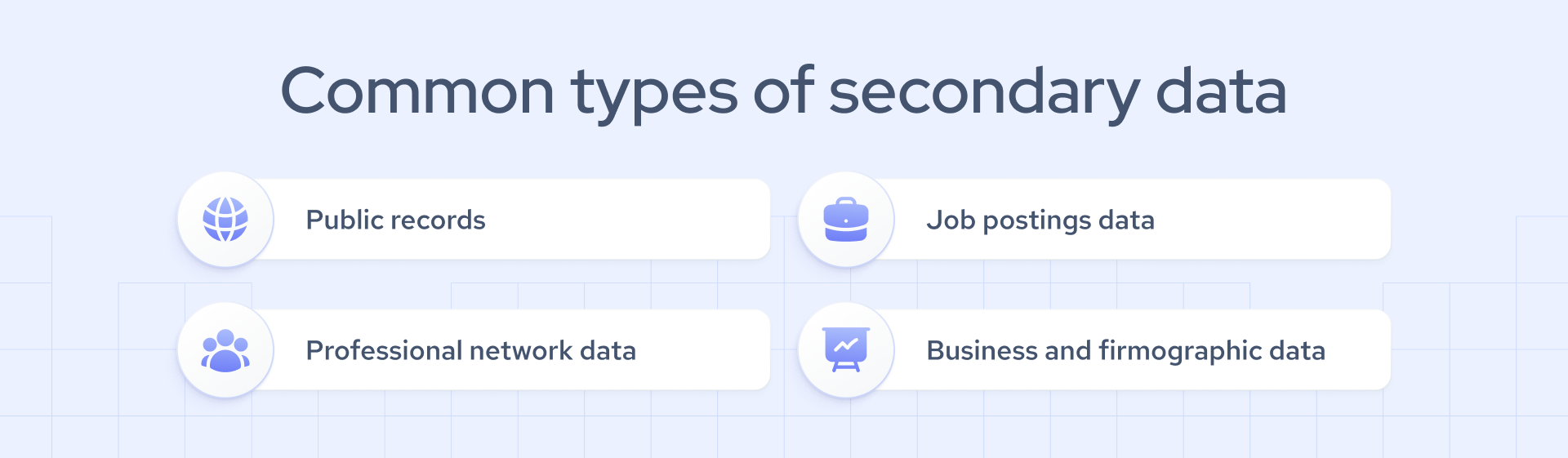
External data sources come from outside the organization. Common examples include government statistics and databases, academic research, industry reports, commercial data providers, and public web data, such as company websites, job postings, and other publicly available online information. These sources can support secondary data analysis across use cases ranging from market research and competitor analysis to investment intelligence and lead generation.
How secondary data analysis works
Secondary data analysis follows a structured process that helps organizations extract meaningful insights from existing information. The first step is to define the research goal and determine the questions the analysis should answer. Once the objective is clear, researchers identify relevant secondary data sources that align with the business need, whether internal records, public datasets, industry reports, or commercial data providers.
After gathering the data, it’s important to evaluate its quality by assessing factors such as accuracy, completeness, relevance, and timeliness. The selected data is then cleaned, structured, and, when necessary, enriched to improve usability and support more robust analysis. Researchers can then analyze the information, validate their findings against the original research objectives, and identify actionable insights. Finally, these insights are applied to business decisions, helping organizations improve strategies, uncover opportunities, and make more informed choices.
Secondary data examples
Secondary data examples can vary depending on the research objective, industry, and specific use case. The same dataset may serve different purposes across organizations, from informing strategic decisions to supporting operational improvements. As mentioned previously, in business research, secondary data examples typically fall into two categories: internal and external data.
- Internal secondary data examples: sales records, CRM data, customer support interactions, website analytics, financial statements, employee surveys, and operational reports. Although these datasets originate within the organization, they qualify as secondary data when reused for purposes other than those for which they were initially collected. For example, customer support data may be analyzed to identify product improvement opportunities or emerging market trends.
- External secondary data examples: government statistics, census data, academic publications, industry reports, competitor websites, company filings, public web data, and datasets provided by commercial data vendors. Businesses often use these secondary data examples to conduct market research, monitor competitors, identify potential leads, evaluate investment opportunities, or analyze broader economic and workforce trends.
How to evaluate the quality of secondary data
Before using secondary data, assess its quality to ensure it is suitable for your research or business objectives. Consider the following factors:
- Relevance. Does the data answer your research question and match the scope, industry, geography, or audience you are analyzing?
- Source credibility. Was the data published by a trusted organization, government agency, academic institution, or reputable commercial provider?
- Data freshness. Is the information current enough for your use case? In fast-changing industries, working with frequently updated datasets, such as real-time company, employee, and job market data from providers like Coresignal, helps ensure your analysis reflects current market conditions.
- Collection methodology. How was the data originally collected, and is the methodology reliable, transparent, and appropriate for your needs?
Advantages of secondary research
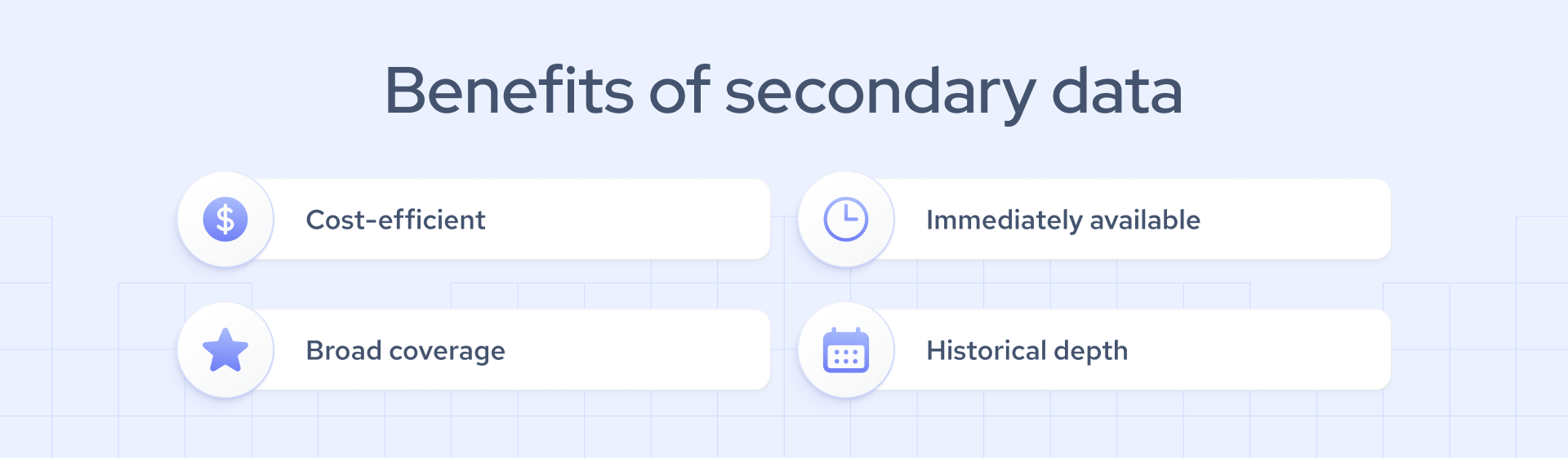
The advantages of secondary data make it an essential resource for business decision-making, market research, and academic research. Because the information has already been collected, organizations can answer research questions more quickly and at a lower cost than with primary research. Below are some of the main advantages of secondary data.
Saves time and effort
One of the biggest advantages of secondary data is that it is immediately available for analysis. Instead of designing surveys or conducting interviews, researchers can focus on interpreting existing information and generating insights. This significantly reduces the time needed to complete a project.
Cost-effective
Secondary data is generally much less expensive than collecting primary data. Government databases, public records, academic publications, and B2B data providers offer access to large amounts of information without the costs associated with surveys, field research, or experiments. Even paid datasets are often more economical than conducting original research.
The large volume of data
There’s only so much primary data that researchers can collect before having to start the actual analysis. With secondary data, there’s no such limit. There is more information available in secondary sources than one could handle in a lifetime of data analysis. Thus, secondary data researchers certainly don’t have many restrictions on what sources to choose from.
Ready for analysis
Many secondary datasets have already been cleaned, standardized, or structured, reducing the amount of preparation required before analysis. Although some processing may still be necessary, researchers can often spend more time generating insights and less time preparing data. Working with clean data also helps improve data quality, consistency, and the reliability of research findings.
Supports better decision-making
The importance of secondary data extends beyond saving time and money. Businesses use secondary data to validate assumptions, monitor competitors, identify market opportunities, and support strategic planning with evidence-based insights before investing in primary research.
Disadvantages of secondary research
Despite its many benefits, secondary research also has limitations that organizations should consider. Understanding these challenges helps companies evaluate whether secondary data alone is sufficient or if additional primary research is needed.
Differing requirements
The biggest among the disadvantages of secondary data research is that one can’t quite be sure that the data will suit the goals of the research exactly. Primary data analysts can gather exactly what they need. Secondary researchers, on the other hand, work with what they were able to find from what is available.
Control over the collection process
Secondary data analysts can’t be completely sure that the data was collected according to rigorous standards and therefore is valid and representative. They may check the source and try to find out as much about the collection as possible, but there will always be a degree of uncertainty.
Lacking uniqueness
Since secondary data sources are often accessible to multiple organizations, competitors may rely on similar information when conducting research. While unique insights can still emerge through different analytical approaches and dataset combinations, secondary data alone may provide less exclusivity than proprietary primary data collected specifically for an organization's needs.
Five metrics for evaluating and analyzing secondary data
Evaluating secondary data is an essential step before starting any analysis. While researchers cannot control how the data was originally collected, they can assess whether it is reliable, relevant, and suitable for their research objectives.
- Reliability of the source. Is the data published by a trustworthy organization, reputable data provider, or established institution? Understanding who collected the data and how it was gathered helps determine whether it can be trusted.
- Relevance. Even high-quality data has limited value if it doesn't answer your research question. Before selecting a dataset, define your objectives and ensure the information aligns with your industry, audience, geography, or timeframe.
- Overall quality. Assess the data for errors, inconsistencies, duplicates, or missing values that could affect your analysis. According to Gartner, poor data quality costs organizations an average of $12.9 million annually, highlighting the importance of using accurate and well-maintained datasets.
- Freshness. When was the data last updated? Outdated information may no longer reflect current market conditions or answer your research question. Working with frequently updated datasets, such as real-time company, employee, and job market data, helps reduce this risk.
- Accessibility. Consider how easily the data can be accessed and integrated into your workflows. Whether you're using datasets, APIs, or AI agents, flexible access makes it easier to automate research and turn secondary data into actionable insights.
The importance of secondary data analysis in business
For years business heads and data analysts have been lamenting the fact that most data never get to be analyzed. For example, a few years ago, it was estimated that only about 32% of all data is ever analyzed and utilized.
Having this in mind, one can’t help but wonder whether it’s worth spending money on additional data production when so much existing data never gets used. Of course, primary research is often necessary, for example, when new qualitative data is required, but it is equally important not to overlook the potential of secondary data.
Especially when it comes to secondary quantitative data, the large volumes of public web data already available would suggest first going for secondary research. Thus, combining the two research methods is the surest way for businesses to benefit from data analysis.
The value of secondary data also depends on its freshness. Markets, workforce trends, company information, and consumer behavior can change quickly, making outdated data less useful for decision-making. Using regularly updated secondary data sources helps businesses base their analyses on current conditions and generate more relevant insights.
Wrapping up
Researchers can either collect new data for analysis or get secondary data from some of the many diverse sources. Whichever path is chosen, the key to success and business benefits is, as always, attention to data quality and choosing the right method for the right goals.


