


B2B data has a reputation for being a competitive advantage – and it is, once it's actually usable. Making it so is a different story.
Before a sales team can prioritize accounts, an AI model can be trained, and a market intelligence analyst can spot a trend, someone has to collect the raw data, clean it, deduplicate overlapping records, normalize inconsistent formats, and keep the whole pipeline from breaking when an upstream source changes. That work falls on data engineering, and it's rarely as straightforward as it sounds.
This article breaks down where that engineering overhead actually comes from and how production-ready, multi-source B2B data can shorten the path from data access to insight – for technical teams and non-technical users alike.
Why B2B data projects often require more engineering resources than expected
Working with a B2B data API is rarely as simple as connecting to a source and querying what you need. In practice, most organizations underestimate how much engineering work sits between raw data and something usable, and that gap tends to grow as data volume, source count, and downstream use cases increase. Here is where that overhead typically comes from.
Raw data is rarely ready for immediate use
Data collected from public web sources or assembled from multiple providers almost never arrives in a state that is immediately usable. Fields are inconsistently named or structured across sources. Records overlap, with the same company or person appearing multiple times with slightly different attributes. Values are missing where contextual search failed or sources simply did not publish them. Formats vary – dates, company sizes, location strings, and job titles rarely follow a consistent convention without deliberate normalization. Profiles go stale as people change roles and companies evolve. And entity structures are often unclear, making it difficult to reliably link a subsidiary to its parent or a job posting to the correct employer.
Each of these issues requires engineering time to diagnose and resolve, and they compound quickly when data is coming from more than one source.
Data access is only the first step
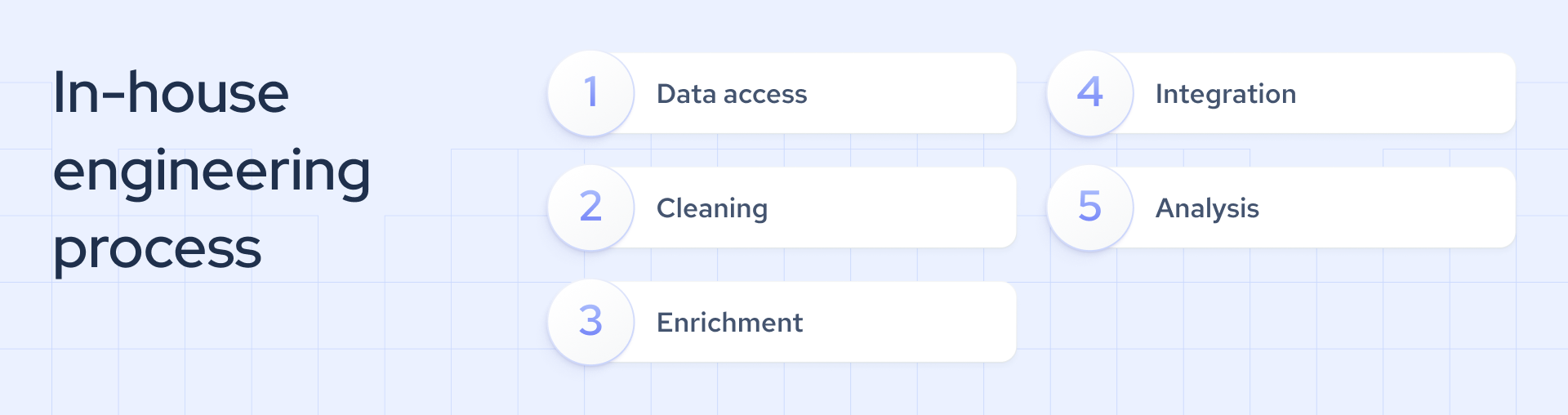
Getting data is not the same as being able to use it. Once access is established, engineering teams typically work through a sequence of steps before any analysis is possible: cleaning out noise and invalid records, normalizing inconsistent fields, enriching incomplete profiles, matching entities across sources, and integrating the result into existing systems. Only after that pipeline is stable can analysts and business teams start extracting insight.
Each step takes time, introduces potential failure points, and requires ongoing maintenance as upstream data changes. The further a team is from production-ready data at the point of access, the more of that work falls on engineering.
Maintenance becomes an ongoing engineering cost
Building a working data pipeline is not a one-time project. Sources change their structure without notice, breaking ingestion logic that worked fine the week before. Schemas need updating as new fields are added or deprecated. Deduplication rules that handled last month's data may not account for edge cases in this month's. And data freshness requires continuous monitoring – stale records that go undetected can quietly corrupt downstream models, scores, and decisions.
This means engineering resources are not just spent once at setup. They are drawn on continuously, often pulling attention away from higher-value work every time something upstream shifts.
The hidden data engineering work behind B2B data pipelines
Most conversations about B2B data focus on what the data contains. Less attention goes to the engineering infrastructure. The work behind a functional pipeline spans several distinct areas, each with its own complexity:
- Data collection and source management. Collecting B2B data at scale means managing connections to public web sources, professional networks, job boards, and company registries simultaneously – each with its own structure, availability, and failure modes. Building and maintaining those connectors, handling rate limits, and monitoring for disruptions is a continuous operational burden.
- Data cleaning and normalization. Company names, job titles, location strings, and industry classifications vary widely across sources. Invalid records and malformed fields introduced during collection need to be identified and removed. This work is largely invisible to end users but consumes substantial engineering time.
- Entity matching and enrichment. Identifying that two records refer to the same company or person – across different sources, spellings, or time periods – is one of the more technically demanding problems in B2B data work. Enrichment adds a further layer: pulling in additional signals to fill gaps that no single source covers completely.
- Data freshness and update logic. People change jobs, companies grow or contract, job postings open and close. Keeping data current requires update logic that detects changes at the record level and delivers them efficiently, without requiring a full dataset re-download each time something changes.
- Delivery formats and integration work. Different downstream systems expect different formats – JSON, CSV, Parquet, JSONL – and different delivery mechanisms, whether APIs, webhooks, or cloud storage. Mapping data to the schema a system expects, and keeping that mapping current as both sides evolve, adds another layer of ongoing effort.
What defines high-quality, ready-to-use B2B data
The difference between raw, fragmented data and production-ready data is not just a matter of completeness – it determines how much engineering work is required before the data can support any real use case. Understanding what separates high-quality, ready-to-use B2B data from everything else is the starting point for reducing that overhead.
Aggregated from multiple public sources
No single source captures the full picture of a company or professional. Multi-source data addresses this issue by combining signals from across the public web into a single, unified view of each entity – broader coverage, richer context per record, and resilience against gaps or disruptions in any one source.
For teams building on top of B2B data, this matters because the quality of downstream decisions is only as good as the completeness of the underlying records. An AI agent fed incomplete entity profiles will fill those gaps with inference, which is where hallucinations begin.
Cleaned and normalized for immediate use
Production-ready B2B data arrives with the foundational preprocessing already done. Field inconsistencies are resolved, invalid records removed, and values standardized across sources, so company names, job titles, locations, and industry classifications follow a consistent structure regardless of where the underlying data originated.
For data engineering teams, this means not having to build cleaning and normalization logic from scratch before any other work can begin. The pipeline starts further downstream, closer to the use case, rather than at the raw collection stage.
Enriched with business context
Raw records become genuinely useful when they carry context beyond basic identifiers. Production-ready B2B data is enriched with the signals that support real business decisions:
- Firmographics such as company size, industry, and location
- Technographics showing which tools and platforms a company uses
- Employee data and organizational structure
- Job postings and hiring signals that reveal where a company is investing
- Broader growth and market indicators that show how an entity is changing over time
This enrichment layer is what separates a contact list from actionable intelligence, and building it independently, across multiple sources, is one of the more resource-intensive parts of any data engineering project.
Delivered in formats that fit engineering workflows
Even the cleanest, most enriched dataset creates friction if it arrives in the wrong format or through the wrong channel. Production-ready B2B data should adapt to how engineering teams actually work, not the other way around.
That means availability across multiple delivery options: REST APIs for programmatic access, bulk datasets for large-scale ingestion, and structured file formats including CSV, JSON, JSONL, and Parquet. One example is the Coresignal Databricks integration, which lets datasets be delivered to cloud storage and then loaded into Databricks for analytics, enrichment, or machine learning workloads. For teams building event-driven architectures, signal delivery allows updates to flow automatically as underlying data changes, without polling or scheduled re-downloads. For non-technical users, a self-service platform provides direct data access without requiring API setup or any engineering involvement.
Native integrations reduce the gap further for teams that want to connect B2B data to existing tools without writing custom connectors. The Coresignal n8n integration is a good example of this, connecting live B2B data directly into automated workflows. Depending on the use case, there are also several popular ways to use the Coresignal integration that cover common pipeline and enrichment scenarios.
How simplified data access helps non-technical teams use B2B data
Non-technical teams are often the primary consumers of B2B data insights but rarely the ones who can access the data directly. Raw APIs require authentication and schema knowledge. Extracting a useful segment may mean writing SQL or Python. When something is unclear, a request goes to engineering, and then everyone waits.
Simplified access does not mean eliminating technical depth. It means giving different users an appropriate entry point: a self-service platform with clear filters, natural language search, API playgrounds for exploring data interactively, and ready-to-use export formats. The use cases that benefit most are those where the primary task is finding and evaluating data – identifying the right segment, checking quality, or testing a use case before involving engineering at all.
Coresignal supports this across the full range. Non-technical users can query data in natural language through the AI data search or explore it via the self-service platform. Teams building workflows can use API playgrounds, native integrations, or the agentic search API to connect AI agents directly to live B2B data with minimal setup.
Simplified data access: from API to natural language search
The right access method depends on who is using the data and what they are trying to do.
Self-service platforms for faster data discovery
A self-service platform lets users browse, filter, and export data without writing a single line of code. For business teams, it removes the dependency on engineering for exploratory work. For data teams, it speeds up the initial scoping phase before a full pipeline is built.
API playgrounds for faster technical evaluation
API playgrounds allow developers and data engineers to test queries interactively before committing to an integration. Rather than building a connection to discover what the data actually looks like, teams can validate coverage, field structure, and query logic in a live environment first.
Native integrations for operational workflows
Pre-built integrations with tools like n8n allow B2B data to flow into existing workflows without custom connector development. This is particularly useful for teams that need data as part of a broader automated process rather than as a standalone dataset.
AI data search for non-technical users
Natural language search removes the need to understand query syntax or data schema. Users can describe what they are looking for in plain terms and receive structured results, making B2B data accessible to analysts, sales teams, and researchers who would otherwise depend on engineering support.
Agentic Search API for AI agents
The agentic search API connects AI agents directly to live B2B data using natural language queries, with minimal setup and no data pipeline required. For teams building autonomous AI workflows, it removes one of the most common bottlenecks: getting structured, reliable data into an agent's context in real time.

How to evaluate B2B data providers by engineering effort
Choosing a B2B data provider is not just a question of coverage and price. The provider you choose determines how much engineering work your team inherits. These are the five areas worth examining before committing.
- Preprocessing requirements. How much work does the data need before it is usable? Check whether records are already cleaned, fields are normalized across sources, duplicates are resolved, and entity matching is handled by the provider. The more of this that arrives done, the less your team builds from scratch.
- Data freshness. How often is the data updated, and is historical data available? For most B2B use cases, both matter – current data for operational workflows, historical data for trend analysis and model training. Check whether changes can be tracked at the record level over time.
- Access flexibility. A solid provider supports multiple access methods: API access for programmatic use, bulk datasets for large-scale ingestion, standard file formats such as CSV, JSON, and Parquet, and an API playground for testing queries before committing to an integration. Self-service access is a further signal that the provider has invested in usability, not just raw data delivery.
- Accessibility for both technical and non-technical teams. Can business users find and evaluate data without filing a request to engineering? Can data engineers still access the full depth of the data when they need it? The best providers support both, allowing teams to start with simplified access and move to API-based workflows as use cases mature.
- Ongoing maintenance ownership. This is the most underestimated factor. Does the provider monitor sources and handle structural changes, or does that fall to your team? How stable is the schema? Is documentation kept current? Support availability and schema stability directly affect how much of your engineering capacity goes toward keeping existing pipelines alive rather than building new ones.
Build vs buy: should you engineer your own B2B data pipeline?
At some point, most teams working with B2B data face a version of the same decision: build a custom data pipeline from scratch, or source production-ready data from an external provider. Both paths have legitimate use cases, so below is a breakdown of each.
When building internal data pipelines makes sense
Building internally is worth considering when data requirements are specific enough that no external provider can meet them – proprietary data sources, highly customized schema requirements, or use cases that depend on collection logic only an internal team can implement. It also makes sense when full control over infrastructure is a hard requirement, whether for compliance, security, or architectural reasons.
For organizations with a large data engineering team and the ongoing capacity to build and maintain a pipeline, the investment can pay off over time. The key word is capacity – not just to build, but to maintain as sources change and requirements evolve.
When buying production-ready data makes more sense
For most organizations working with B2B data, sourcing from a production-ready provider is the faster and more resource-efficient path. It is worth considering when time-to-value matters: when the goal is to reach insight or build a working use case quickly rather than spend months on infrastructure. Teams without dedicated data engineering capacity benefit most, since building and maintaining a multi-source pipeline is a significant ongoing commitment rather than a one-time project.
Buying also makes sense when the required data spans multiple public sources and the engineering effort of aggregating, cleaning, and deduplicating across them would be substantial. For use cases where data freshness is critical, relying on a provider that handles source monitoring and update logic removes an entire category of maintenance work. And when the priority is validating a use case before committing to infrastructure, production-ready data allows teams to test quickly without building first.
The hybrid model: APIs, datasets, integrations, and no-code tools
The build vs buy framing is rarely binary in practice. Most organizations end up somewhere in between: sourcing production-ready data from an external provider and integrating it into their own workflows, systems, and internal infrastructure.
A team might consume data through an API for real-time enrichment, pull bulk datasets for model training, and give business users self-service access for exploratory work – all from the same source, without maintaining a scraping or processing pipeline of their own. Buy the infrastructure, own the application.
How Coresignal reduces data engineering overhead
The engineering overhead described throughout this article – source management, cleaning, normalization, entity matching, enrichment, freshness, delivery – is work that Coresignal handles before data reaches the customer.
Coresignal aggregates company, employee, and jobs data from multiple public web sources into a single, unified dataset. Records are cleaned, deduplicated, and enriched with business context including firmographics, technographics, hiring signals, and employee movement. Historical data is available alongside fresh records, and updates flow at the record level rather than requiring full dataset refreshes.
On the access side, the same data is available through REST APIs, bulk datasets, standard file formats, native integrations, a self-service platform, and natural language search. So, both technical and non-technical teams can work with it without additional tooling or custom connectors.
The practical outcome is a shorter path from data access to usable insight, and less engineering time spent on infrastructure that is not core to the product.
Conclusion: the best B2B data strategy reduces engineering work, not insight quality
The assumption that high-quality B2B data requires significant engineering investment to unlock is fairly reasonable. It just matters where that preprocessing work happens. When it happens inside the provider, engineering teams inherit clean, enriched, production-ready data instead of a raw collection problem.
That shift has practical consequences across the organization. Non-technical teams get faster access to the data they need without depending on engineering queues. Data engineers can focus on building products, models, and automation rather than maintaining pipelines. And organizations can move from data access to actionable insight without the overhead that typically sits in between.
Coresignal is built around this model – aggregated, cleaned, and enriched B2B data delivered through access methods that fit how different teams actually work, so the path from data to insight is as short as possible.


