Fresh, accurate data often makes the difference between businesses that successfully navigate their markets and those that fail due to poor results. IBM’s survey, cited in the Harvard Business Review article, shows that U.S. businesses lose over $3.1 trillion in annual revenue due to bad data alone.
Even though been a while since this survey was conducted, but as someone working in the field, I can assure you that things have only gotten worse.
For that reason, in 2026, freshness is everything, and companies with access to a real-time data API platform are bound to outperform those who focus on speculative opinions. Still, there’s a fine line between real-time B2B data APIs and fresh data, and I intend to clear up the distinction for you in this guide.
The cost of B2B data decay
Data freshness plays a crucial role in pinpointing a company’s growth and hiring signals. I’ve seen numerous businesses use this for competitor research, and that’s where accurate B2B data comes in handy.
It’s just how modern-day business works: instead of conducting customer surveys and analyzing trends manually, they use public B2B data for sales intelligence, recruiting, market research, and investment analysis.
If the data is stale and incorrect, it sends mixed signals and often leads to bad business decisions that simply don’t cut it anymore. The same goes for AI model training, which also depends on data freshness. Here are several issues that would arise along the way:
- Loss of revenue from targeting the wrong companies or reaching out at the wrong time
- Missed opportunities when fresh hiring, expansion, or funding signals go unnoticed
- Wasted sales and marketing spend on outdated contacts, poor-fit leads, and mistimed campaigns
- Inefficient recruiting efforts caused by inaccurate company and hiring data
- Flawed market research that leads to weak assumptions and poor strategic planning
- Misguided investment decisions based on stale or incomplete business signals
- Lower AI model quality when training data is outdated, inconsistent, or unreliable
- Reduced competitive awareness when teams fail to spot important shifts in the market early
What is data freshness? Continuous updates matter the most
This term refers to continuously updated data with frequent changes, and I mean "frequent" quite literally, as the best data platforms will freshen up their datasets on am hourly or daily basis. As new records are added, old inputs are validated and, when necessary, removed.
Outdated data, on the other hand, is updated with much lower frequency, and this is especially harmful for businesses focusing their strategy on real-time job postings, employee role updates, and company profile changes.
Think of it this way: if an employer fails to remove a job ad after the position gets filled, you have no use for it, even if you’re a top applicant. The same applies to B2B data freshness: if existing information is outdated, any sales, marketing, and outreach strategy based on such parameters is doomed to fail.
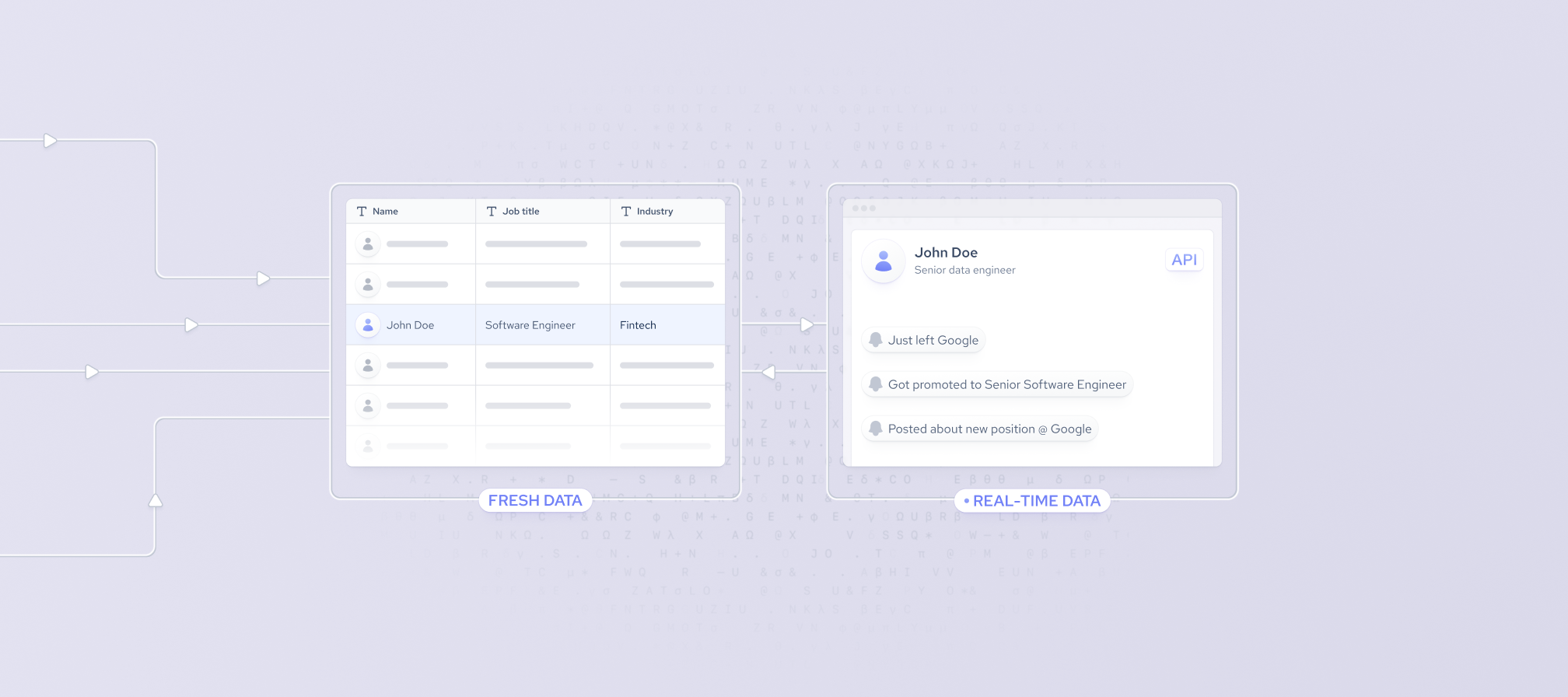
That’s why data companies that can offer real-time data APIs with historical records make the perfect middle ground. Users can still receive the freshest data out there, but also get to compare it with trends and changes over time.
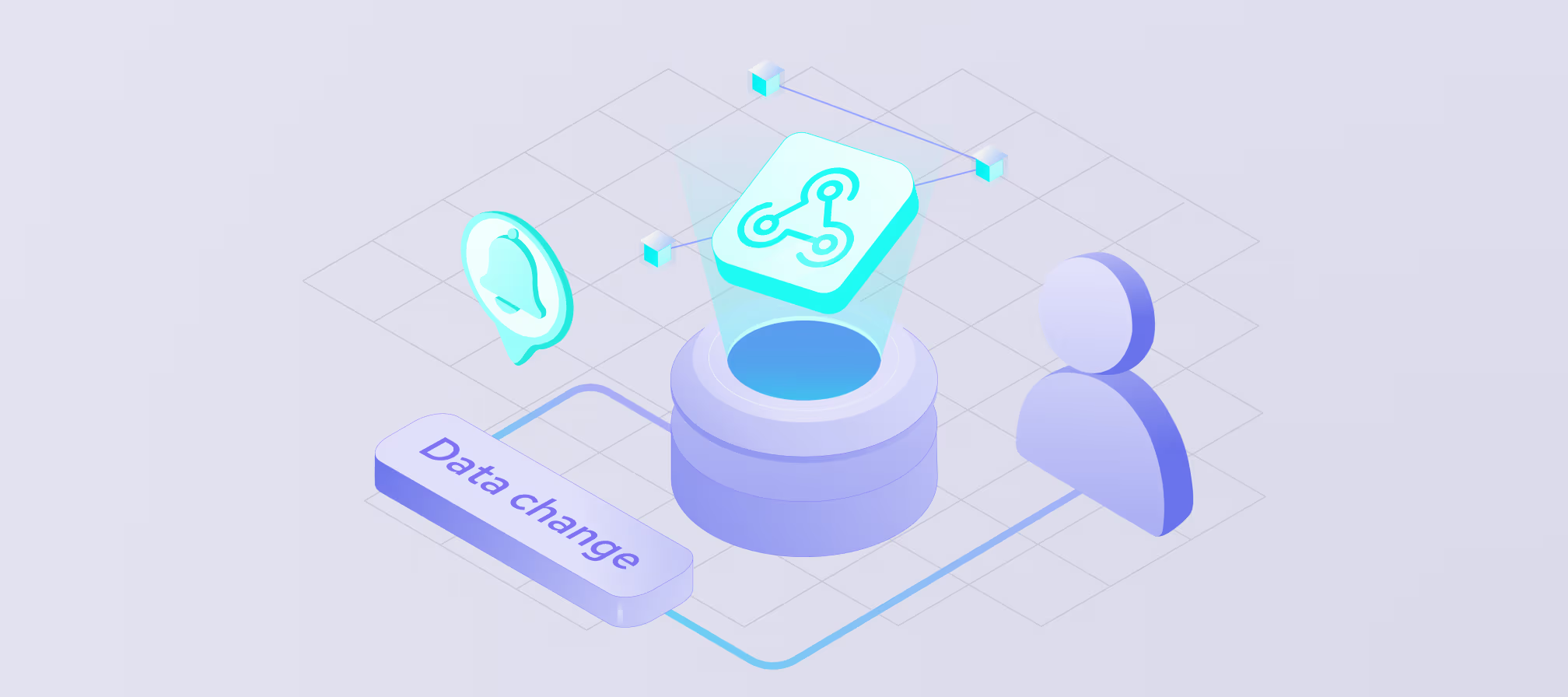
Brands like Coresignal also use webhooks for instant notifications when something changes, so you don’t have to search the API manually looking for updates.
What is real-time data? Every second counts
Most businesses change staff and venture into new markets on a daily basis, and real-time data keeps up with that. Data companies pull the current information from real-time databases via APIs, event tracking, and webhooks for notifications.
According to Gartner's 2026 data and analytics predictions, generative AI and automated agents are predicted to cause a major shift in business productivity by next year. For such systems to operate efficiently, they need to be fed real-time data, and every second matters here.
Here’s an example: imagine two companies crafting their marketing strategies based on the current trends shown through data. The first one uses a real time API from a renowned provider, while the second one doesn't fetch current data and relies on information collected several weeks ago. Who do you think is more likely to succeed?
Of course, I’ve seen cases where this didn't make that big of a difference, but taking that risk can cost your business a lot as the competition goes ahead.
With Coresignal’s real time data API, data change responses have an average time of just 176 ms, so your workflow always gets fed the latest information.
When to use fresh data vs real-time data
With years of experience in the data industry, I’d say that the combination of starting out with fresh datasets and using real-time data APIs for updates works wonders for most companies. Still, most vendors focus on either data freshness or real-time updates.
It’s not necessarily a bad thing, as it at least helps you pick a suitable provider. Fresh datasets are best for market research and AI model training, as well as investment research based on headcount tracking.
Real-time data APIs are valuable for setting up sales alerts triggered by sudden shifts like staff changes and funding updates. I’d recommend it as the best option for competitor monitoring and lead scoring systems.
Think of it this way: fresh datasets sets the foundation, while real-time APIs fill the gaps in it by capturing signals the moment they appear. When possible, I’d definitely recommend using both.
Real-time B2B data providers comparison
Many providers offer fresh B2B datasets or real-time APIs, but a select few offer both. Coresignal is one of them, with continuously updated datasets at scale. Here’s how the most valuable data providers stack up in this context:
How real-time and fresh data work together
Not even the most responsive real time data API can give you a complete picture without building the baseline with fresh datasets. Coresignal is a prime example of a data provider offering the best of both worlds, with a responsive API layout, notifications via webhooks, and historical data records.
I’d also highlight multi-source data here, as our datasets contain records with hundreds of data fields, combined from multiple integrated sources.
Real-time B2B data APIs from Coresignal
Our real time API uses real-time employee scraping API that fetches data in just around 176 ms, which is an industry-leading number. Instant webhook notifications for field-level changes provide swift updates whenever employee roles change, while historical records spanning up to 9 years serve as an ideal basis for comparison.
You can download large datasets in bulk with just a few clicks, exported in AI-ready formats like Parquet and JSON for easy integration with your existing workflow systems.
Fresh B2B datasets for companies, employees, and jobs
Coresignal’s fresh business data records are pulled from a massive database of over 4.5 billion company, employee, job posting, and other records. Multi-sourced datasets are deduplicated and ready for use, with 300+ data fields for professional profiles and 500+ data fields for company profiles.
Naturally, teams working in tech, HR, sales intelligence, and AI need a regular flow of hiring signals. In my experience, major workforce changes happen overnight, and it’s crucial that your team makes split-second decisions based on conveniently packaged datasets ready for integration.
Why it’s best to combine both fresh datasets and real-time data APIs
The fresh vs real time data discussion makes it seem almost as if you need to choose either one or the other. In reality, combining both is the right way to go, and data vendors like Coresignal readily offer real-time APIs with instant responsiveness and constantly updated B2B datasets to ensure data freshness.
The way I see it, you should use fresh data covering target markets as the foundation, while real-time data processing via APIs can be your business edge for capturing signals the moment they appear.
At Coresignal, we offer over 9 years of historical depth, so you don’t have to choose between one or the other and leave your business strategy open to blind spots.