



.webp)
Labor market data isn’t a newly developed concept. Government surveys and administrative records were established sources long before online job posting data became widely available.
In my work analyzing and compiling large-scale job posting data, I’m often asked whether modern datasets and APIs can replace traditional labor market statistics. The short answer is no; each serves a different user and purpose, and in this guide, I’ll walk you through the differences and help you draw a line between the two.
What are traditional labor market data sources?
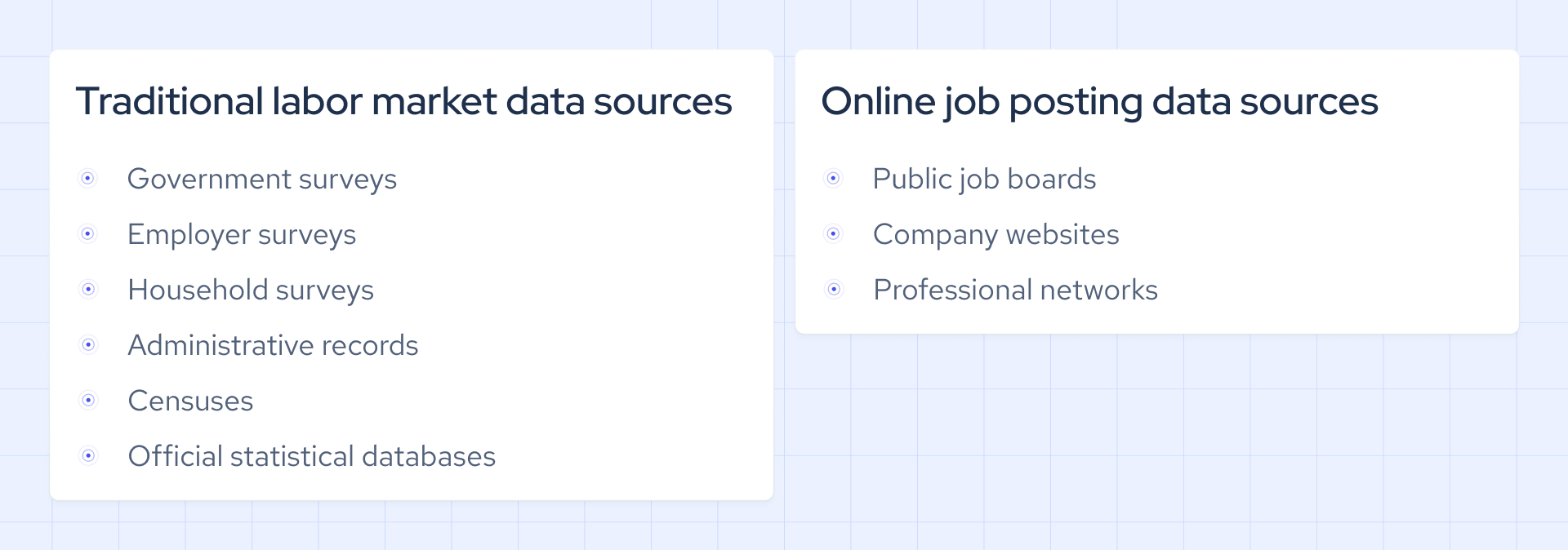
Traditional labor market data sources include official statistics compiled by government agencies. These include government, employer, and household surveys, as well as administrative records, censuses, and official statistical databases. Until recently, these sources were the sweet spot for labor market analysis.
The thing is that they only cover true labor market trends up to a certain point. Think of it this way: traditional labor market sources mainly cover existing parameters, such as who is employed and where, as well as overall statistics like unemployment rates.
On the other hand, job market data reveals the direction in which the market is heading. It provides information on in-demand skills and current hiring demand.
When faced with the question of which gives more value to the user, I tend to consider both necessary. Beyond the differences I’ve explained above, it’s also important to note that labor market data is compiled from official sources like government agencies, statistical records, and administrative records.
In the U.S., the Bureau of Labor Statistics (BLS) is a major official source. For the European Union, Eurostat is the statistical office. Eurostat offers a practical example of how the two sources can complement each other.
Alongside its traditional vacancy statistics, Eurostat uses online job advertisements with official vacancy and EU Labor Force Survey data to produce experimental occupational and regional estimates. The combined approach adds occupational and regional detail while still carrying coverage and representativeness limits.
What is online job posting data?
Job postings data is one type of labor market data derived from publicly advertised vacancies on job boards and company websites. It reflects the latest labor market news by showing who’s hiring, which skills are in high demand, and which roles employers are seeking to fill.
Depending on the posting, the data can include the job title, employer, location, required skills and qualifications, salary range, employment type, and posting date. It’s the most relevant type of information for current labor market analysis, especially when you use reliable sources and datasets aggregated from thousands of listings and ads.
Traditional labor market statistics vs online job posting data
I often get asked about the main differences between labor market data and online job posting data, and my answer is always the same: it’s all a matter of perspective.
Online job posting data shows current hiring demand, while traditional statistics describe broader labor market conditions and outcomes. Either way, I’ve summed up the main differences below to make it more convenient for you to scan:
When are traditional labor market statistics most useful?
I’ve always relied on traditional labor market data and statistics for market analysis.
This type of data is best for tracking employment (and unemployment) trends, wage growth, or demographic patterns. Of course, technology is evolving rapidly, so labor market data is now more refined and representative.
Labor force surveys’ broad population coverage and standardized methods make them useful for macro-level and historical analysis.
Then again, there is a fair share of limitations to account for, including:
- Slower updates due to publication cycles
- Limited for company-level, near-real-time hiring signals
- Less focus on skills and jobs in demand
- Heavy aggregation
When is online job posting data most useful?
Online posting jobs data is useful for tracking frequently updated hiring trends and signals. It gives you more information on current hiring changes and trends, even hinting at company-level hiring activity.
Official labor market data series follow fixed release schedules, which may be monthly, quarterly, or annual. Commercial job posting data can be refreshed daily or in real time.
Of course, the choice of data provider matters. For instance, Coresignal combines job postings from multiple public sources and deduplicates them into a consistent format.
Using multiple sources can broaden coverage, but source quality, record matching, and deduplication still matter. A job posting represents an advertised vacancy, not a completed hire, and online ads do not capture every vacancy in the labor market.
How can labor market data sources be combined in practice?
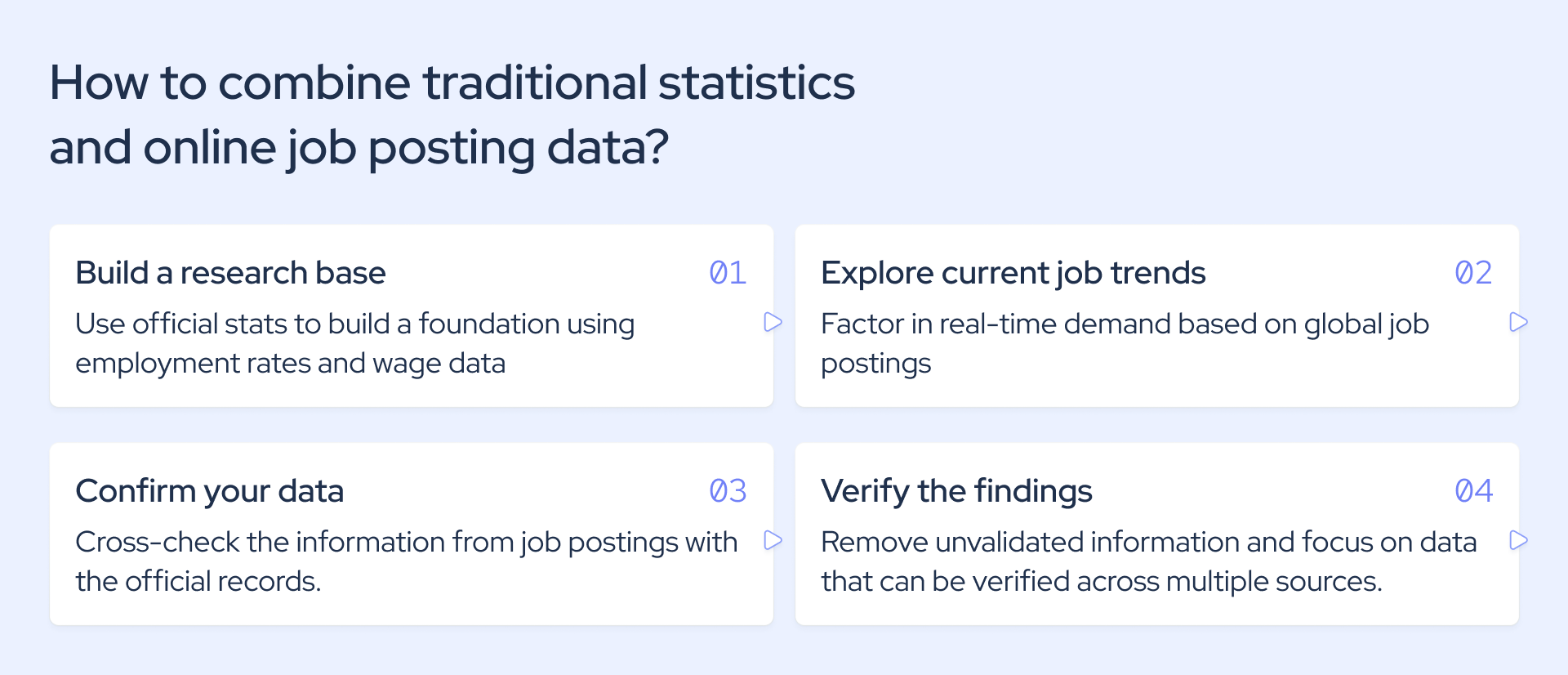
In my experience, single-source information doesn’t cut it for labor market analysis and research. Eurostat’s experimental statistics show how online job advertisements can complement official job market data with occupational and regional detail while still carrying coverage limits. Here’s how I would do it:
- Use official stats from the BLS, Eurostat, or ILOSTAT to build a research base on employment rates and wage trends.
- Factor in real-time demand based on individual job postings, showing which skills are in demand and which employers are actively hiring.
- Cross-check the information from job postings with the official records.
- Remove unvalidated information and focus on data that can be verified across multiple sources.
Specific datasets, such as employee data, can also add workforce context. This can reveal details such as employee tenure, workforce size, and hiring dynamics in a given region.
How can you access labor market data from job postings at scale?
Besides the validity of the data, where you’re getting it from is also very important. That’s why it’s crucial to choose a data provider that delivers labor market information in a structured, deduplicated format.
Coresignal’s Multi-Source Jobs API provides programmatic access to structured, deduplicated job posting data. The API can support real-time workflows that monitor hiring signals or supply current job posting data to AI systems.
For large-scale or historical analysis, the Multi-Source Jobs Dataset provides bulk access to active and historical job posting records.
When I’m tasked with studying hiring trends over time and salary benchmarking across industries, I always use bulk datasets. Both access options use structured, deduplicated data from multiple sources.
Final thoughts
Ultimately, the choice between traditional labor market data and job posting data depends on the research question. Each type serves a different role in market research and analysis.
The Multi-Source Jobs Dataset supports granular analysis of current hiring demand, while traditional labor market statistics remain useful for broader historical research. Together, they provide a strong foundation for up-to-date market insights, but it’s important to choose the right provider to ensure data quality.