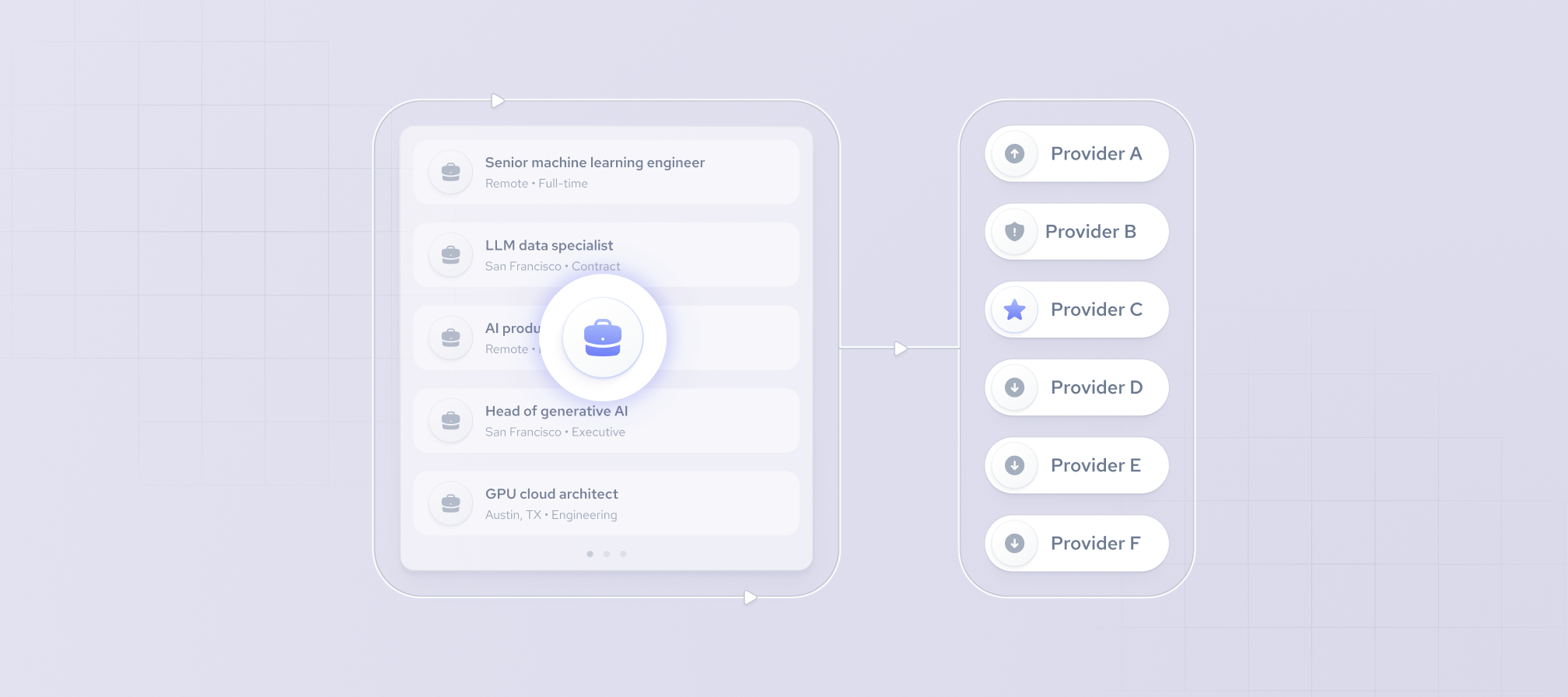



Two well-known data providers, Coresignal and ZoomInfo, serve very different use cases.
Coresignal offers fresh company, job, and employee data that your developers, product builders, and analysts can pipe into your system in real time. ZoomInfo, on the other hand, provides contact, firmographic, intent, and related datasets curated for sales, marketing, and RevOps teams.
The two also differ in data freshness, delivery models, API orientation, and other features. So, the question isn’t which provider is better overall, but rather which better fits your data needs, workflow, AI readiness, and use case.
Coresignal vs ZoomInfo: which one fits your workflow?
With digital channels accounting for 61.1% of total marketing spend in 2025, choosing the right data provider to maximize the impact of that spend is crucial. Below is a quick checklist to help you pick between Coresignal and ZoomInfo.
Choose Coresignal if you:
- Build AI models, custom pipelines, HR tech, analytics solutions, or enrichment workflows.
- Need company, job listings, or employee data via API or as flat files.
- Prioritize real-time, structured, and deduplicated data delivered straight into your systems.
- Need AI-ready data that is designed to be a building block for your product.
- Look for tools such as the Agentic Search API, n8n, or MCP integrations to help integrate B2B data into your product.
ZoomInfo, a Coresignal alternative, might be a better fit if you:
- Are looking for a GTM platform built for sales, marketing, and revenue operations.
- Need prospecting UI, intent data, CRM integrations, direct-dial phone numbers and emails, and workflows.
- Require a ready-made platform and do not need customization options
- Are after the whole pipeline, from contact discovery and account prioritization to buyer signals and sales execution.
What is Coresignal?
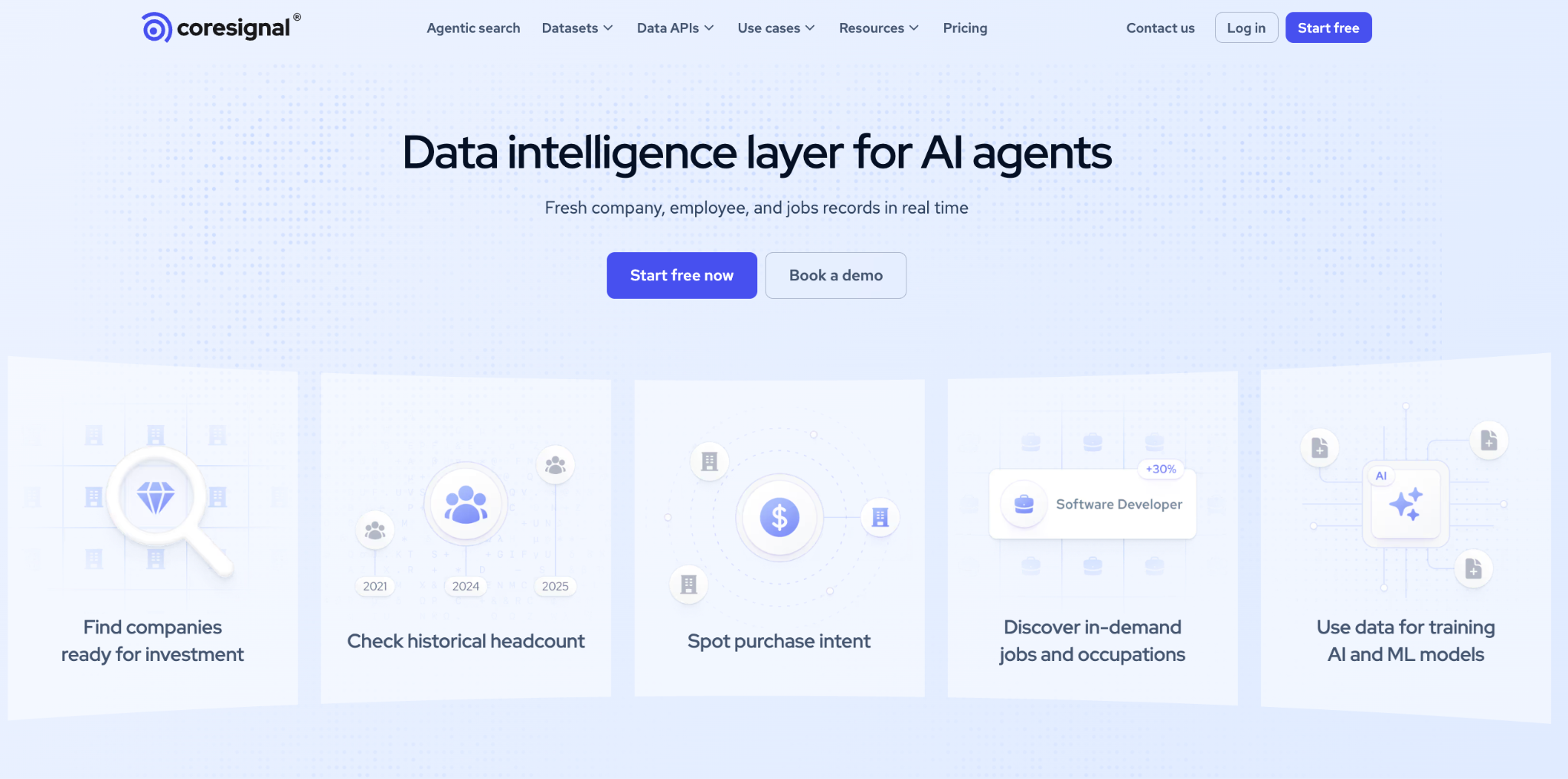
Coresignal is a public web data provider offering company, employee, and job posting data. Its customer base includes more than 1000 organizations working across AI search, HR tech, sales tech, investment research, market intelligence, lead enrichment, and workforce analytics.
As the Coresignal review explains, this provider structures, deduplicates, and enriches data before delivering it in JSON, JSONL, CSV, or Parquet formats, all multi-source. It also streamlines data integration by offering a self-service platform and data access through APIs, datasets, webhooks, an MCP server, and the Agentic Search API.
What is ZoomInfo?
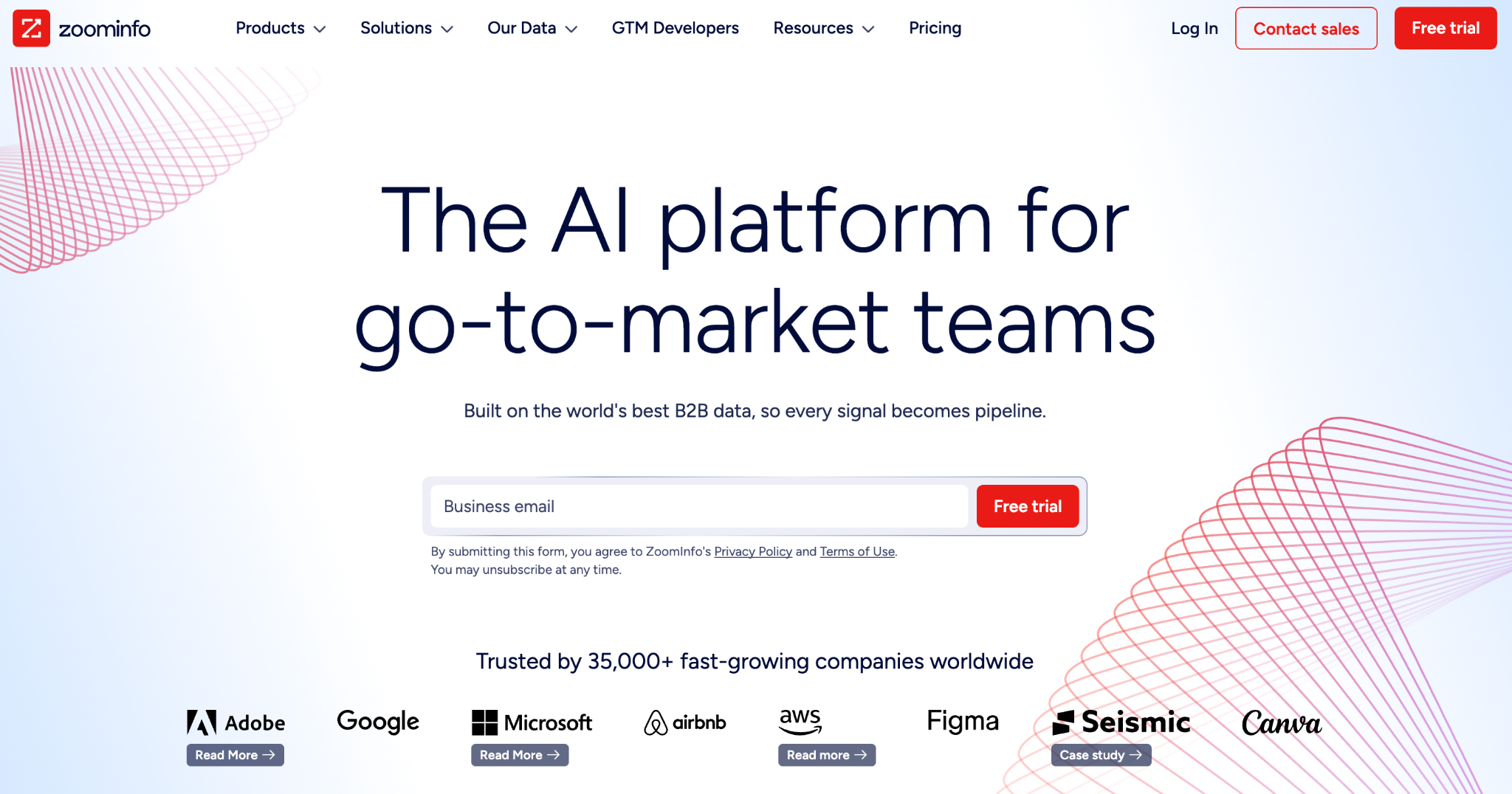
ZoomInfo is a go-to-market (GTM) and sales intelligence platform built to help sales, marketing, and RevOps teams find, engage, and retain customers.
As a data vendor, it provides access to B2B contact data with verified emails, direct dials, company insights, technographics, org charts, and buyer intent signals. It organizes all this data in a readily accessible UI, allowing sales reps to use it without technical knowledge.
ZoomInfo also integrates with CRM and sales tools, workflow support for sales and marketing operations, and API-based access for enrichment and automation use cases.
Coresignal vs ZoomInfo: side-by-side comparison
For a clearer understanding of both, the table below compares Coresignal vs ZoomInfo features.
Employee data API comparison
Both ZoomInfo and Coresignal offer APIs, but with different goals.
ZoomInfo’s APIs are designed to enrich and activate GTM data in sales and marketing workflows. As such, they fare well in lead generation, CRM data enhancement, outreach and targeting campaigns, as well as broader GTM automation.
Coresignal’s offerings go beyond the contact or employee API. The company caters to teams who want to build with structured B2B data at scale, whether that’s for employee profile enrichment, real-time lookups, bulk data retrieval, or powering AI and data products.
Additionally, Coresignal offers various other APIs, including company, jobs, historical headcount, and Agentic Search APIs.
API, MCP, and AI-agent readiness
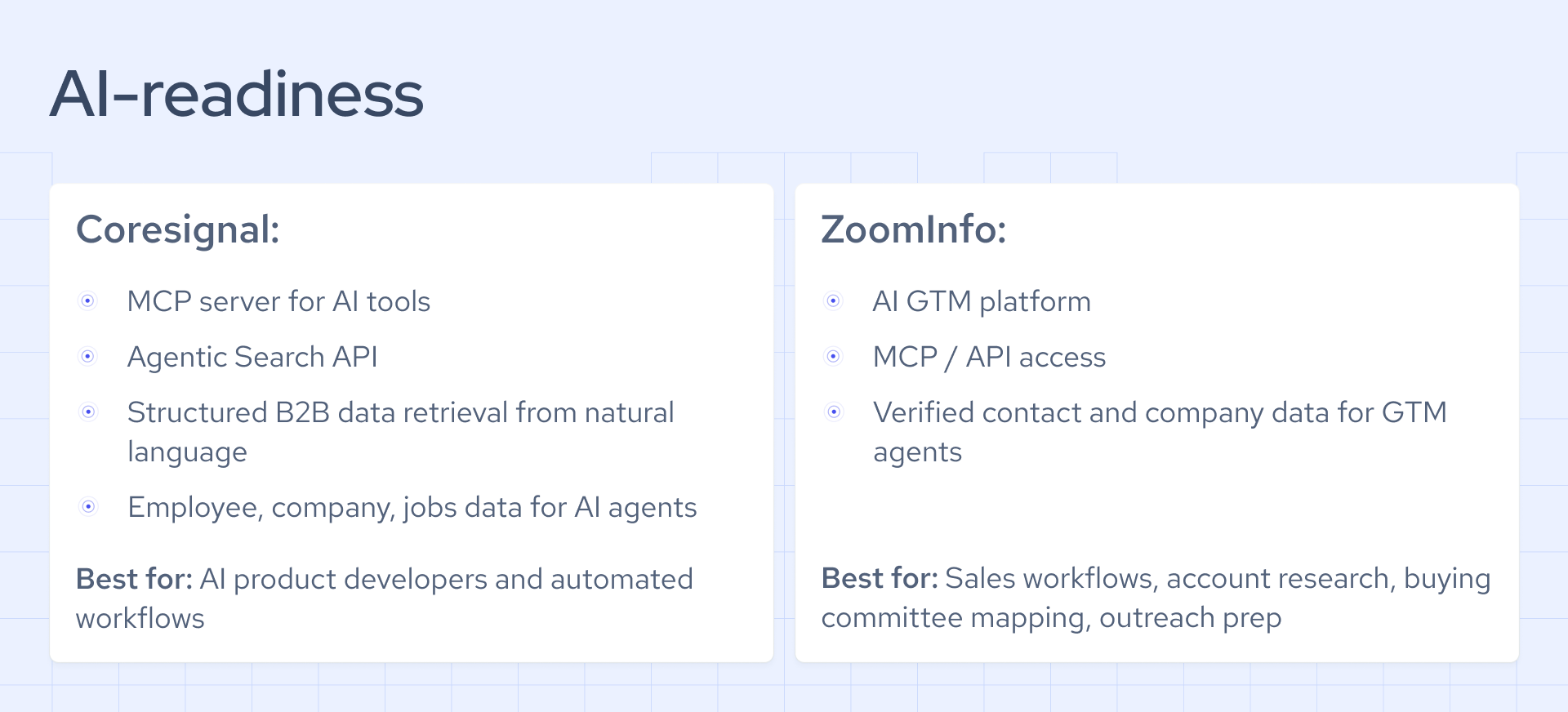
Research shows AI is only as good as the data it uses. AI agents perform far better when they’re working with structured datasets, like Coresignal’s B2B job, company, and employee data, because it’s easier to process, train on, and integrate.
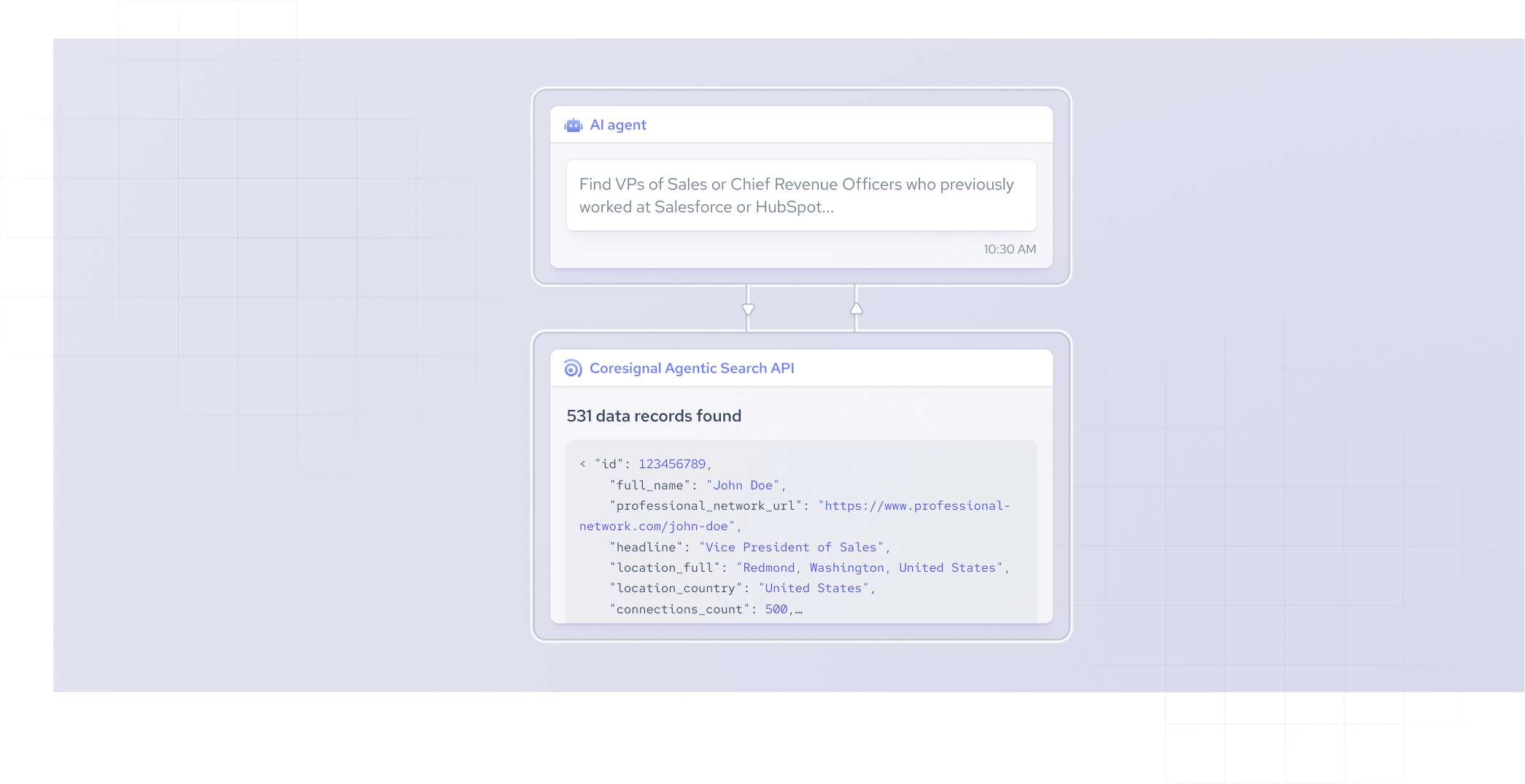
Coresignal’s MCP server and the Agentic Search API also make it AI-ready by design. They let users retrieve structured B2B data through natural language queries, making it easier to feed into AI agents and applications.
Both vendors support AI-driven workflows, but their focus differs.
Coresignal is better positioned as a data retrieval layer for AI agents, data products, and automated enrichment workflows. ZoomInfo is better positioned as a GTM intelligence layer for sales and marketing teams that need contact, company, intent, and technographic data inside prospecting and revenue workflows.
Fresh employee data vs real-time employee data
Another key difference in the Coresignal vs ZoomInfo comparison is data freshness.
ZoomInfo only offers fresh data that updates at set intervals. This setup makes it a good fit for bulk analysis or historical research, but not a real-time workflow.
If you also need access to ready-to-use data, Coresignal is a better choice. It offers real-time data via APIs, including the Real-time Employee API, so you always work with the most up-to-date information.
Use case comparison
Coresignal and ZoomInfo are designed for different use cases. Make the right choice early, and you’ll have your data stack support long-term growth without much rework.
Pricing and packaging considerations
ZoomInfo does not publish fixed plan prices in the same way Coresignal does. Its pricing is quote-based and depends on the team’s needs, package configuration, and business goals.
Coresignal is more transparent on its pricing page, listing a free option, paid API subscription plans starting from $49/month, and datasets starting from $1,000.
Limitations of each platform
Coresignal may not be the right fit if you need a rep-facing prospecting or outreach tool rather than API or dataset access.
Where ZoomInfo lags behind Coresignal is flexibility. Its platform-led approach has to align with your product or AI teams to deliver value.
Final verdict: choose based on how you use B2B data
Consider your needs, compare employee data providers, and make your choice.
If you are looking for a ready-made platform with contact data, CRM integrations, and rep-facing workflows, ZoomInfo is a decent Coresignal alternative.
However, Coresignal is the stronger fit if you are building your own AI products, HR tech tools or sales platforms and seek to leverage structured high quality employee, company, and job data.