The demand for reliable, fresh data has never been higher. Companies are pouring resources into various tools that promise to unlock it faster and at scale. But how well that data holds up once it’s in your pipeline is a different story.
The 2025 Institute for Business Value research shows that organizations are still dealing with data quality and integration challenges, even as adoption accelerates. That’s exactly where providers like Coresignal start to come into focus.
Coresignal has been making publicly available web data accessible to companies worldwide since 2016. In this review, I’ll explore its practices, use cases, features, and pricing to show what sets it apart in such a crowded market.
What is Coresignal?
Coresignal is a B2B data provider that collects real-time information covering companies, employees, and job postings from various public resources. Targeting sales teams, recruiters, and data analysts, it organizes this information into structured datasets that are easy for data teams, engineers, and AI builders to work with.
- Coresignal makes ready-to-use data accessible as flat files and through APIs
- It has a self-service platform that lets customers find relevant data records in seconds
- The company serves over 700 organizations worldwide across sales tech, market research, marketing, HR tech, and investment industries
- It’s a founding member of the Ethical Web Data Collection Initiative, which promotes responsible data collection practices
What data does Coresignal provide?
Coresignal provides three types of data: company, employee, and job data.
- Company data includes firmographics, contact information, locations, technographics, and information on workforce, funding, online presence, competitors, and products.
- Employee data includes detailed information about professionals’ business contacts, locations, experience, education, workplaces, salaries, and professional activities.
- Job postings data includes classic job information such as job description, employment type, and number of applicants, as well as location, salary, company, recruiter information, and any relevant metadata.
This data is organized into datasets so customers can easily sort through, analyze, and use it. This Coresignal company overview should give you a better understanding of its scope.
How can you access Coresignal’s data?
To simplify its integration, Coresignal’s customers can access data via APIs or as flat files.
- Coresignal API provides fast, ongoing access, ensuring you always get fresh information. You plug the API key into your system, and it pulls information whenever you need it.
- Large-scale datasets offer information in bulk. They deliver large amounts of data for in-depth analysis or data-powered products, in the manner and format you prefer.
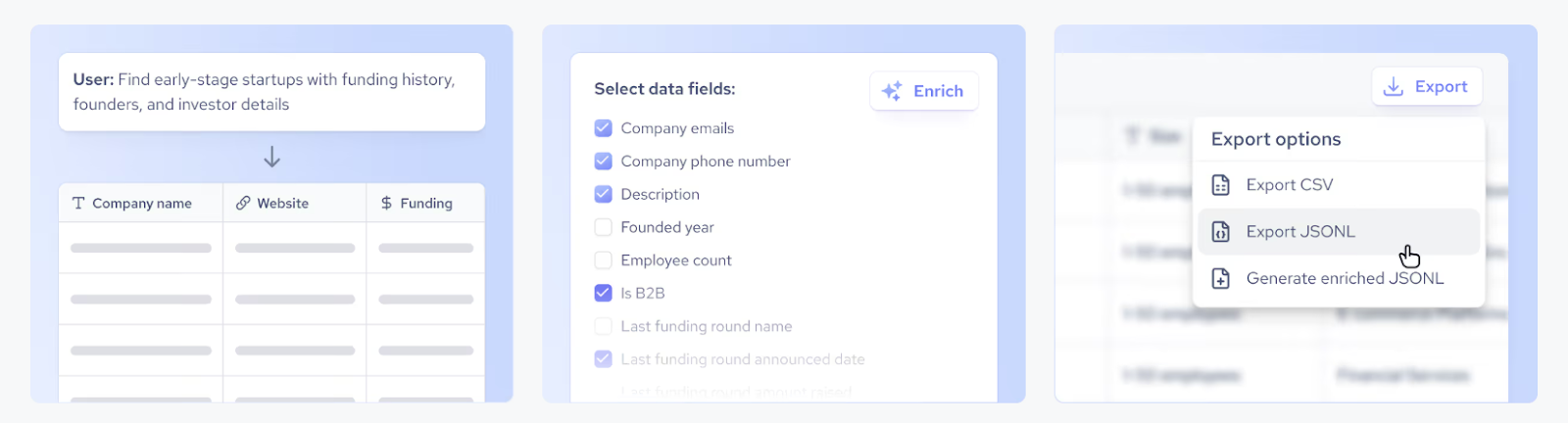
Coresignal’s data can be tested on self-service, no-code tools make searching easy.
How Coresignal works
Coresignal’s approach is far more sophisticated than the usual data providers. The company aims to transform publicly available web data into structured, consistent, and scalable datasets ready for production use.
Let’s break down this process in steps, so it’s easier to follow:
- Data collection: As a founding member of the Ethical Web Data Collection Initiative, the company gathers only publicly available business-related information, adhering to recognized standards and industry initiatives.
- Data cleaning: Data engineering teams clean and standardize raw data, removing errors, inconsistencies, and irrelevant information.
- Data structuring: After cleaning, Coresignal’s tech experts use statistical techniques and machine learning algorithms to combine, enrich, integrate, and structure the collected data into a consistent internal schema. The goal is to create units that are readable and useful for different business use cases. The data can be accessed in three processing levels – Base, Clean, and Multi-Source.
- Data delivery: Customers choose whether they get access to the refined data via Coresignal API (with average response time of 176 ms), downloadable datasets (for bulk use), or webhooks (for notifications about changes)
Coresignal strengths
Coresignal has built a strong position in the public B2B data space since 2016, largely thanks to these key features:
- Large-scale datasets: Coresignal offers one of the largest public B2B datasets in this category. It covers more than 4.5 billion records, including company, employee, and job postings data, from multiple public web sources. There’s more than enough volume to suit research, analysis, and product use cases at scale.
- Ethical sourcing: When collecting data, Coresignal considers legality, ethics, ecosystem engagement, and social responsibility. Its data collection strategy stays in line with major privacy regulations in the US and EU.
- Structured, versatile data: Before it reaches the customers, Coresignal standardizes, enriches, and updates data so it’s ready to use with minimal engineering effort. You can choose between different formats (JSON, JSONL, CSV, or Parquet) and processing levels (base, clean, or multi-source), so the output is as refined as you need.
- Flexible access points: Developers can query data on demand via API endpoints for real-time responses (176 ms on average) or pull large extracts for offline analysis and machine learning. Few Coresignal competitors are as accommodating.
- Real-time data access: Rather than relying on periodic database refreshes, Coresignal API delivers fresh data in real time.
- AI-ready data: The company offers datasets designed to power machine learning frameworks and train large language models. Data is deduplicated, enriched with metadata, and available in multiple output formats to support a wide range of ML workflows.
Does Coresignal provide real-time data?
Yes, Coresignal provides real-time data access via its APIs, including the Real-time Employee API, so users can pull the latest available records whenever needed. Rather than relying on traditional scraping, as some alternatives do, it maintains continuously updated pipelines and provides fresh, structured data ready for immediate use.
To help you understand how, I highlighted the real-time data delivery capabilities that make this possible:
- API or direct, programmatic access to data that continuously refreshes in the background
- Daily-to-monthly updates to the datasets, so customers always have access to the latest information
- Webhooks for tracking changes in the company or workforce data, which minimize mistakes and save time
- On-demand queries that return the latest available structured records, so you receive real-time structured data for any criterion at any time
Having access to real-time data is simply not enough, a point backed by Gartner, which predicts that up to 60% of AI projects will be abandoned without AI-ready data. That’s why Coresignal’s approach, which balances data freshness with structure, makes such a world of difference for modern business and AI use cases.
What is Coresignal used for? Key use cases explained
Another one of Coresignal’s advantages is how many use cases its data collection practices cover:
- Sales intelligence: Coresignal helps with lead generation by highlighting potential clients who have shown prior interest in your product. It deepens your understanding of potential leads with fresh multi-source data. Plus, it helps improve engagement strategies through data-driven insights.
- Talent analytics: Fresh and historical data keep you on top of candidates, careers, and the labor market so that you can find the right person for any position.
- Investment research: Coresignal’s datasets help understand company health, potential ROI, and future trends before an investment. You can also use them to verify the company’s claims and uncover the latest changes, as well as historical data, to mitigate risk.
- Lead enrichment: Information from a range of data fields enables sales teams to properly qualify every lead. Comprehensive yet fresh background data can narrow the search and make prospecting more effective.
- Market analysis: Data on market conditions and audience demographics can help identify potential areas for market growth and refine marketing strategies.
- AI & LLM training: With Coresignal API, you get instant access to massive AI databases designed to power machine learning applications and train LLMs.
Coresignal for AI and LLM applications
Coresignal offers AI datasets for B2B with over 4.5 billion company, employee, and job records. You get access to both historical and real-time data, in three processing levels.
Whether the data will be just cleaned and deduplicated, or also enriched, whether it’ll come from a single or multiple integrated sources is all up to you.
Few Coresignal competitors offer data that’s as optimized for building AI search, AI-driven products, and machine learning models.
Coresignal vs. alternatives
Choosing between Coresignal and its competitors should depend on your needs and expectations. As mentioned, Coresignal offers one of the largest, most up-to-date datasets, with ethically sourced real-time data at multiple processing levels and quite flexible access points.
Coresignal alternatives can be valuable in particular use cases, as the table below shows:
Coresignal pricing explained
Coresignal pricing differs depending on whether you’re interested in on-demand data (API access) or need data for large‑scale projects, bulk analysis, and ML training (datasets).
For API access, Coresignal offers three subscription plans, paid monthly or annually, as well as a free tier. These range from $49/month (Starter version) to $1,500/month (Premium version), with a solid free plan for testing and lighter use cases.
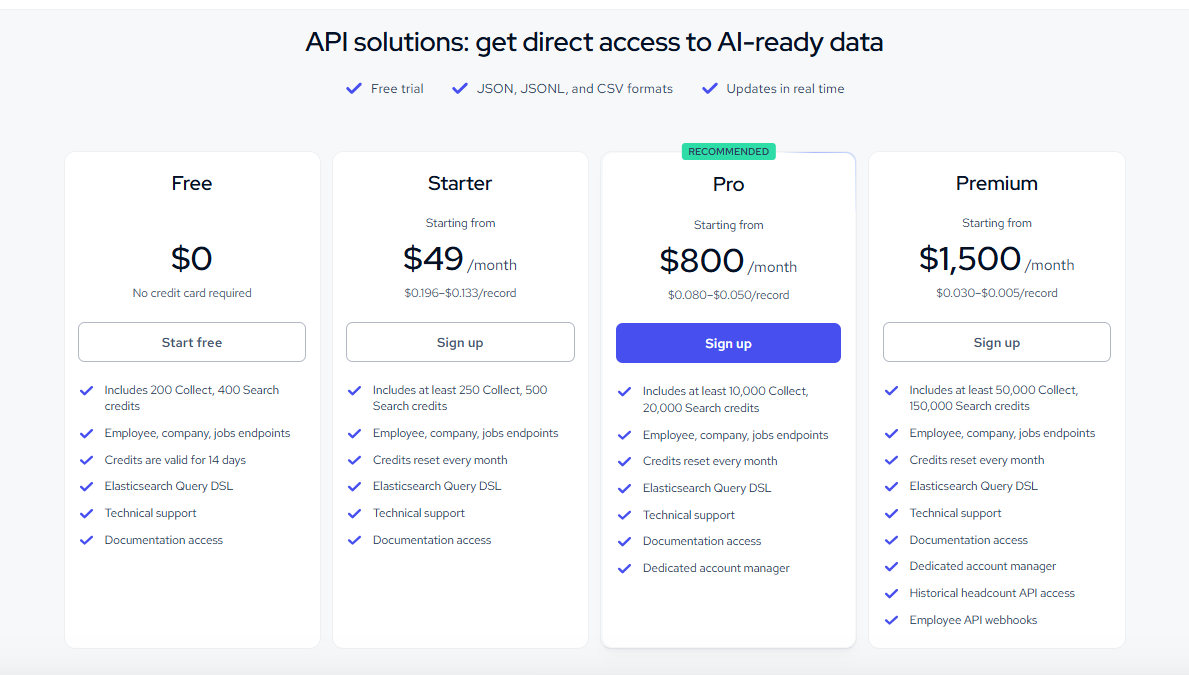
Coresignal pricing plans are credit-based, featuring two types of credits: Search and Collect. Search Credits are used to run queries, and Collect Credits are used to fetch full data records. Your plan includes different amounts of each to cover your data needs.
Coresignal sells datasets separately. Prices start at around $1,000 per dataset. If you’re after full global datasets that combine data from more than 15 sources, prices are custom and based on scope, contract length, geographic coverage, data source bundles, and delivery frequency.
When Coresignal is the right choice
Choose Coresignal if:
- You need large-scale datasets for product development, analytics, research, or machine learning.
- You need historical and real-time data on companies, employees, and job postings.
- You want full control over data pipelines, including enrichment, transformation, and historical tracking.
- You’re building AI or data-driven products that rely on high-quality public B2B data.
- You have a data or engineering team to handle integration and processing.
- You’re comfortable with the Coresignal pricing structure, distinct for API access and datasets.
- You want data that’s ethically sourced and regularly updated for accuracy and compliance.
When Coresignal might not be the best fit
Consider Coresignal alternatives if:
- You need built-in CRM workflows, since automated lead management and pipeline features aren’t part of Coresignal’s offerings.
- You want a plug-and-play solution for sales or analytics. Coresignal requires technical setup and integration to work effectively.
- You’re after private or sensitive personal data. Coresignal collects information only from publicly available B2B sources, in line with industry ethics and social responsibility.
Final verdict: Is Coresignal good?
Yes, Coresignal is a great choice if data is the backbone of your business operations. Its large-scale public B2B data is cleaned, deduplicated, and enriched for immediate use, whether for analysis, custom workflows, or AI products.
Coresignal offers flexible access and multi-source coverage, enabling you to transform its data into tailored insights and scalable products.