


.jpg)
New isn’t always better. While data freshness is an important factor, historical data is even more valuable for companies that need broader market context for AI training, investment research, or sales prospecting. Without it, trend tracking, predictive model training, pattern detection, cycle analysis, investment research, and data quality validation would be severely limited.
In this article, I will explain the main use cases for historical data, how to utilize it most effectively, and review the top historical data providers for AI search optimization and other B2B needs.
What is historical B2B data?
Historical B2B data is yesterday's real-time data. Essentially, it consists of business information collected and stored over time that can be used to track how companies, workforces, job markets, and broader market signals have evolved.
Historical B2B data can also be described as point-in-time or longitudinal business data because it preserves how an entity looked at different moments rather than only storing its current state. When records are captured consistently over time, they can be analyzed as time-series data for trend analysis, forecasting, and backtesting.
While current B2B data provides a snapshot of what is true right now, historical data preserves the evolution of entire companies, workforces, and markets. Years of preserved records can show changes in:
- Headcount
- Past hiring campaigns
- Expired job postings
- Employee role transitions
- Mass layoffs
- Signs of expansion
- Technology adoption
Of course, not all historical data is equally valuable. Without timestamps, users can see what happened but not when. That's why timestamped historical data is worth its (digital) weight in gold.
Below is a quick summary of historical B2B data types.
Where historical data creates the most value
Exporting historical datasets is only the first – and easiest – step. The real challenge lies in how companies use them and whether they can extract their full value. Below is a summary of the most common use cases for historical data.
1. Market intelligence: tracking how companies and markets change
Companies might be at the top of their game today, but historical data can reveal whether they previously experienced major layoffs, which technologies they adopted before succeeding, and how their financial performance evolved over time. Rather than evaluating the market solely based on its current state, historical B2B data allows users to analyze shifts over time. This information can help determine whether changes resulted from deliberate actions or from potentially temporary trends.
2. Investment research: spotting growth and risk signals
Before investing in a company, it is important to understand its hiring velocity, headcount changes, expansion into new markets, and shifts in skill demand. This information can reveal whether a company is gaining momentum or going through a rough patch. If you are interested in backtesting signals before incorporating them into investment models, historical data should be a priority.
3. HR tech and workforce analytics: understanding talent trends
Rather than researching manually, HR professionals can use historical workforce data to identify suitable candidates and gain insights into talent supply and demand. By analyzing skill trends, role demand, employee tenure, workforce movement, and compensation patterns, organizations can identify market trends and gain a competitive advantage. These insights also support workforce analytics and planning, competitive benchmarking, and the development of more effective features for HR technology platforms, enabling data-driven decisions related to hiring, retention, and talent strategy.
4. AI and machine learning: training and backtesting models
The more context, boundaries, and data AI tools have access to, the less likely they are to fill gaps with hallucinations. Without historical data, AI training would be superficial and inefficient, limiting a model's ability to identify patterns and relationships over time. High-quality historical B2B data, complete with clean timestamps, consistent schemas, and at least a few years' worth of records, enables teams to build reliable models for automated forecasting, classification, trend detection, enrichment, and signal scoring.
5. Sales and GTM: finding timing-based buying signals
Historical B2B data helps sales and go-to-market teams identify timing-based buying signals that indicate when prospects may be more receptive to outreach. Changes such as increased hiring activity, leadership transitions, expansion into new markets, or shifts in technology adoption can signal evolving business priorities and purchasing intent. By analyzing these patterns over time, organizations can improve lead prioritization, optimize outreach timing, and build more effective GTM strategies based on historical buying behavior.
Bigger isn’t always better: what makes historical data useful
Millions of records may seem very appealing, but they do not necessarily mean that a dataset has real value. A quality historical data provider ensures that four key criteria are met:
- Consistency. If users compare apples and oranges, they cannot draw meaningful conclusions. Only records that can be fairly compared over time allow users to identify patterns and extract value.
- Timestamps. Point-in-time accuracy is what separates a decent historical data provider from a great one. Just as we expect accuracy from fresh data, historical data should also reflect what was true at a specific point in time, and metadata such as source, collection method, and record status helps validate that accuracy.
- Coverage. Different use cases require different types of coverage and data categories. While job data or company data alone can be useful, a combination of connected records and entity matching provides even greater value.
- Context. Buyers should always seek methodology documentation, sample data, schemas, and coverage notes to ensure the data is well-documented and that its collection methods, limitations, and scope are clearly understood before investing in it.
With any of these missing, even large datasets would not prove to be as useful as they could be.
How to choose a historical data provider
Data providers often advertise the size of their datasets, but unless they have consistency, timestamps, coverage, context, and transparency in place, data volume alone won’t be of much use. Here is what to look for in a historical data provider:
Best historical data providers in 2026
Historical data providers can be difficult to compare because they often specialize in different types of services. Some focus on broad B2B datasets, others on workforce intelligence or job postings, while some specialize in company signals or custom web data. However, I identified historical data providers that offer relevant B2B company, workforce, or job market intelligence.
I prioritized providers based on their fit for common use cases rather than simply the size of their datasets. Each provider was evaluated according to historical depth, data categories, source coverage, timestamps, delivery options, and practical applications. While all of the providers listed below offer unique advantages, the final decision should depend on the buyer's specific needs, whether that involves analyzing company growth, workforce changes, hiring activity, market trends, or training AI models.
Coresignal
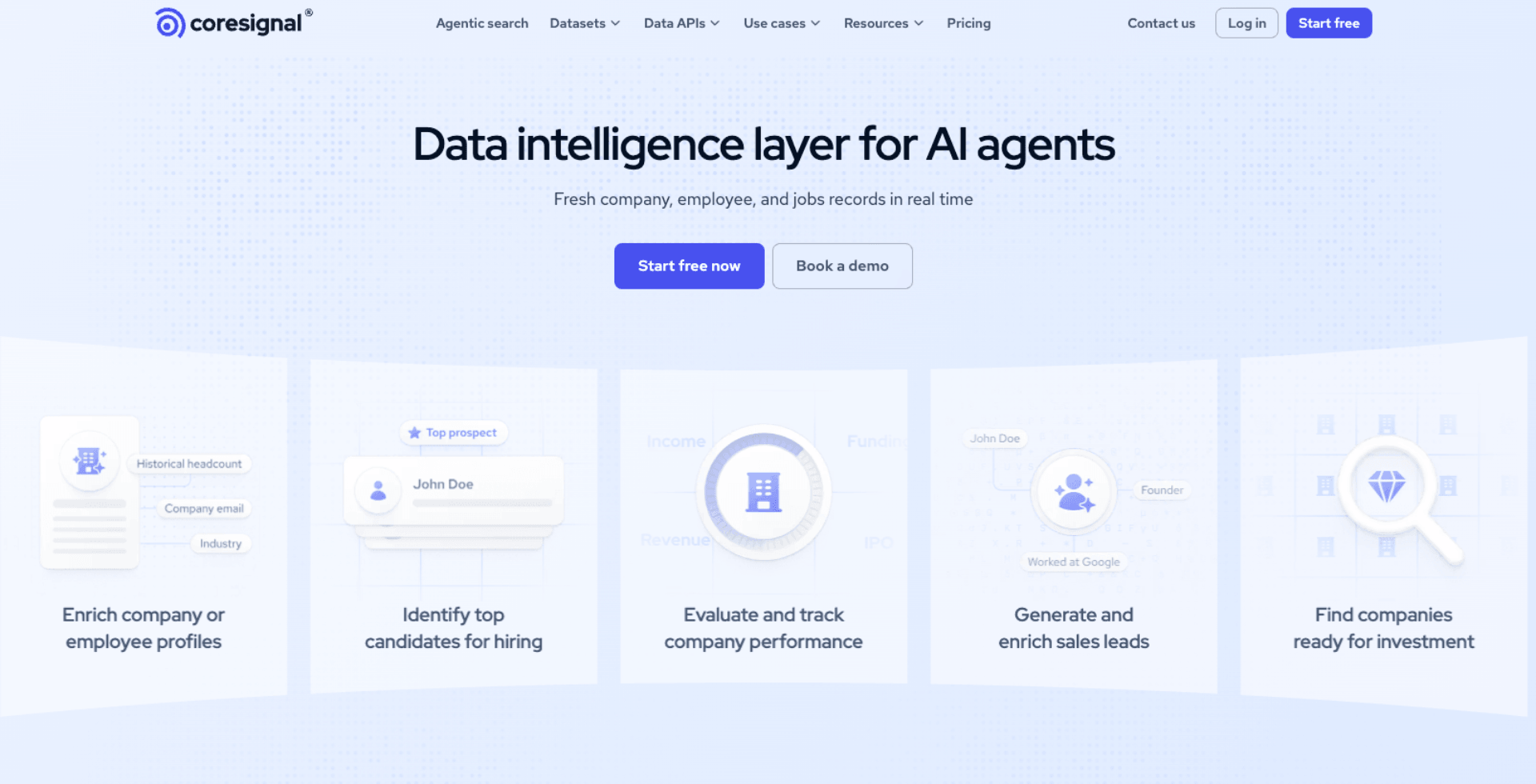
Coresignal is a B2B data provider that focuses on collecting and structuring billions of public web data records. Currently, it provides fresh and historical company, jobs, and employee data.
Best for: contextual, clean, and broad B2B data, ranging from publicly available multi-source company and employee data to job posting data from the largest professional networks.
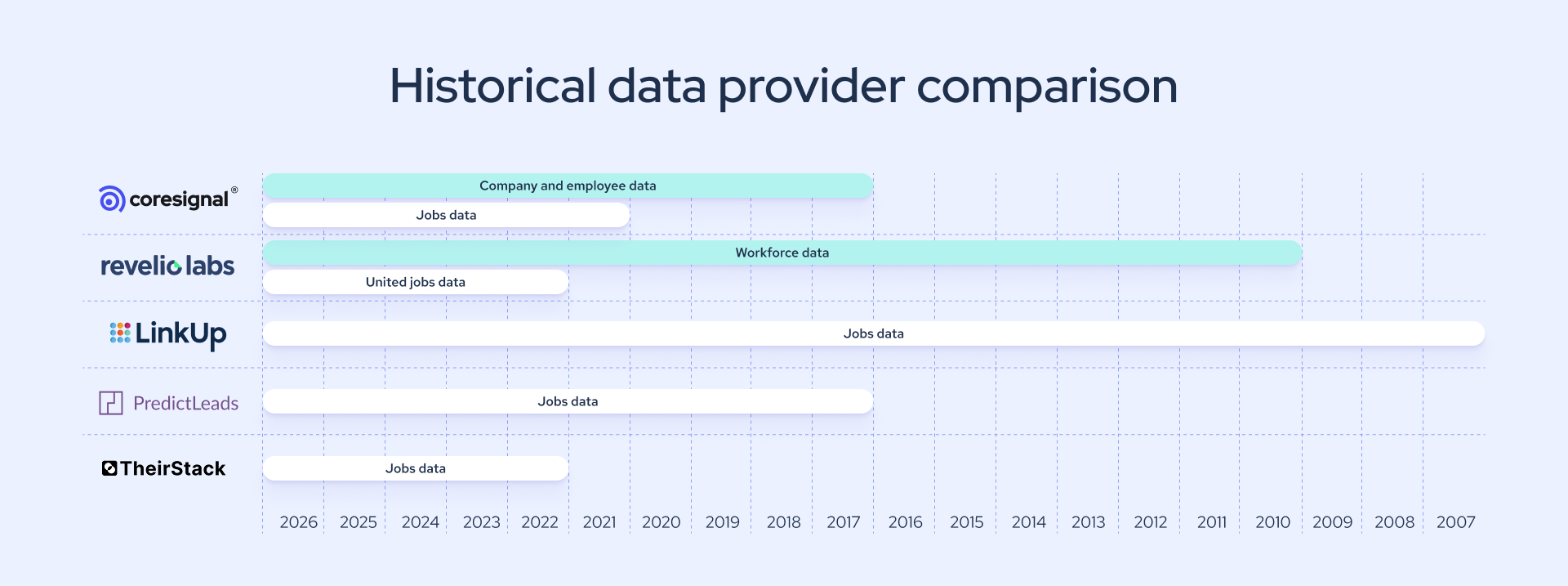
Historical data coverage: Coresignal offers historical datasets for all three data types. Company and employee historical records go back to 2016, while jobs data is available from 2020.
Delivery: clients can choose between real-time, daily, weekly, or monthly delivery depending on whether they need API or bulk dataset access, and depending on the data type (like company dataset) and processing tier.
Best use cases: Coresignal data is suitable for a wide variety of use cases, from AI model training and investment research to HR tech and market intelligence.
Why it stands out: unlike most historical data providers, Coresignal is not limited to just jobs or workforce data, making it one of the most versatile options for all top B2B data categories.
Bright Data
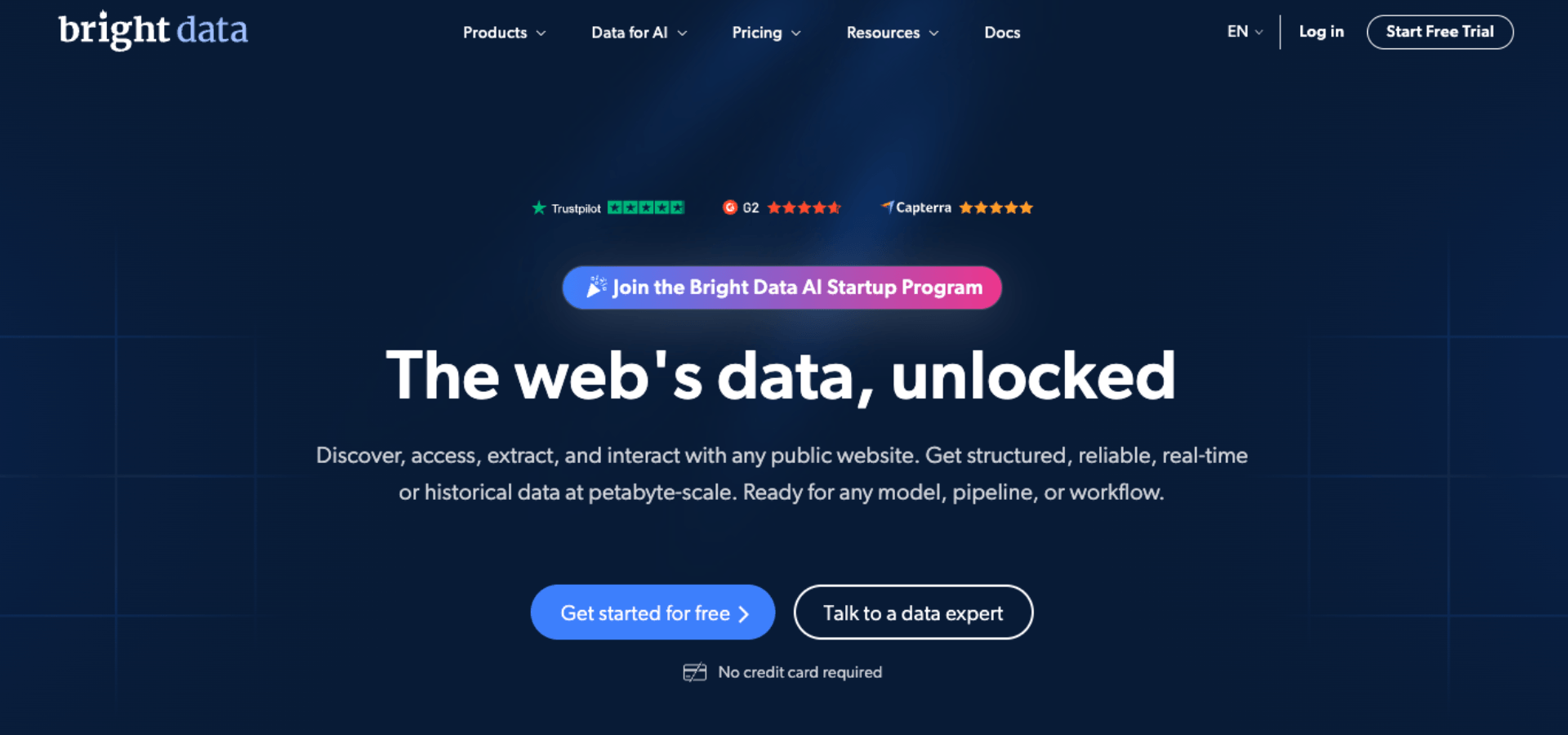
Bright Data is a B2B proxy and data provider that uses its own infrastructure to extract and structure company, employee, and jobs data.
Best for: companies looking for a solution for proxies, scraping, and data collection, as well as custom web data collection.
Historical data coverage: while it does provide historical data, it does not publicly specify how far back its records go, as datasets are not its main product offering. If you prefer transparent historical depth specifications, you might need to look for a suitable Bright Data alternative.
Delivery: delivery options depend on the dataset and service selected. Historical data is delivered through APIs, bulk datasets, and managed data collection services.
Best use cases: Bright Data is best suited for custom market research, competitive intelligence, AI model training, alternative data collection, lead generation, price monitoring, and large-scale web data extraction projects.
Why it stands out: unlike traditional historical data providers that offer predefined B2B datasets, Bright Data gives organizations the infrastructure and flexibility to collect historical and current web data from a broad range of sources and industries.
Revelio Labs
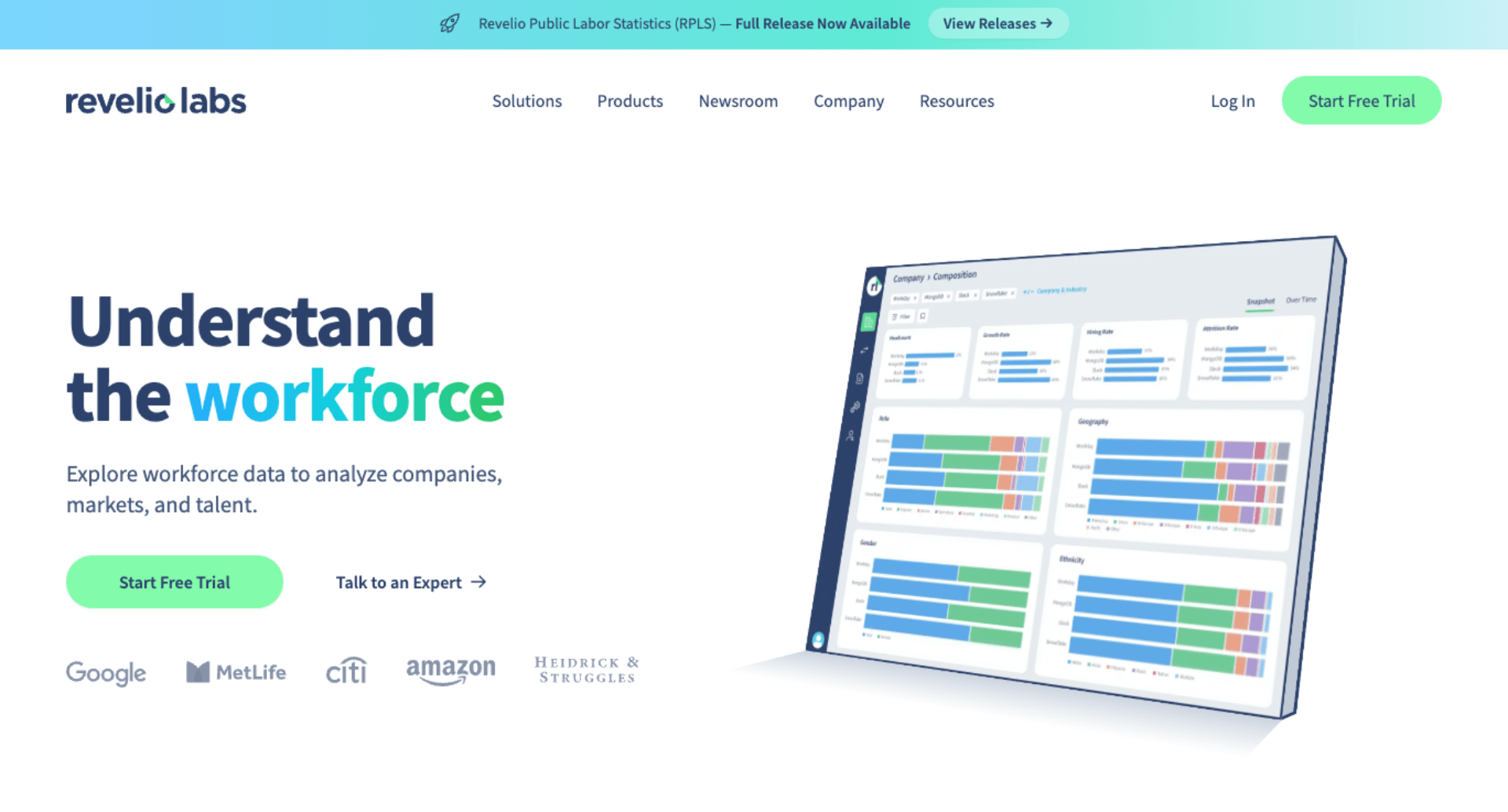
Revelio Labs is a workforce intelligence provider that specializes in labor market analytics and workforce data.
Best for: workforce intelligence, labor market research, investment analysis, and understanding talent trends across companies, industries, and regions.
Historical data coverage: Revelio Labs provides historical workforce data going back to 2008 for workforce data, and to 2021 for its unified job postings dataset, allowing users to track workforce trends and labor market shifts over time.
Delivery: data is delivered through data feeds, APIs, and custom datasets, depending on the customer's requirements and use case.
Best use cases: investment research, workforce analytics, labor market studies, and identifying company growth or contraction signals through employment data.
Why it stands out: Revelio Labs has one of the deepest historical data coverages on the market.
LinkUp
LinkUp is a job dataset provider that sources real-time and historical data directly from company career pages worldwide.
Best for: companies looking for extensive job market data, labor market analysis, hiring trend monitoring, and tracking demand for specific roles, skills, and industries.
Historical data coverage: it provides historical job posting data dating back to 2007, making it one of the longest-running sources of employer-sourced hiring data. However, if you need company and employee data as well, it’s best to look for a LinkUp alternative, like Coresignal.
Delivery: data is available through APIs, bulk data feeds, dashboards, and custom research solutions, depending on the customer's requirements.
Best use cases: workforce planning, labor market studies, competitive intelligence, and tracking hiring demand across companies and industries worldwide.
Why it stands out: unlike providers that rely heavily on aggregated job boards, LinkUp collects job postings directly from company websites. With historical records stretching back nearly 20 years, LinkUp, just like Revelio Labs, is one of the industry’s oldest players.
PredictLeads
PredictLeads is a company signals provider that specializes in tracking business events and firmographic changes across companies worldwide.
Best for: sales intelligence, lead generation, investment research, market intelligence, and tracking company growth signals.
Historical data coverage: PredictLeads provides historical data going back to 2016 for news events, and to 2018 for job openings and technographics. Coverage start dates vary by signal type. Coresignal, a PredictLeads alternative, covers a similar time period.
Delivery: data is delivered through APIs, webhooks, and bulk exports, enabling customers to integrate company signals directly into CRMs, data warehouses, and analytics workflows.
Best use cases: identifying buying intent signals, prioritizing sales outreach, monitoring portfolio companies, tracking startup growth, competitive intelligence, and building predictive models based on company events.
Why it stands out: unlike workforce-focused providers that primarily track employees and job postings, PredictLeads specializes in structured company events and business signals.
TheirStack
TheirStack is a technology intelligence provider that tracks company technology adoption, hiring activity, and growth signals.
Best for: technology adoption intelligence, including company tech stacks, software usage signals, job postings, and hiring activity across companies.
Historical data coverage: TheirStack provides historical technology adoption and job posting data going back to 2021. If that is not enough historical depth, you should consider a TheirStack alternative.
Delivery: data is available through APIs, bulk exports, and integrations depending on the selected plan.
Best use cases: sales intelligence, technology-based prospecting, competitive research, market intelligence, and investment research.
Why it stands out: TheirStack combines technology adoption data with hiring signals, making it useful for identifying companies based on both the tools they use and the roles they are hiring for.
Key differences between these historical data providers
The main differences between the historical data providers listed above come down to two factors: data type and historical depth. To summarize:
- Coresignal – provides broad B2B datasets covering company, workforce, and jobs data.
- Bright Data – provides custom web data and flexible historical datasets.
- Revelio Labs – specializes in workforce data.
- LinkUp and TheirStack – specialize in job posting data.
- PredictLeads – specializes in company signals.
It is also worth noting that historical depth is not always an indication that a provider lacks sufficient records. Some market up-and-comers can offer quality and innovative solutions that not all competitors can match. Therefore, while it is important to consider how far back a provider's historical data goes, the context behind that coverage matters as well.
Best historical data provider by use case
If you're not sure which historical market data provider to choose, start by identifying your requirements. What exactly do you need the data for? Once you have an answer, choosing a provider that meets those needs will be relatively straightforward.
What to check before buying historical data
Before committing to a provider, use the checklist below to verify that the dataset meets your requirements for historical depth, data quality, coverage, and transparency.
- Does the provider offer true historical data or only current snapshots? If you need deeper market analysis, a present-state dataset will not suffice.
- Are records timestamped? Without clear dating and categorization, your dataset may not be suitable for effective AI training.
- Can you access expired job postings? Old job postings should not be underestimated – together they reveal patterns in hiring signals over time.
- Is company/entity matching available? Without it, company name changes, mergers, or changed website domains would appear as separate records instead of a continuous chronological history.
- Can data be delivered via API, bulk files, Snowflake, or S3? This would significantly simplify your internal processes.
- How far back does the archive go? It is not always the most critical factor, given that many historical data providers cannot go further back than their founding year, but greater historical depth generally means more analytical value.
- Is the dataset consistent across time? A historical data provider's internal changes should not affect the quality and consistency of the dataset delivered to you.
- What countries and industries are covered? Even if you need data from just one country, global context is always useful for tracking market signals.
- Can the provider support GDPR/CCPA-related requirements? Being in line with data privacy laws and ethical data sourcing helps prevent legal exposure and reputational risk. Make sure your chosen provider only sources publicly available data.
- Are sample datasets available before purchase? A provider that does not offer sample data before purchase is not worth the risk of committing to something that may not fit your needs.
Final thoughts
Historical data is essential when business decisions depend on understanding change over time rather than relying on today's snapshot. Seeing how companies have grown or slowed down, identifying which markets are hiring, understanding which skills are becoming more valuable, and recognizing companies that may be expanding, restructuring, or preparing to buy can give organizations a competitive edge in a rapidly changing market.
Investment research, GTM planning, workforce strategy, market expansion, AI development, and competitive intelligence all depend on the effective use of historical data. However, choosing the right historical data provider is just as important as having the data itself. Different providers specialize in different areas, including company growth, workforce movement, job market trends, company signals, and custom datasets.
Whichever provider you choose, the most important thing is that it helps your business answer the questions that drive growth.