


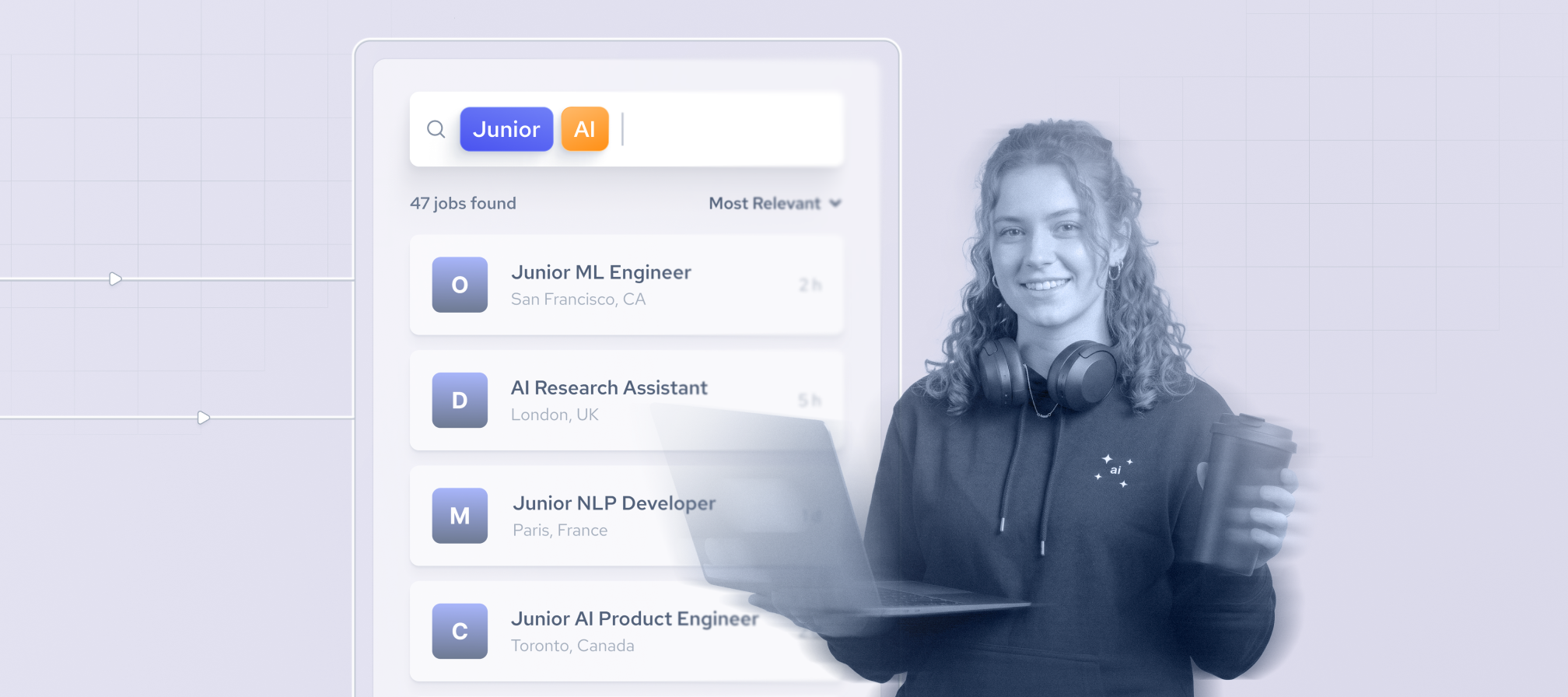
AI is undoubtedly affecting the job market. Various studies, including one conducted by Stanford University, found that junior roles are shrinking. However, there is one outlier that defies expectations. For every single junior ML engineer, AI developer, or data scientist role, AI-building firms look for eleven junior analysts, accountants, administrators, and coordinators.
While other studies focus on different data, like payroll, our team analyzed 2.6 million entry-level job ads in the U.S., comparing January to May 2025 with the same period in 2026. What they reveal is an unexpected concentration of junior roles among broader market decline, specifically within AI-building companies.
Note: "AI-building" and "AI-active" are used synonymously throughout this article. AI-building companies are defined as those advertising at least one AI-builder role – regardless of whether the company formally engages in AI development. "AI-active" serves as the broader umbrella term for the same group.
AI-active companies: market leaders for junior office roles
Out of all companies that posted a total of 2.6 million entry-level job ads in the United States, 92.8% were non-AI-active firms and 7.2% were AI-active. Overall, our research agrees with common studies that show a reduction in junior hiring. If entry-level positions accounted for 34.6% of all job ads in January-May 2025, the same period in 2026 saw a 4.05 percentage point reduction in the market's junior hiring.
However, this is where AI-active firms stand out. While the broader market cites AI adoption as one of the main reasons for reduced entry-level positions, AI-building companies offer a higher share of junior roles. At non-AI-active firms, 7.8% of entry-level postings fall into AI-exposed categories – analyst, accounting, admin, and support roles. At AI-active firms, that share is 13.3% – a raw gap of 5.50 percentage points.
This data runs counter to the dominant narrative. Firms actively posting AI-builder roles – ML engineers, data scientists, AI developers – advertise a significantly larger share of junior analyst, admin, accounting, and office roles than comparable firms that are not building AI. This gap holds even when comparing firms of the same size in the same industry.
Whatever displacement is happening elsewhere, the companies at the center of AI development are not cutting their junior office headcount proportionally.
Note: Table shows entry-level job posting classification: share by role type, 2025 vs 2026
AI-active companies need supporters, not builders

While AI-active companies represent a relatively minor proportion of the entire job market, they show a year-over-year increase in entry-level jobs. However, contrary to popular belief, AI companies are not necessarily looking for builders. Most junior job ads are for AI-exposed, not AI-building, positions.
The difference between AI-building and AI-exposed junior roles is significant. There are 10.7 AI-exposed junior role postings for every one AI-builder role. For scale, while AI-builder roles represent 1.1% of job ads at AI-active firms, AI-exposed junior roles account for 12.2% of all postings.
These numbers show that AI-active companies are looking for junior office workers rather than training future AI builders. To clarify the difference:
- AI-builder roles are the junior postings for jobs like ML engineer, AI developer, data scientist. These are the roles that literally build AI systems.
- AI-exposed roles are junior postings for jobs like analyst, accountant, admin assistant, coordinator. These are office roles that AI could assist or automate but that these firms are still actively hiring for.
Junior hiring is changing, not collapsing
Across the full U.S. market, the mix of entry-level jobs being advertised is changing in a consistent direction. Roles in food service, warehouse, retail, and manual trades make up a shrinking share of junior ads – down 9.46 percentage points across all firms in the Jan-May window. Roles in software, data, finance, and office administration make up a growing share. This is a compositional shift in what kinds of junior roles are being advertised, not a wholesale reduction in junior hiring activity.
Note: Table shows change of junior job ad share 2025 vs 2026 in AI-exposed and manual roles
The pattern becomes clearer when looking at which role types dominate active job postings across major platforms. Our data shows that frontline and manual roles still dominate raw posting volume across nearly every source. Registered nurse, cook, sales associate, and cashier consistently rank among the most-posted titles globally. By contrast, explicitly AI-exposed office roles appear in smaller but measurably growing concentrations.
What the data reflects collectively is a labor market that is still heavily weighted toward in-person and manual work at the entry level globally, while the knowledge-worker and office-role segment – the portion most intersecting with AI adoption – is quietly gaining share. The shift is real, measurable, and consistent across sources, but the baseline of manual and frontline junior hiring remains large.
What this could mean for future hiring
Hiring trends are difficult to predict. Ten or five years ago everyone was encouraged to pursue jobs in IT. A year ago, AI was the skill of the future, with junior non-AI IT roles shrinking. However, there are some trends we can already notice.
1. The AI-exposed office role share will likely keep growing
The shift from 10.76% to 13.97% within entry-level AI job postings held across every robustness check: same firms, reweighted industries, alternative classification scenarios. A trend that survives that many stress tests has momentum behind it. If it continues at even half the observed rate, AI-exposed roles could represent 16–18% of entry-level ads by mid-2027. This is a projection of a confirmed direction, not a specific forecast.
2. Junior hiring as a share of all hiring will likely keep shrinking
The 34.7%→30.6% decline was broad – 39 of 51 U.S. states and territories moved the same way. Broad declines like this rarely reverse quickly. The most likely near-term trajectory is continued compression of junior roles relative to mid- and senior-level hiring, particularly in knowledge-worker sectors.

3. The geographic concentration will likely intensify
The U.S. states – DC, NJ, NY, CT, and CA – are already above the national average and still rising. The states below average are mostly catching up slowly. The pattern suggests AI-exposed junior hiring is consolidating into metro and tech-hub markets, and there is nothing in the data to suggest that reverses.
4. Healthcare is the most likely sector to shift direction
It is the only large industry where AI-active firms post fewer AI-exposed junior roles than similar companies. But healthcare AI adoption is accelerating. As imaging, diagnostics, and decision-support tools scale, they will eventually generate downstream demand for data, analyst, and administrative roles, which would flip that negative gap. The current anomaly is probably a lag, not a permanent divergence.
5. The manual and in-person baseline will keep losing share, but gradually
The 9.46 percentage point drop looks dramatic, but 5.2pp of it was title labeling drift into generic categories, not roles leaving the market. The genuine compositional shift was about 3.2pp. At that rate, the underlying movement is meaningful but not disastrous. More a slow, steady rebalancing over several years than a sudden collapse.
Bottom line
The popular narrative is that AI eliminates junior knowledge work. The data shows the opposite pattern at the firm level. Companies posting AI-builder roles – the ones actually building the technology – advertise proportionally more analyst, admin, accounting, and coordinator roles at the junior level than comparable firms that are not building AI. The gap holds whether you look at small, mid-size, or large employers, and whether you adjust for industry composition or not.
The broader market context adds an important layer: junior hiring is becoming a smaller slice of total hiring overall, and the mix within junior hiring is tilting toward AI-exposed office roles and away from manual and in-person ones. So the market-level picture is more ambiguous – fewer junior roles overall, but the ones that remain are increasingly the kind AI could eventually affect.
Research methodology and limitations
Below is information on our data, research methodology, and limitations to consider.
- Data source and cleaning. The analysis is built on Coresignal's U.S. entry-level multi-source job postings deduplicated, cleaned, and enriched dataset, anchored to the January-May 2025 versus January-May 2026 like-for-like window, which controls for seasonality and the partial 2026 data year. Additional context provided in the “Junior hiring is changing, not collapsing” section is from our broader multi-source jobs dataset.
- Classification approach. Roles are sorted into four buckets by job title text only: AI-exposed, in-person/manual, ambiguous/held-out, and unclassified. Department and industry fields are used only for grouping, not classification.
- Job ad shares, not employment counts. All figures throughout the study are shares of advertised job postings within a given period, not counts of people hired, employed, or laid off. A rise in the AI-exposed share means that type of role makes up a larger fraction of junior ads. It does not measure whether more people were hired into those roles, whether wages changed, or whether employment in those occupations grew. The study measures the composition of what employers are advertising, not what is happening to the workforce.
- Firm-level analysis is associational, not causal. AI-active firms are identified by the presence of at least one AI-builder posting, a thin proxy that cannot detect senior AI hires or distinguish genuine AI-building companies from job board aggregators posting AI-titled listings. No causal relationship between AI adoption and hiring patterns is established or claimed.
- Structural limitations. The analysis covers a single year-over-year step, not a multi-year trend. It is also not possible to fully rule out that part of the observed shift reflects a change in which platforms contributed postings, though same-firm robustness checks confirm the direction holds.