

.jpg)

Building an Agentic AI tech stack is more challenging than assembling a chatbot or a simple automation pipeline. Unlike systems that execute predetermined tasks, agentic AI uses data to make independent decisions and automate complex workflows end to end.
In this guide, I’ll break down the practical components developers need to consider when moving from experimental AI agents to systems that can retrieve data, call tools, execute tasks, and remain observable in production.
Agentic AI tech stack: from experiments to production systems
According to McKinsey’s State of AI in 2025 survey, 62% of respondents say their organizations are at least experimenting with AI agents, but only 23% are scaling agentic AI somewhere in the enterprise. In any individual business function, no more than 10% of respondents report scaling AI agents. That gap between experimentation and production is where the agentic AI tech stack becomes more than an architecture diagram.
While some companies are concerned about the risks of entrusting AI systems to operate their data and management systems independently, the lack of a clear underlying architecture is a major barrier. In 2026, agentic AI architecture is becoming more realistic for teams that know what to look for and how to incorporate AI agents into existing systems.
What makes a stack “agentic”?
A tech stack based on generative AI will only take you so far in terms of workflow automation. For that, you need an agentic AI tech stack. It’s not just a basic, static system based on reactive properties, completing simple tasks, and pulling information from pre-defined sources.
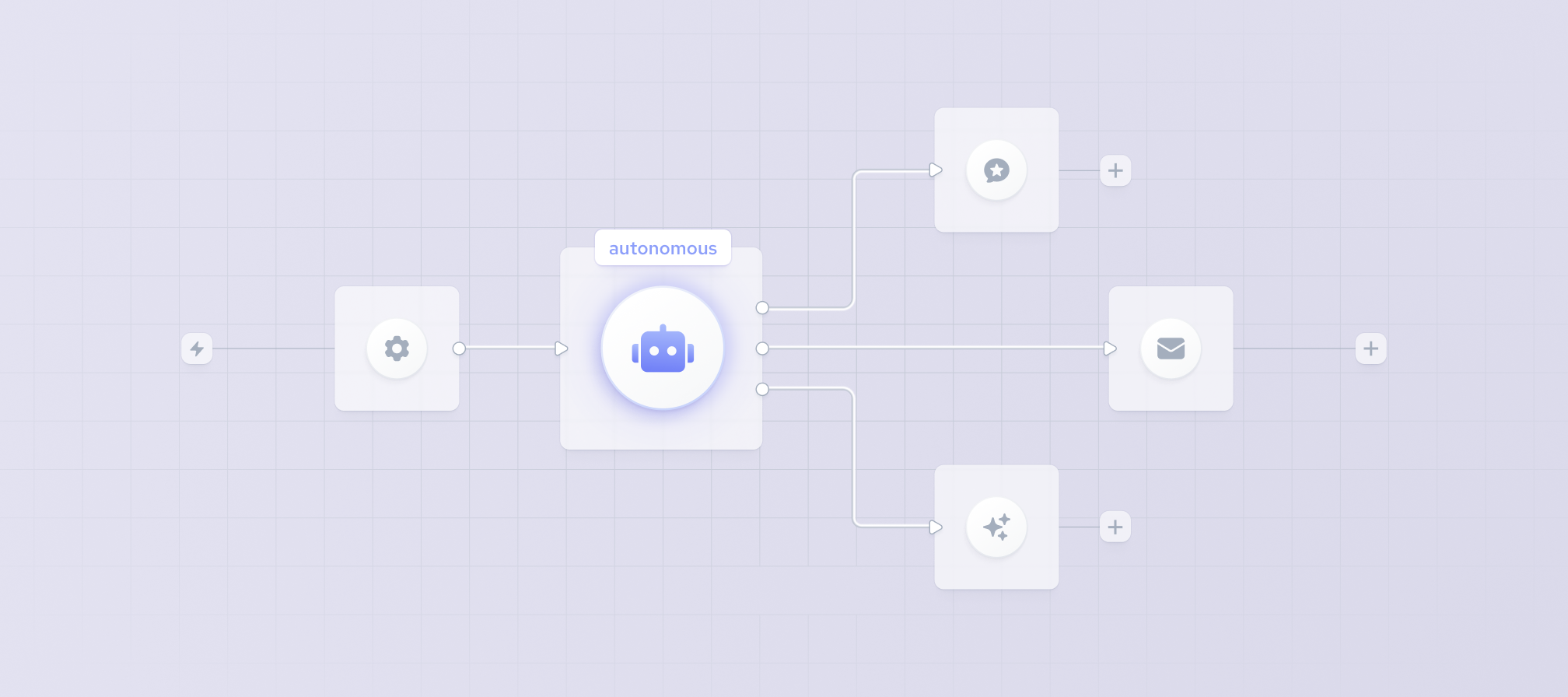
A multi-structured agentic stack, often consisting of multiple AI agents working together, offers greater autonomy within defined constraints. It can reason through problems, plan a course of action, and execute it independently.
The agents coordinate planning, tool calls, execution, and evaluation. They’re even capable of evaluating themselves and re-adjusting without any extra inputs.
Agentic AI tech stacks have changed how teams consider latency budgets, security boundaries, and cost attribution for AI use at the organizational level. To understand how it works and what makes it so different from reactive AI models, you need to first understand all the components.
Agentic AI tech stack 2026
Agentic systems aren’t like basic generative AI apps; they demand a proper stack of tools that would help them reason, plan, and memorize.
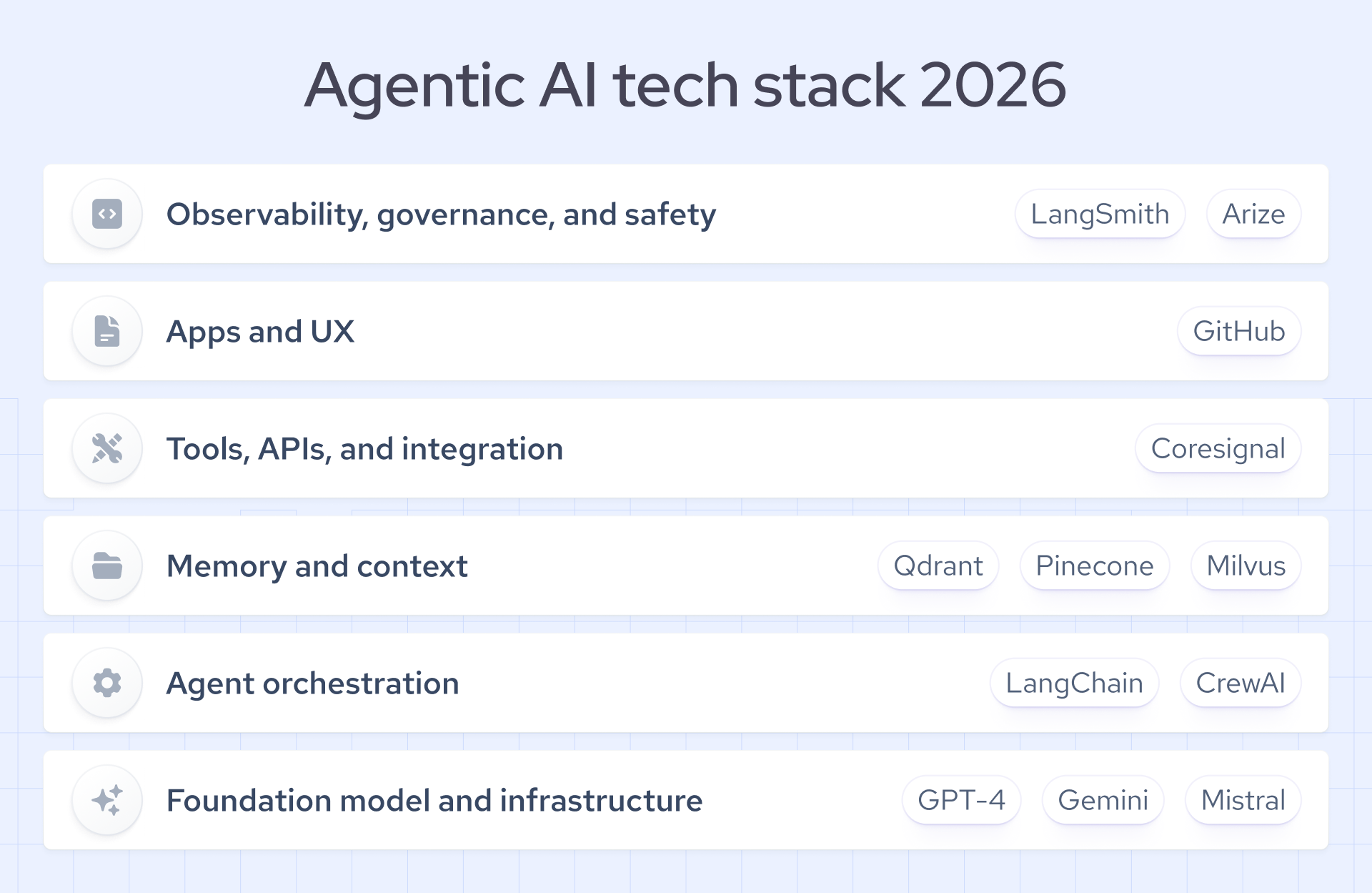
A mix of the right stack elements is necessary for safe deployment. I’ll break it down below.
Foundation model and infrastructure
The foundation model is the brain of the operation. It’s the one part of the stack that’s most responsible for reasoning behind the important decisions, like whether to call a specific tool or delegate the issue to another agent.
LLMs and multimodal models: there’s no substitute for the right model at the core of the agentic infrastructure. No matter how much time you spend on orchestration or contemplating which tools you use, it’s still not possible to compensate for the lack of a fitting LLM or a multimodal model. What’s new in 2026 is that teams are increasingly relying on the combination of multiple models, instead of using just one. Simpler tasks are routed to faster ones, while more complex LLMs handle delicate and time-consuming tasks. I’ve also noticed the rising trend of developers refraining from closed models like GPT and Gemini and relying more on customizable options like Llama and Mistral.
Agent orchestration
The orchestration framework determines how agents are structured and how they communicate with each other. Different frameworks give developers different ways to control the planning and delegation of tasks done by AI agents. For instance, the Model Context Protocol (MCP) agentic workflow provides a standardized interface, which relieves developers of customization overhead. The MCP determines how AI agents connect to plug-ins and external systems. For example, the Coresignal MCP server enables compatible AI agents to access structured company, employee, and jobs data without building custom integrations for each data source.
Frameworks and tools: frameworks like LangChain and CrewAI give developers a toolkit for creating fully autonomous agents and determining how they plan, reason, collaborate, and execute tasks. Infrastructural elements like containers, serverless functions, and Kubernetes provide the support for the framework to enable AI agents to manage workloads at scale.
Memory and context
Highly capable AI agents are built on memory, which enables them to draw on previous experiences when handling new tasks. Short-term (also called in-context) memory allows the agent to pull information from the existing session and apply reasoning steps based on historical data.
Vector databases and stores: long-term memory goes beyond the current session, allowing agents to pull information from past conversation data. Vector databases like Qdrant, Pinecone, and Milvus provide that long-term memory. It’s not just about keywords and pulling data related to these keywords: these vectors allow the agent to understand the meaning of data, remember user preferences, and effectively manage tasks according to the previous interaction history.
Tools, APIs, and workflow incorporation
The real challenge is in incorporating the agents into existing workflows in a way that benefits real-world problem-solving. An AI agent needs to be able to communicate with external services. Here’s how it can be achieved:
- Connectors to internal microservices, systems, data lakes, and automation tools: Connecting the agent with CRM platforms, APIs, and automation tools such as n8n allows it to query databases, execute automated workflows, and complete advanced tasks.
- Adding data: The AI agent is only as reliable as the data it’s being fed. Poor data quality leads to misguided decisions due to stale pages, structural issues from poor data fetching online, and other downstream problems. That’s where choosing the right data provider for AI becomes a critical part of the stack. For instance, Coresignal’s Agentic Search API provides AI-ready firmographic and workforce data in machine-readable formats like JSONL and Parquet. This means that automated agents can ingest data in plain English without processing, enabling ground-based decision-making based on that data.
- The role of the MCP: This is also where the MCP agentic workflow comes in handy, as it provides the standardized framework that determines how agents call on specific tools at scale.
Applications and UX
The role of AI agents isn’t to take over the entire workflow process, but rather to make it easier for users to manage. The front end still needs to be intuitive enough for the user to operate in a safe and standardized way, without any disruptions in agent capabilities.
User-facing apps: Applications like copilots, autonomous workflows, and dashboards optimize the user’s experience with AI agents. For instance, GitHub Copilot boosts human workloads via recommendations and content generation, while collaboration apps help with task delegation within the agent’s orchestrated framework.
Observability, governance, and safety
According to IBM’s research, companies with mature orchestration-led governance were 13 times more likely to scale their agentic AI stacks successfully. At an agentic AI level, that means using tools with real-time insights into agent performance. Developers need to know which tools were called, in which order, and with what outcome in order to further optimize the agentic performance. Guardrail systems go hand in hand with observability tools, flagging behavior that falls outside the defined operating scope. In 2026, LangSmith, Arize, and Helicone proved to be among the best observability tools.
The agents promised autonomy. They didn’t come with data
AI tech stacks often perform well in testing but underperform in production. Naturally, all of this is still relatively new technology, and it’s hard to predict how AI models and agents will behave within an agentic system.
That’s what the nuanced approach is all about controlling a system's reach and resources in a secure environment. Still, there’s one thing that often goes under the radar of most teams, and it’s the quality of the data they feed to the system.
An autonomous AI search agent might have to pull market signals, evaluate staff changes, and cross-reference company and jobs data across multiple sources. If the data doesn’t add up, the whole process is at risk.
The biggest challenge isn’t building agents; it’s deploying them. You’ll rarely hear of a deployment failing due to a framework issue. More often than not, data issues are among the main failure points.
Data providers like Coresignal offer tools, such as the natural language search option built for LLM pipelines and AI agents, making it easier for agents to handle and retrieve complex data via simple requests in plain English.
Where structured, proprietary B2B data fits into the agent loop
AI search agent tools and research stacks require more than just basic web search for executing tasks. Of course, web search APIs are still crucial for many agentic stack tasks, but well-structured, AI-ready B2B data is the perfect complementary addition for most use cases.
The three problems with web search as your data component
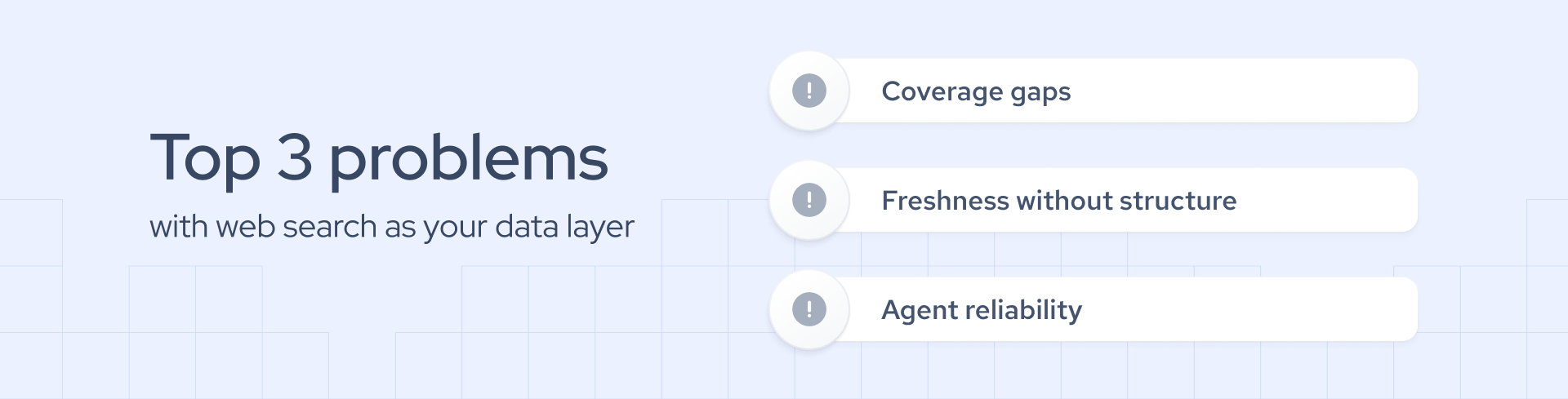
Agents that operate within a deep research agent stack and similar stacks face structural problems with web search as the primary data component. Here’s a snapshot of the main problems and why they matter:
- Coverage gaps. Web search only gets AI agents so far in interpreting key tasks relevant to the workflow. For instance, if the agent is pulling company information, web search indexes might not show companies with a low online presence and historical snapshots of staff changes and hiring trends. AI-ready B2B data APIs do.
- Freshness without structure. HTML pages are designed with human readers in mind, not autonomous AI agents. Besides being fresh, web search data also needs to be structured in a way that’s easy for the agent to comprehend.
- Agent reliability. Data quality is a major challenge here. Every component of the agentic stack has been solved except one: where do agents get reliable, structured, real-world data about companies, people, and markets, and how do they query it without breaking the loop? Stale data from web pages can lead to incorrect execution of research tasks, further compromising the workflow. By using data from a B2B data provider like Coresignal, such issues can be reduced before they affect downstream tasks.
What AI-ready data infrastructure actually looks like
The traditional B2B data infrastructure was built for humans, as data is delivered in a way humans understand best. The data is delivered in CSV exports, with monthly batch updates and fields optimized for readability in specific formats, like dashboards or spreadsheets.
It is even structured in a way that human analysts could understand, but it doesn’t work that way for agentic AI tech stacks.
Autonomous systems need data that can be pulled dynamically in real time. The data needs to be represented in natural language or in a semantic search context, and all responses must be available in JSONL, Parquet, and other machine-readable formats.
They need reliable and consistent schemas, freshness guarantees, and context understanding without preprocessing. That is where AI-ready B2B data APIs become relevant. They deliver data in an easily digestible format that easily blends into the agentic query loop.
Coresignal offers real-time datasets connected to APIs, direct API integration, and natural-language AI Data Search through its Agentic Search API. For instance, Coresignal’s Multi-Source Employee Dataset can help agents track workforce changes by leveraging structured data from public sources.
The real differentiator in 2026 is not only which model you choose, but how much control you keep as the system evolves. A practical setup might combine a reliable reasoning model, a production-ready orchestration framework, persistent memory via vector databases, and controlled access to tools such as web browsers, MCP servers, or structured data APIs.
Teams already using AutoGen can account for Microsoft’s migration path, while new builds should evaluate current orchestration options before standardizing.