


Five years ago, a company automating its sales tools and enriching leads with AI would have seemed like a distant future. Now, if you’re not using sales technology, don’t expect to beat your competitors.
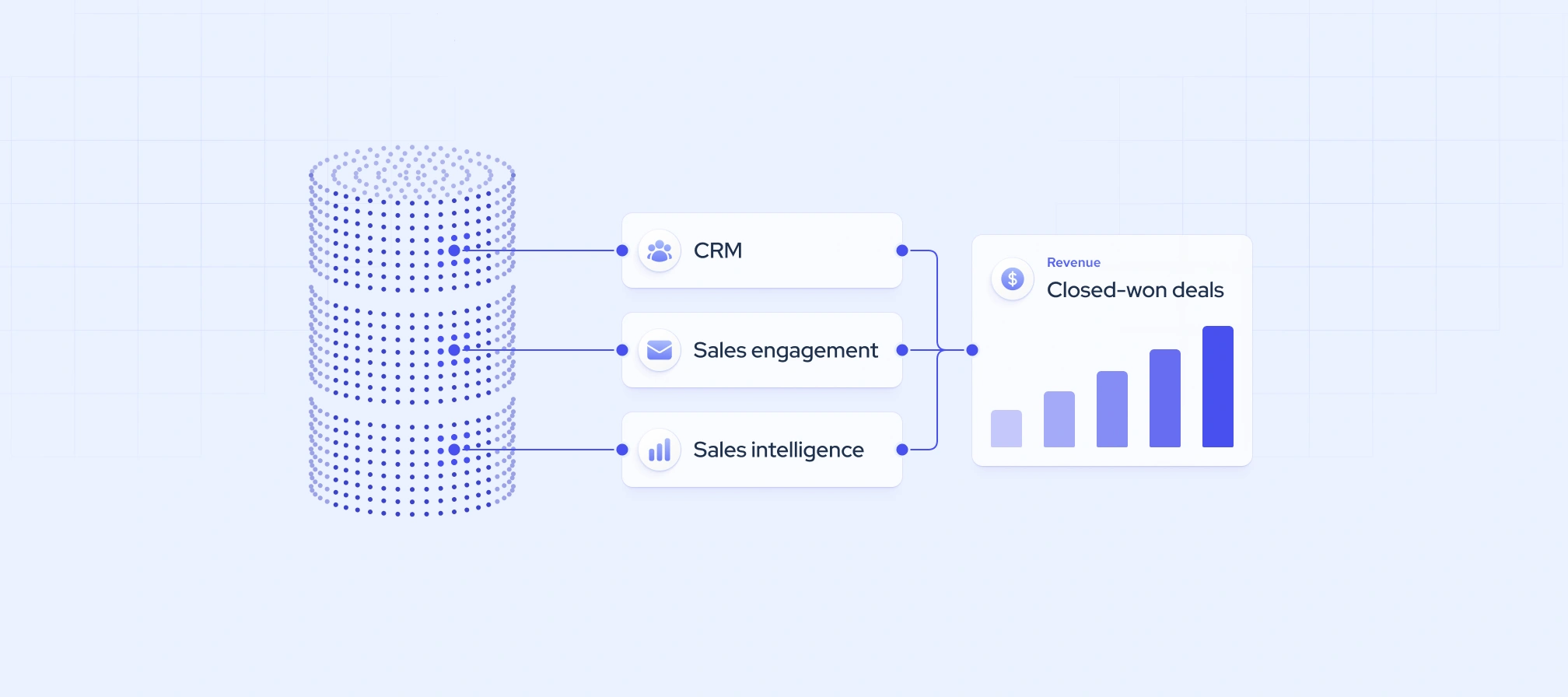
Sales technology is the software sales teams use to find prospects, engage buyers, manage pipelines, and close deals. Most teams already run several of these tools, from CRM and lead enrichment to communication and analytics platforms. The teams that get the most value from them share one trait: their tools run on accurate, up-to-date data about companies and people.
In this article, you’ll learn the main types of sales technology, the benefits they bring, how to choose the right tools for your team, and the trends that will shape sales technology in 2027.
What is sales technology?
Sales technology brings together a variety of software tools that streamline daily sales tasks. Different sales technology solutions help teams identify prospects, engage buyers, manage pipelines, and close deals more efficiently.
AI-based tools, such as CRM, sales intelligence, and sales analytics solutions, are inseparable from successful and streamlined sales processes. They alleviate much of the menial work required to proceed to the main task – selling.
3 main types of sales technology
When choosing the right B2B sales technology for your team and workflow, it can be easy to get lost in the wide variety of options. Here are the main categories of B2B sales technology that you can choose from.
Customer relationship management
CRM is undoubtedly one of the most important parts of sales tech for your company. Without this sales automation platform, you would be buried in the manual work of managing customer data and lead information. This tool should be the primary choice upon which all the other complementary tools are implemented.
The main reason behind it is that CRM logs all the emails, calls, and other website interactions for leads, prospects, and customers. If you had to enter and analyze all the data manually, it would consume a huge amount of resources that could be spent elsewhere.
However, a CRM is only as good as the data behind it. Company, employee, or jobs records go stale quickly as people change jobs, companies grow or shrink, and businesses relocate, rebrand, or get acquired. When records are incomplete or outdated, lead scoring breaks, outreach reaches the wrong people, and pipeline reports lose accuracy.
Keeping your records up to date is essential for accurate decision-making. With Coresignal’s B2B data APIs, you receive real-time, multi-source records that ensure your CRM always shows the most current view of a company, not just the details from when it was first added.
Tools for lead enrichment
It's not a surprise that generating and qualifying leads is a challenge that most sales professionals face. They can't sell to everyone who has indicated an interest if they don't meet the company's criteria. Manually researching the leads consumes a lot of valuable time and resources, yet it's not guaranteed that the time spent will bring an opportunity.
To prevent this unnecessary waste of resources, lead enrichment tools should be considered. Lead enrichment is the process of gathering the data on your leads minus the manual work.
To automate this task, companies can use a variety of sales tools. One of the examples is Coresignal’s MCP. With Coresignal MCP, you can connect an AI assistant like Claude or Cursor to multi-source company, employee, and jobs data. The process looks like this:
- Describe your ICP. Type a prompt like “Find marketing directors at U.S. software companies with 200-1,000 employees.” The assistant tells you how many people match and shows a preview of the first results.
- Narrow the list. Add criteria in the same chat, such as “Only companies that raised funding in the last two years.”
- Pull the final list. Ask for the records you need: “Pull the top 50 with name, title, company, and profile, as a file.” You get a JSONL file of complete records, ready for CRM import.
If you’d rather work in a browser, AI Data Search turns a plain-language prompt into a list you can preview, enrich with the data fields you choose, and export as a CSV file of up to 10,000 records. If you need enrichment inside your own product or CRM, the Company Enrichment API takes a company website as input and returns a multi-source company record in 176 ms on average, with only the fields you request.
In other words, with Coresignal’s tools you can easily automate the process and mitigate a huge load of tedious work while qualifying leads.
Communication tools
AI-powered communication tools help reduce the time spent on answering the same questions about a specific problem. A chatbot can be implemented into the website with prepared answers for frequently asked questions.
It's capable of supporting customers 24/7 and replying to elementary queries that have simple objective answers. It eliminates the need for salespeople to engage in repetitive tasks and allows them to focus more on increasing revenue.
However, live chats with actual human beings for more complex questions are useful, too. It increases the speed at which the leads are contacted. The fact is, people demand it and they expect to receive live customer support before engaging in an action. And AI-powered bots are not always properly equipped to understand or answer certain questions.
The takeaway is, chatbots are useful in terms of basic queries that could provide you with a lead, but at the end of the day, human interaction is the final factor that will define whether you make a sale or not.
Benefits of sales technology
Enhancing your sales technology has its price, but it also has its benefits that compensate for the investment. Here is a list of several benefits.
Motivates the sales team to operate more effectively
Motivation to do a job is one of the key aspects to avoid burnout by a hurricane of tedious tasks. One example could be call-logging.
One of the main tasks of sales reps is making sales calls to prospects. However, a big part of that is taking notes on every call. Naturally, it consumes quite a bit of time that could otherwise be spent on increasing revenue. Modern sales tech helps with that. The sales teams no longer need to log the calls, take notes all the time, and stress over the idea that they might have missed something. There are various call logging tools that do the work for you. It reduces stress and saves time that can now be used on more important parts of the job the sales rep actually enjoys doing.
Logged conversations become even more useful once you analyze them. According to a McKinsey case study, a Peruvian contact center used AI to review all of its 600,000+ monthly customer calls, up from less than 1% reviewed by hand. The system flagged promising sales leads and missed opportunities for agents to follow up on. Within 10 weeks, inbound service sales grew 40%.
Also, the sales reps who have time to improve their skills have a chance at becoming sales managers or sales leaders one day. On the other hand, those who are constantly stuck doing menial tasks that could be automated are lacking that time and missing out on opportunities to grow.
Enhances the sales process via automation tools
Sales automation tools, as discussed before, alleviate a great deal of manual struggles. Here is a list of the sales activities that could be automated:
- Data entry
- Call logging
- Taking notes
- Examining candidates
- Follow-up interactions with clients
- Approvals and updates
- Lead enrichment
After having eliminated the manual work for the aforementioned aspects, sales teams can now focus on the more important aspects of their job and start increasing revenue growth more effectively.
Provides the sales teams with a competitive advantage
Companies are realizing that sales technologies are necessary to keep up with the customer demands and the ever-increasing pace of the industry.
Automated processes that instantly respond to queries and collect more customer data on the potential lead can barely be called for comparison with sales reps who still use sheets and research the leads manually.
For instance, there are tools that could be integrated into the customer relationship management platforms that qualify potential leads according to a predefined set of criteria.
If a new lead comes to your website and makes an action, those tools will either qualify or ignore the lead based on its information. This way, sales reps do not need to identify all of the leads themselves and can only focus on those that have the potential to bring profit.
All in all, even though sales organizations can work without employing upgraded sales technology, it limits sales performance greatly. Furthermore, marketing and sales teams cannot fulfill their true potential and close more deals.
How to choose the right sales technology for my team?
Every company differs in scope and budget. Let's see some aspects to think about when selecting a sales technology.
Integrations with other tools
Multiple tools that aren't in sync with each other could cause more harm than good. Navigating between different platforms and trying to gather some insights might be confusing.
Therefore, selecting a tool that has the ability to be integrated with your lead capture forms and project management tools is essential.
After all, the main purpose of sales tech is to make your life easier, not burden it further.
Pricing
Keep in mind that free solutions are good but they're accessible to everyone. Which means little to none competitive edge. It depends on the scope of your operations, but if you're looking for tools, it probably means you need them at a premium.
Purchasing a tool is also a commitment since many providers look for recurring subscriptions. You might get a cheaper deal by committing to an annual subscription as opposed to a monthly one. Hence, you need to know exactly what you're looking for and have a clear purpose for what you're going to do with it.
Sales technology trends for 2027
Sales technology in 2027 is less about new tool categories and more about how well your tools, data, and people work together. Six trends will shape the year:
- AI agents become standard. Agents handle more prospecting, research, and follow-up across the sales cycle, so it pays to evaluate tools by the tasks they can complete end to end. Gartner predicts that by 2027, 95% of sellers’ research workflows will begin with AI, up from less than 20% in 2024, which makes seller enablement as important as the tools themselves.
- Data quality is the main bottleneck. AI amplifies whatever data it runs on, so clean, connected company and contact records become core infrastructure.
- Signal-based selling replaces static lists. Hiring spikes, headcount growth, funding rounds, and leadership changes trigger outreach at the right moment.
- Stacks consolidate. Teams cut tools that create data silos and favor platforms that integrate cleanly with their CRM.
- Sellers shift to judgment. As AI takes over research and drafting, reps focus on validating insights and building buyer confidence.
The teams that get the most from their sales technology won’t be the ones with the most tools. They’ll be the ones that run a focused stack on fresh, accurate data and reinvest the time AI saves into selling.


