Ever since the 1990s, quantum computing has been predicted to be just another decade away. Now, over 30 years later, that time might have actually come. As technology – particularly AI – developed and governments in the U.S., EU, and China became heavily involved in financing quantum computing, private investors were not far behind. But there are only a few ways for outside observers to predict when the breakthrough will truly happen.
One such way is by monitoring hiring trends. When companies start hiring more quantum physicists and software engineers, it may signal that a breakthrough is getting closer. Coresignal analyzed 25,000+ publicly available historical and current job ads that mentioned "quantum," narrowing them down to 9,500+ tighter matches, to see how quantum computing hiring has progressed and what is happening in the market now.
What are quantum jobs?
A quantum job is one built around quantum mechanics as the working technology. That covers a few core disciplines:
- Quantum hardware: building and calibrating physical qubits – superconducting circuits, trapped ions, photonics, neutral atoms
- Quantum software and algorithms: writing the code that runs on quantum processors or simulates them classically
- Quantum error correction: the physics and engineering of keeping fragile qubit states usable
- Adjacent fields like quantum sensing and quantum-safe cryptography: using quantum effects for ultra-precise measurement or securing systems against future quantum-capable attacks
All of these disciplines are essential to quantum computing – the field aiming to solve problems modern computers could never handle.
Searching "quantum" on a job board isn't enough to gauge quantum computing hiring. The word itself turns up in marketing copy, coursework listings, and unrelated job titles that have nothing to do with the underlying physics. That's why 25,000 job listings, while sounding impressive, aren't fully indicative of quantum computing development.
Coresignal's dataset started with 25,000+ job ads mentioning "quantum" anywhere in the listing, which we narrowed to 12,000+ that were relevant to the topic. But title-matching alone wasn't enough: a closer read found nearly 2,900 of those listings came from a single tutoring platform, posted under templated titles like "Quantum Physics Tutor" across more than 150 U.S. cities. These are real postings, but they're for contractors helping students with physics coursework – not for building or researching quantum technology.
Stripping those out brings the working dataset to roughly 9,500 quantum postings from 2023 till August 2026: hardware and systems engineers building quantum processors, software developers writing quantum algorithms, research scientists, and specialists in adjacent fields like quantum sensing and cryptography.
Quantum Boom: hiring trends 2023–August 2026
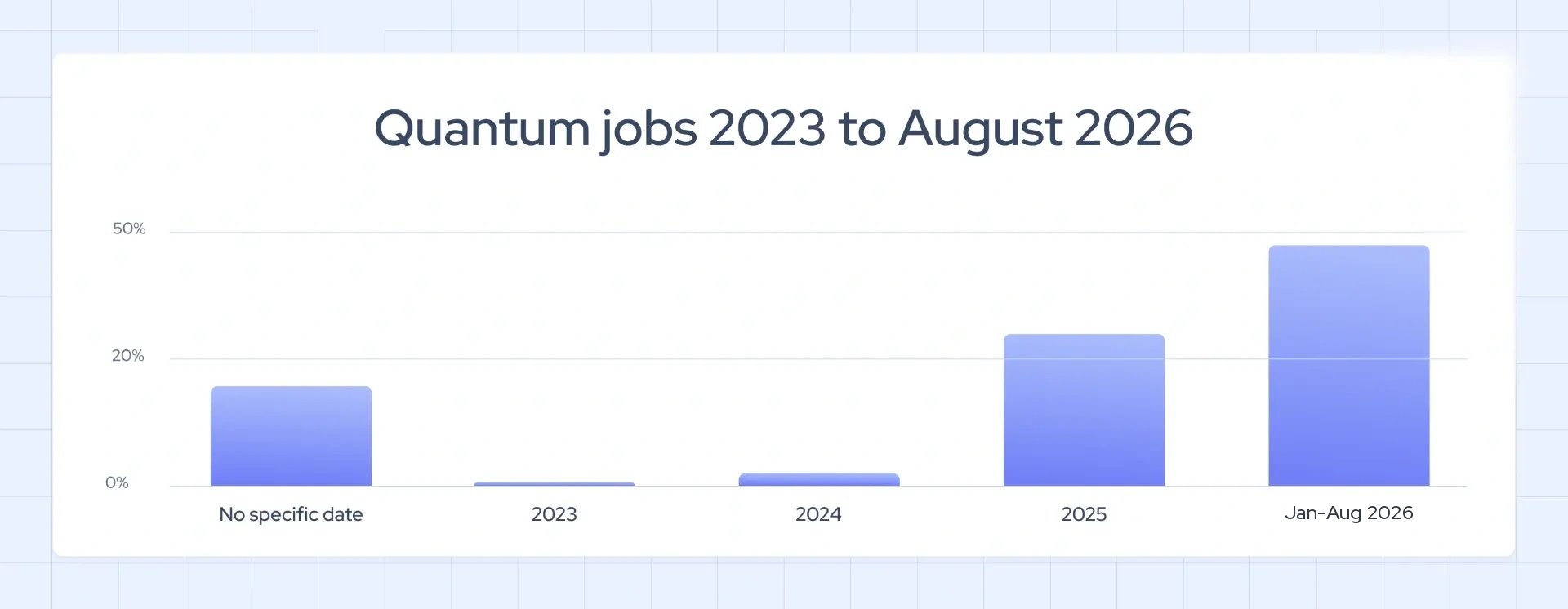
Almost four years ago, in 2023, quantum computing progress seemed as distant as it did in the early 2000s – steady, but unlikely to change the world before the end of the decade. That was especially true in hiring, with barely any quantum job ads on the main recruitment platforms worldwide.
Whether it was the emergence of major generative AI companies in 2022–2023 or a natural progression, hiring jumped by roughly 2,000% in 2024. Growth has been exponential ever since: the United Nations declared 2025 the International Year of Quantum Science and Technology, the same year governments worldwide began investing heavily in quantum computing. That coincided with a further increase in hiring of about 1,100%.
Note: The table does not include 2023–2026 records with no clearly defined date.
By August 2026, hiring had already surpassed all of 2025 – with at least four months, and traditionally busier hiring-wise autumn months, still to go before the year is even over. Comparing quantum job ads pre-2025 with post-2025 overall, the change comes to roughly 2,850%.
Google, Amazon, and Microsoft out of the Big 5 lead in quantum hiring
We narrowed down 12,000 quantum computing job listings to those whose descriptions match the kind of role quantum-developing companies would actually hire for, leaving 9,500 postings across the largest professional networks. These were posted by about 1,000 distinct employers, though some stood out in hiring volume.
Google is a clear leader in quantum hiring 2023-2026, posting nearly 200 more quantum job ads than the second-place IBM. Other top-hiring companies include Amazon Web Services (AWS), Infleqtion, IonQ, NVIDIA, Microsoft, Booz Allen Hamilton, Mercor, and Mindrift. Of the Big Tech's top five companies, only Meta and Apple are absent from the list. Check the methodology and limitations section to understand why.
Focus on low-to-mid level builders
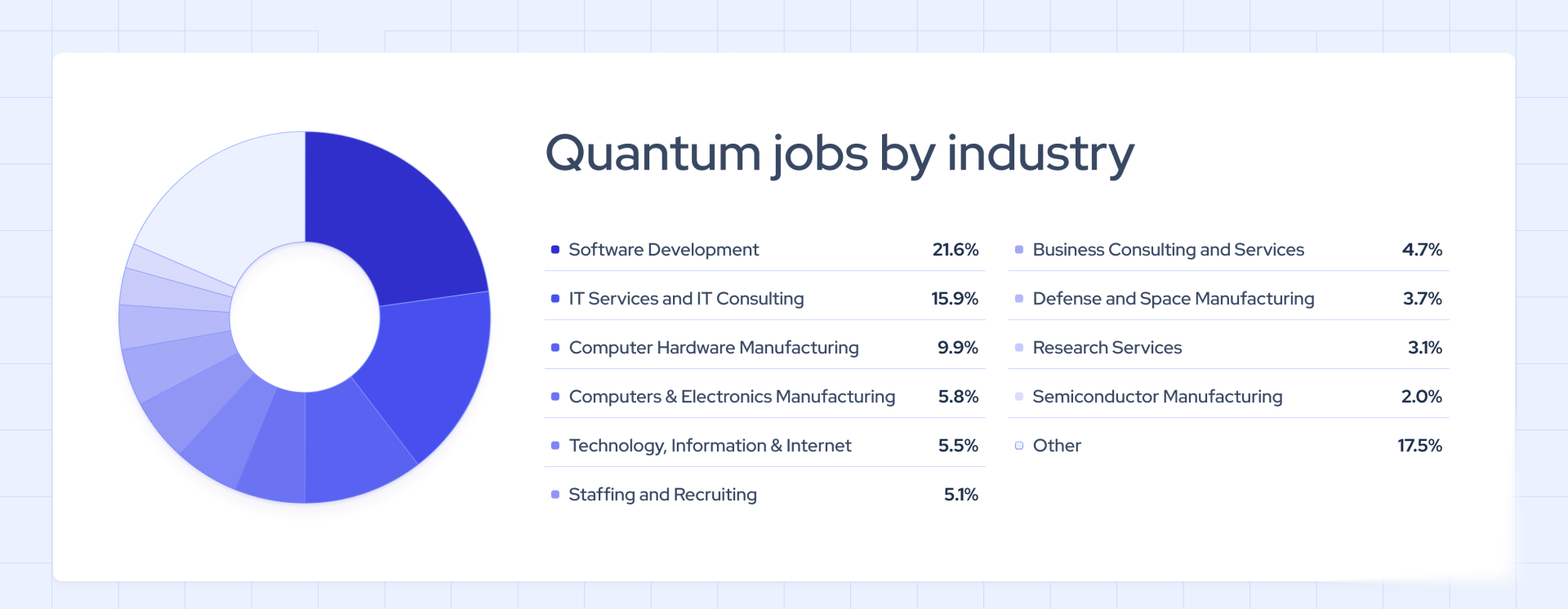
The biggest chunk of job ads is for software development roles – well ahead of the second-most-hired-for industry, IT services and IT consulting. Of the top 10 industries 2023-2026, 40% are quantum-building roles: hardware manufacturing, semiconductor manufacturing, or computers and electronics manufacturing. Other industries include research, consulting, recruiting, and infrastructure support (internet, technology, and information sectors).
Seniority levels are also mid- and entry-level heavy. The vast majority of job ads are looking for mid-senior level leads, followed by entry-level, internship, and associate roles. Directors and executives have the smallest share of quantum job ads. This seniority split shows quantum as an industry that's still growing and looking to expand.
The U.S. – leader in quantum hiring
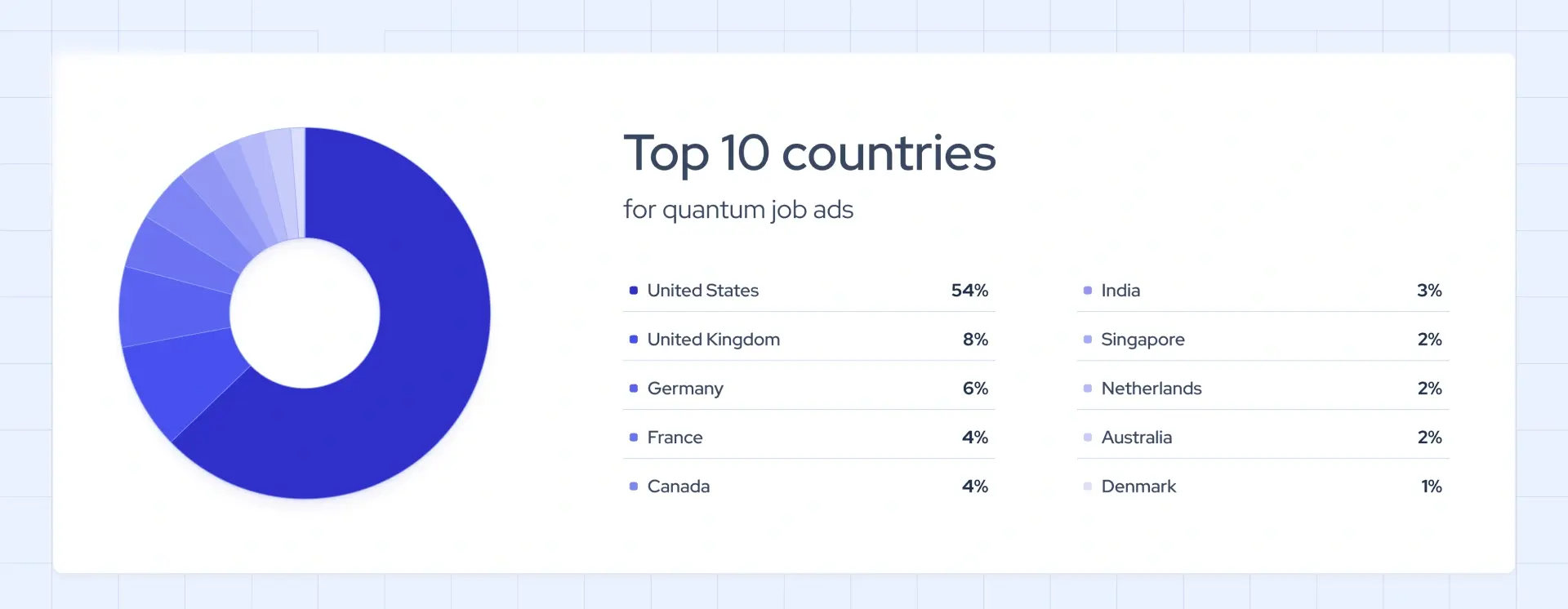
Based on Western job boards and aggregators, more than half of professional networks' quantum job ads are in the United States. Of the top 10 countries for quantum job ads, two are in North America, five in Europe, one in Oceania (Australia), and two in Asia. Outside of the U.S., the leading cities for quantum jobs are London, UK, and Paris, France.
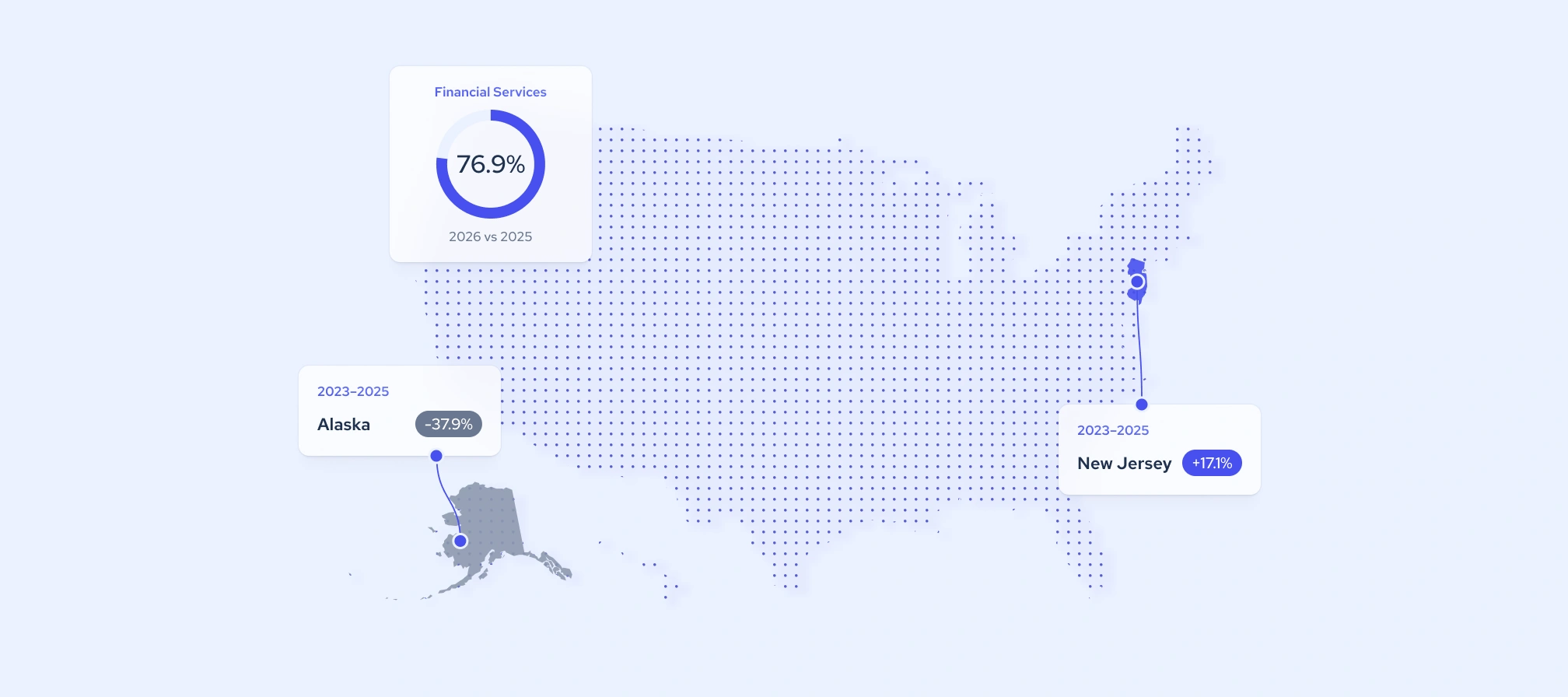
Unsurprisingly, the top U.S. state for quantum jobs is California, where Silicon Valley is located, followed by New York and Massachusetts. Hiring seems to cluster around established tech and research hubs (Bay Area, Boston/Cambridge) and government/defense corridors (DC–Virginia–Maryland). Goleta, California, is an interesting case – it's the city mentioned most often in quantum job ads, due to a notable photonics/quantum-sensing cluster located there.
The case of China
The jobs analyzed in the dataset are mainly from Western, English-language job boards and aggregators, which tend not to cover China's main quantum employers, such as USTC's quantum lab, Baidu, or Alibaba's quantum computing division. Government funding figures suggest China is nonetheless one of the top global players in quantum research and technology investment: one widely cited estimate puts Chinese government quantum spending at about $15.3 billion in 2022, compared to $8.4 billion for the EU and $3.7 billion for the U.S.
More recently, limited transparency around commercial quantum activity in China – along with a broader global shift from state funding toward private investment – has made it harder to gauge the country's quantum investment landscape today. However, China's 15th Five-Year Plan puts quantum first among "future industries."
What does it all mean?
Quantum hiring is genuinely accelerating, but its exact scale is unknown. Geography confirms a familiar hierarchy: the U.S. dominates, but China is likely not far behind.
Even with sourcing limitations, there is a clear upward hiring trend in 2025 and 2026. Not just in the U.S., though it shows the clearest improvement, but in Europe as well.
The main takeaway is that quantum hiring is real, junior-to-mid-level heavy (a field still building its bench), and potentially indicative of a major future breakthrough.
Methodology and limitations
- The study is based on Coresignal’s multi-source job dataset. We analyzed over 25,000 job ads that mentioned quantum, narrowing them down first to 12,000 quantum computing-related ones, then to 9,500 true quantum development roles. Job ad dates range from 2023 to August 2026. Some sources did not have dates associated with their postings. We labeled these as "No specific date," but all of them are from the 2023-2026 period.
- The study is based on publicly available English-language data from major professional networks and job boards. However, this means that smaller, company, or national job ad pages were omitted. This is a particularly prominent limitation in cases like China, where local job ad sites dominate over Western job boards, or in Big Tech company cases where companies might limit job postings to their own platforms.
- This study does not cover positions that job ads do not describe as quantum or quantum-related, but that could still lead to quantum computing development. For example, a company may search for a Research Scientist – Physics or a Silicon Engineer, but if neither the description nor the title mentions quantum, the role would be omitted from the study results.
- The study does not cover cases where companies are hiring their own researchers and specialists to work on quantum development, which is a significant limitation when covering large Silicon Valley companies. So, for example, Apple or Meta not being among the top 10 companies hiring for quantum does not mean that those companies are not investing in quantum development or do not have a team working on quantum computing.
- All findings are based on aggregated job posting data. The analysis does not use or disclose information about any individual.