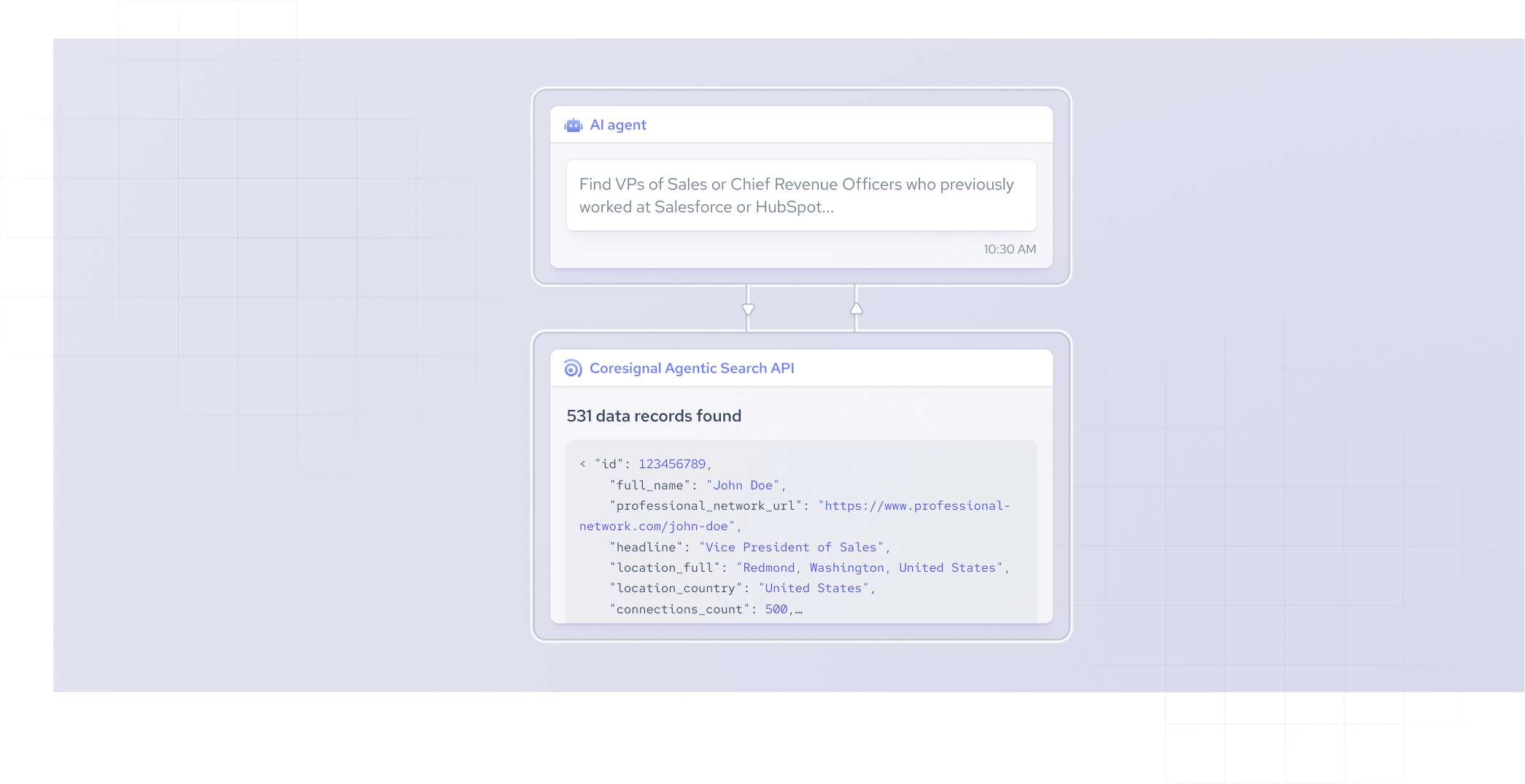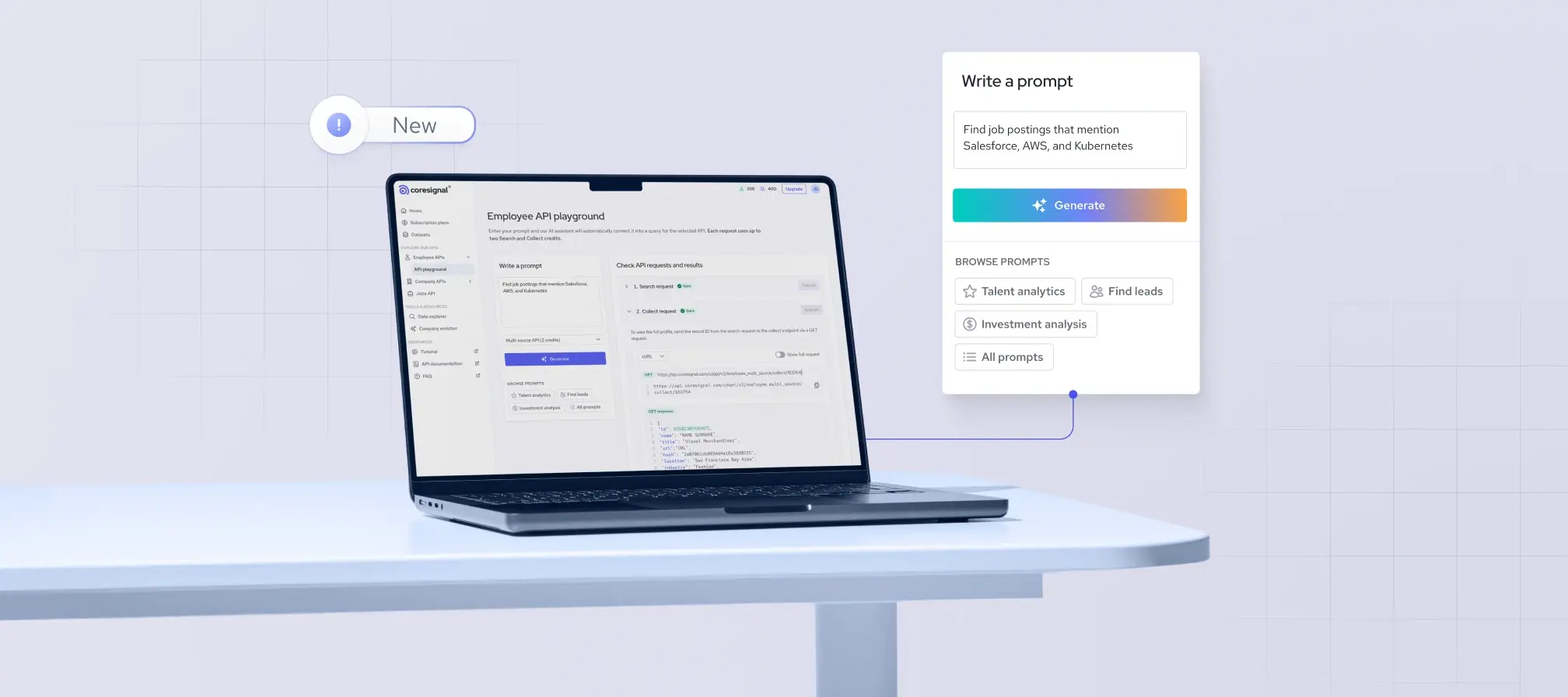


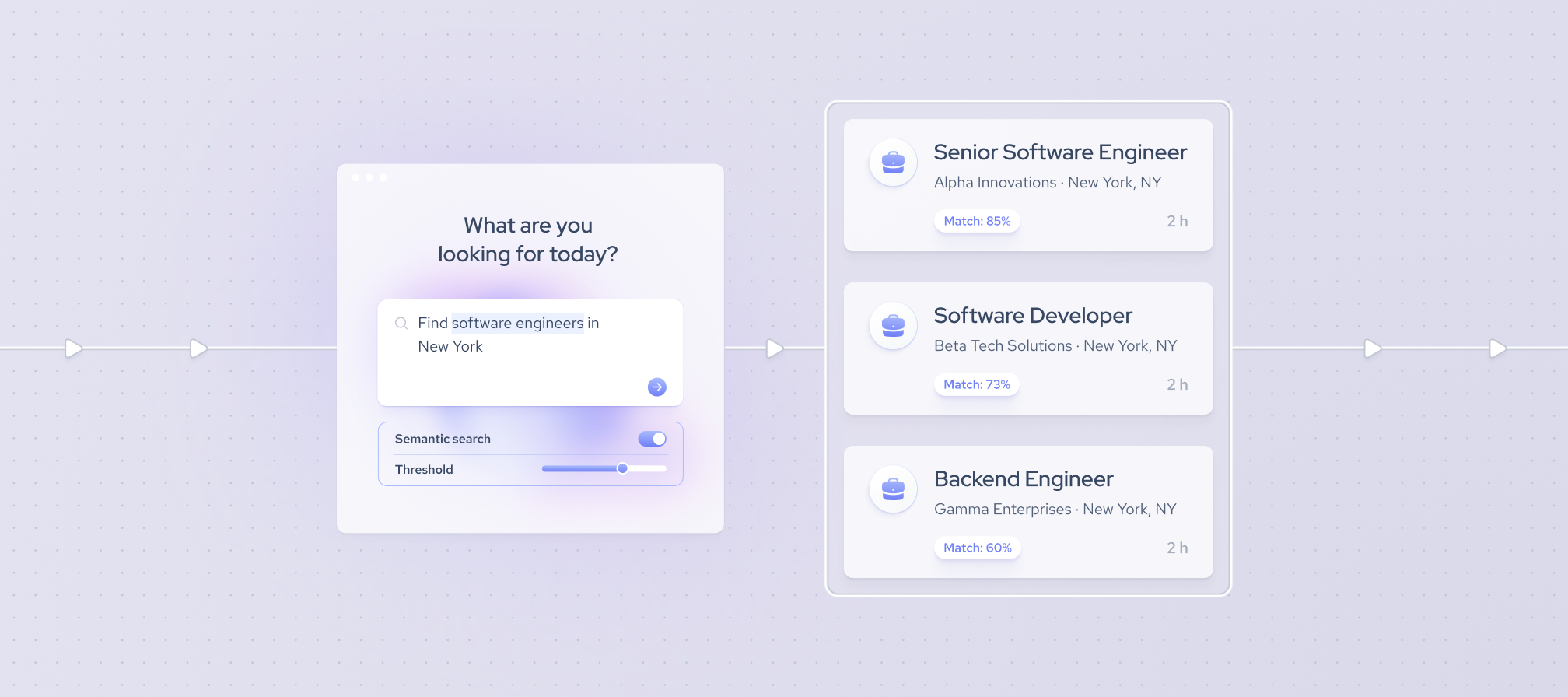
Finding the right people, companies, or job postings should be straightforward. But job title search still has a fundamental problem: it depends too much on exact keywords. Search for "Machine Learning Engineer" and you'll miss "ML Engineer," "MLE," and "Machine Learning Scientist", even though they describe the same role. Teams work around this by manually building lists of every title variation they can think of, or by accepting that their results are incomplete.
This is the keyword trap, and it's one of the most common friction points we hear from entrepreneurs building their products with job title data fields.
Today, we're introducing a new semantic search API endpoint that solves this issue accross company, employee, and jobs data.
What is semantic search?
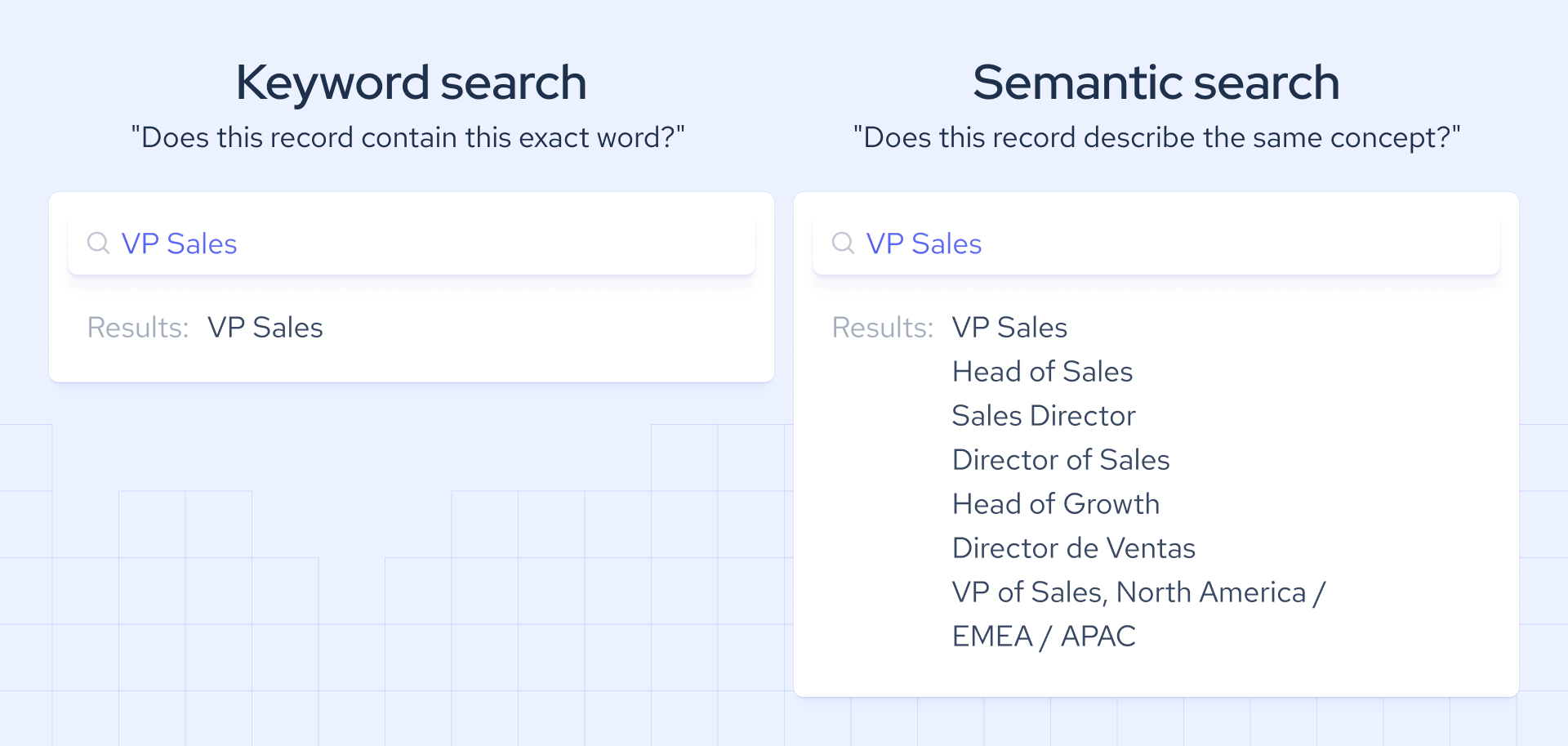
Semantic search is a search approach that understands the meaning and intent behind a query, rather than relying solely on exact keyword matches. Instead of asking "does this record contain this exact word?", it asks "does this record describe the same concept?"
In a job title search, semantic search helps connect different titles that describe the same or closely related roles. "Software Engineer" and "Software Developer" mean nearly the same thing in most hiring contexts, but a keyword-based system treats them as entirely different strings. Semantic search bridges that gap automatically. Coresignal's semantic title search is an upgrade to all Coresignal's data APIs.
Why should you try it?
- No synonym lists to maintain
- Minimal-friction adoption for existing customers
- No need to include variations, abbreviations, mistypes, or localized job titles
- Works across employee, company, and jobs data
- Full metadata on every synonym injected, with confidence scores
- A configurable threshold parameter so you control precision vs. recall
Semantic title search is available via three new dedicated endpoints (semantic_search/es_dsl, one per entity) that accept the exact same request body and return the exact same response shape as the existing search/es_dsl endpoints, plus a metadata block. Customers don't need to change their query format, learn a new schema, or restructure their integration. They just point their existing ES DSL payload at the new URL. The only change required is switching the endpoint they call.
How the semantic title search works
The feature is built on a specialized transformer AI model trained on job titles. From the customer's perspective, almost nothing changes:
- The customer sends an Elasticsearch DSL query to a new dedicated endpoint. The query format is identical to what they use today on /search/es_dsl.
- The system scans the query for match_phrase clauses on any eligible title field.
- If a title field is detected, its value is passed to the vector-based synonym model, which returns related titles with confidence above a threshold.
- Related titles are injected into the query before it's executed.
- The response includes standard results plus a metadata block showing exactly which synonyms were injected, to which field, their confidence scores, and whether seniority boosting was applied.
Customers also have direct control over two parameters: threshold, which sets the minimum confidence score for synonym inclusion (higher leaves you with fewer, more precise synonyms; lower provides broader expansion), and boost, which controls how seniority signals are weighted in the scoring.
The results returned will include various alternatives to the initial request:
{
  "metadata": {
    "threshold": 0.9,
    "synonyms_injected": [
      {
        "field": "active_experience_title",
        "original": "Software Engineer",
        "synonym": "Senior Software Engineer",
        "score": 0.97,
        "boosted": true
      },
      {
        "field": "active_experience_title",
        "original": "Software Engineer",
        "synonym": "Software Developer",
        "score": 0.96,
        "boosted": false
      },
      {
        "field": "active_experience_title",
        "original": "Software Engineer",
        "synonym": "Software Development Engineer",
        "score": 0.93,
        "boosted": false
      },
      {
        "field": "headline",
        "original": "Software Engineer",
        "synonym": "Software Developer",
        "score": 0.9,
        "boosted": false
      }
    ]
  },
  "results": [
    185081738,
    178124333,
    185265111,
    86488772,
    165294653,
    75832125,
    184599454,
    194119106
  ]
}
Semantic search for job titles across employee, company, and job data
The feature works across all three of Coresignal's core data entities, covering the fields where title-based search matters most:
- Employee data. Find people by current or past role titles across active_experience_title, experience.position_title, and headline. Catch candidates and professionals regardless of whether they wrote "VP of Sales", "Head of Sales", or "Sales Director."
- Company data. Identify companies based on role-related signals using active_job_postings.job_posting_title. Companies hiring for a specific function become findable through all the title variations they use in postings.
- Job data. Discover job postings across title variants using the title field. A search for one job title synonym now surfaces the full range of relevant openings.
This breadth matters especially for teams doing large-scale analysis, where even a small improvement in title recall compounds into meaningfully better data coverage.
Where semantic title search creates the most value
Who benefits most from semantic job title search?
- Recruitment and HR tech platforms
Recruiting automation depends on comprehensive candidate sourcing, and the title variation problem sits at the heart of why sourcing falls short. Platforms building talent matching workflows deal with hundreds of title variants per role. A search for "Product Manager" that excludes "Product Lead," "Group PM," and "Director of Product" leaves relevant candidates out.
Semantic title search handles this variation automatically, improving recall for every recruiter and end-user on the platform without requiring them to manage synonym lists.
- Sales and GTM platforms
Sales tech platforms that power prospect search by role live or die by result quality. Missing close title synonyms directly shrinks the addressable pipeline.
A search for "Chief Revenue Officer" that also catches "CRO," "VP of Revenue," and "Head of Revenue Operations" means more complete prospect lists, better automated outreach targeting, and higher pipeline quality, all from the same underlying query.
- Private investment teams
Investment teams tracking executive movements and leadership changes rely on finding people across the full range of titles they may hold or have held. A company founder might appear as "Co-founder," "Serial entrepreneur," or "CEO" depending on the company and region.
Semantic title search ensures role-based signals aren't missed because of how a specific individual chose to write their title.
- Market research and talent intelligence teams
Competitive hiring analysis and talent flow research require complete data. If a team is analyzing how companies hire for a specific function, missing title variations skews every downstream finding.
Semantic title search makes role category analysis more accurate by capturing the full distribution of titles that map to a given function, not just the most common one.
Semantic title search vs. manual job title synonym lists
What’s the difference between the manual title search and the semantic title search?