

.jpg)
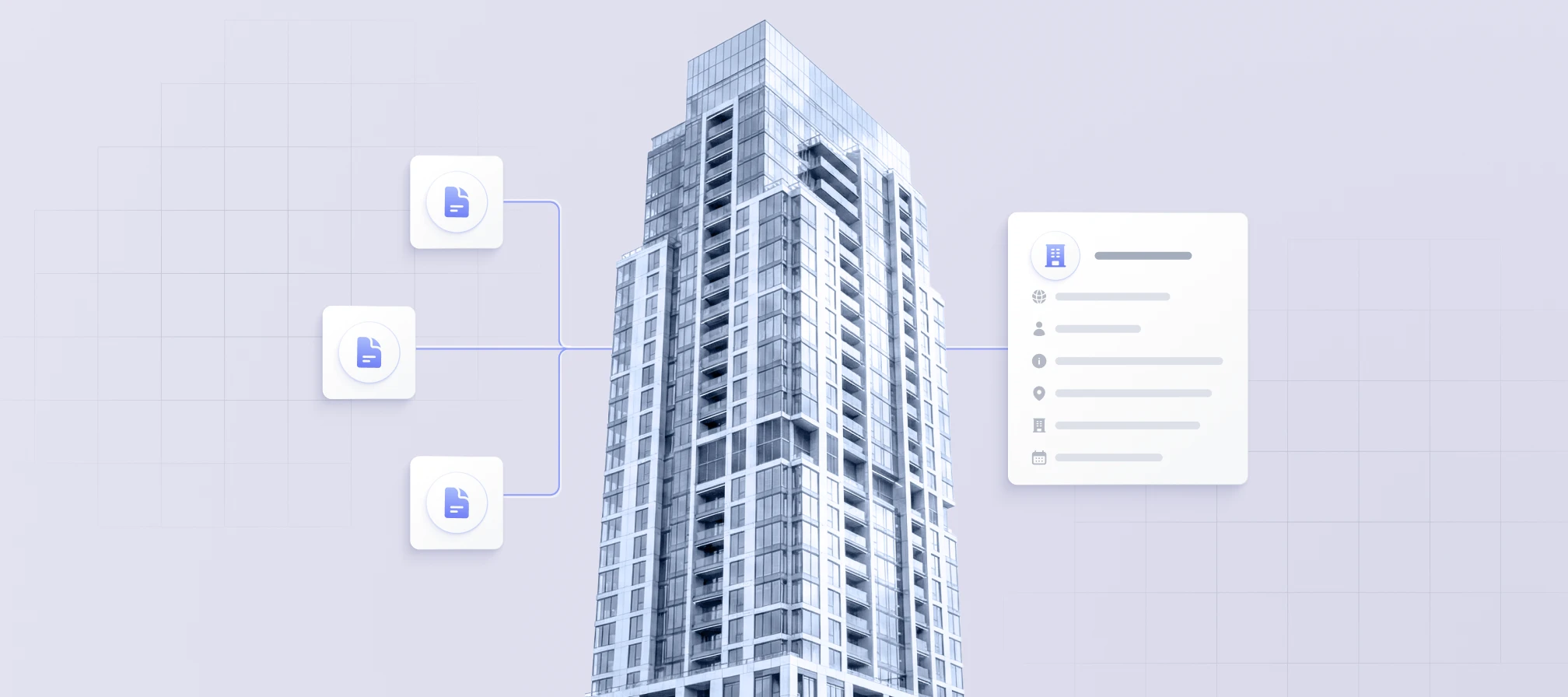
At first glance, finding accurate company information seems straightforward. In reality, the data is scattered across multiple sources, and no single provider offers a complete picture.
Every month, hundreds of thousands of new companies are registered in the U.S. alone. When you factor in the millions of existing businesses, the scale is enormous. Turning this volume of raw data into actionable insight requires careful collection, sorting, mapping, and cleaning.
In this post, you will learn where to find reliable company information, how public and private company data differ, and how to access large-scale data efficiently, without manual effort.
Main company information types you can source
When doing a company search for competitive analysis or researching companies for sales, partnerships, investment, or recruiting, it's all about finding the right data. You can uncover insights based on various data, from growth signals to hiring trends and market positioning.
We gathered key categories of business data you can source to help you understand and evaluate your target companies more effectively.
Public vs. private companies
Public companies have better access to capital but are more regulated, while private companies have greater independence but limited access to funding. Private companies might go public when wanting to raise capital.
Key characteristics of public companies
Public companies are corporations that sell ownership shares to the general public. Think about large corporations here - the list includes Apple, Microsoft, Walmart, or ExxonMobil. These companies have the typical corporate structure while management and strategy are assigned to a board of directors selected by the shareholders.
The shares to the public companies can be bought and sold on a stock exchange. Information about these companies is readily accessible to the public due to detailed financial and operational reports. Public companies have better access to capital through issuing corporate bonds in the public markets or selling new stock. On the other hand, they deal with stricter regulations from the government and shareholders.
Public companies are legally required to disclose operational and financial details, including quarterly and annual reports. Therefore, it makes it more difficult to find public company data from private companies.
Key characteristics of private companies
Private companies are businesses owned by a single person or a small group of individuals . It can be anything between a mom-and-pops corner shop to a large private company such as McKinsey & Company. They can be family businesses or larger corporations. These companies can be structured as partnerships, limited liability companies (LLC), or corporations. Their shares are not traded on public stock exchanges.
Private companies are more flexible: decisions are made quickly, owners have greater control, and processes are less complex and less strictly regulated. They're focused on raising capital through loans, private investors, and profits. Private companies are required to have fewer regulations and financial disclosure requirements than public companies.
Although it leads to a lack of transparency, it can be difficult for the public to find accurate, detailed information about these companies. In addition, their growth can be restricted due to private sources limiting access to capital.
What are the top sources of company information?
Public company research sources
When looking for public company information, these are the three best sources:
- Company websites and investor relations pages. Get public company information from company pages, social media channels, and their "About Us" sections, where annual reports are usually posted. Investor relations pages provide company descriptions, leadership information, press releases, annual reports, financial results, presentations, and other official announcements.
- Regulatory filings and stock exchange disclosures. In the U.S., public companies are required by law to file detailed financial and business reports. Also, public companies may be required to disclose ownership information, governance details, and material company events. Requirements and databases vary by jurisdiction.
- Financial and business news. For additional context of public company information and analysis from industry experts, check financial media and business information services. Reputable news sources can provide context about acquisitions, leadership changes, market performance, legal developments, and other significant events.
- Annual and quarterly reports. There you may find public company data on financial performance, business operations, risks, strategy, and management commentary.
- Company databases and data providers. Platforms like Coresignal can bring financial, firmographic, workforce, funding, and other company information together in a structured format, especially when researching multiple companies.
Private company research sources
When researching a private company, it is important to recognize that the available private company data is often less complete and less standardized than what you find for public companies. Private companies are not required to disclose their financials, so you need to rely on alternative sources. The most reliable options for private company information include local registries, business databases, and third-party research.
- News and industry publications. Press releases, job postings, social media, and company websites, are valuable for tracking private company developments. These sources can reveal private company data about funding, acquisitions, leadership changes, product launches, partnerships, and overall market activity.
- Company databases and data providers. They often offer detailed, structured private company information. Multi-source company data, such as that provided by Coresignal, allows you to combine and cross-check records from several publicly available sources. This approach ensures you receive deduplicated, integrated datasets that are ready for analysis. However, even when researching private companies, choose a data provider that stays in line with privacy guidelines and collects only publicly available data.
- Professional networks and job postings. They can offer insights into a company's hiring culture, workforce composition, and organizational changes. These sources help identify employees, executives, team structures, workforce locations, and career moves.
- Business registries and legal filings. These sources may provide legal names, registration status, company identifiers, addresses, directors, and ownership details, depending on the jurisdiction.
- Official company websites They are a primary source for business descriptions, product and service offerings, locations, leadership details, partnerships, expansion announcements, and other direct updates from the company.
- Funding and acquisition announcements. They provide valuable context about a company's growth stage, investor relationships, and recent business activity.
All of these sources help to build trusted company database and verify private company information.
How can you access company data at scale?
Company datasets for bulk access
If you need data at scale, company dataset is often the most efficient starting point. A bulk file delivers a large volume of company information records in a single package. This approach is ideal for building internal databases, mapping markets, or keeping your data warehouse up to date on a regular schedule. At Coresignal, our company datasets don't include private company data that isn't publicly available. They are also designed for bulk access and real-time refreshes. For example, you can use our datasets to access millions of company records for broad market coverage or large-scale research.
Company data APIs for flexible access and enrichment
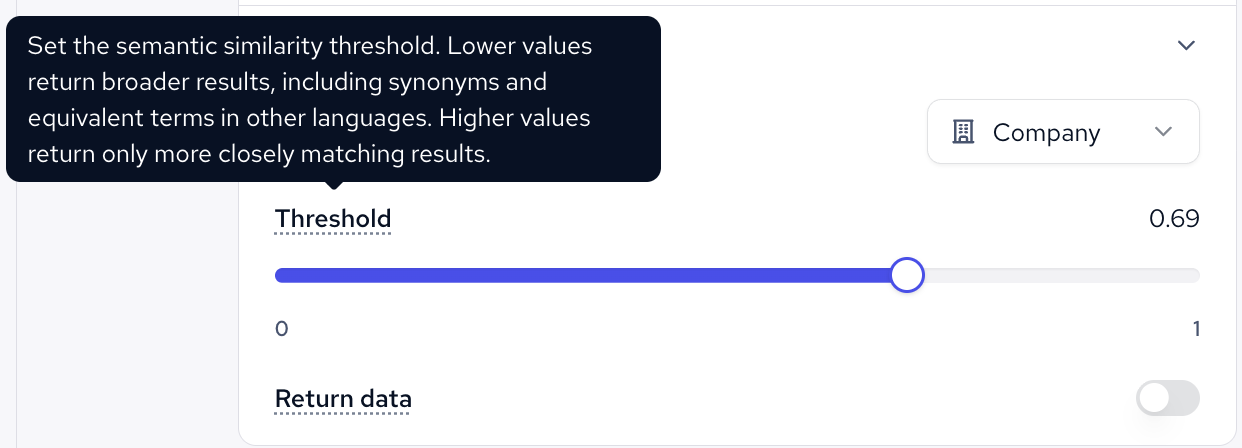
APIs are the right choice when you need flexibility in your workflow. Instead of downloading a full file, you can search, collect, and enrich company records as new leads enter your CRM, as sales teams review accounts, or as your product needs up-to-date company details. Coresignal offers several company data API options to fit different data needs, including solutions for both bulk collection and enrichment. For example, our semantic search API endpoint automatically expands title queries using a specialized AI model. This means you get broader results from the same queries, with no changes needed to your integration. Semantic search understands the meaning behind each query, so you get automatic coverage of title synonyms.
How to find company information?
If you're curious to get company information easier, sign in to our self-service platform for free. There are multiple ways to access company data, including the AI Data Search tool and the Company API Playground. You might want to try these options to find the one that works best for you.
All of these tools will help you find company contact information, verify business information, and search business information that is available on multiple sources.
Explore company data with AI Data Search
Coresignal's AI Data Search lets you find the company data you need without learning complex query syntax. Just describe your criteria in plain language, such as "Find early-stage startups with funding history, founders, and investor details". The platform instantly returns matching company records.
As your research develops, you can use our data dictionary to check all data fields with explanations available in the Multi-source Company data and expand your list by adding employee or job posting data, and fine-tune your results.
Export up to 100 records for a quick preview, or generate an enriched JSONL file with up to 10,000 multi-source records when you are ready for the full dataset. You do not need to navigate filter menus, memorize field names, or learn a new query language.
Agentic search API playground with semantic search
If you want to bring natural-language search into your own product or workflow, the Agentic Search API makes it simple. It offers two endpoints.
- The
/fastendpoint uses a streamlined schema for speed and cost efficiency, ideal for high-volume, programmatic tasks such as AI agents or product search. - The
/reasoningendpoint uses the full data schema and automatically detects entity types, making it a better fit for complex, multi-criteria queries where accuracy is critical.
Both endpoints support semantic search on job titles, expanding queries with synonyms to improve recall.
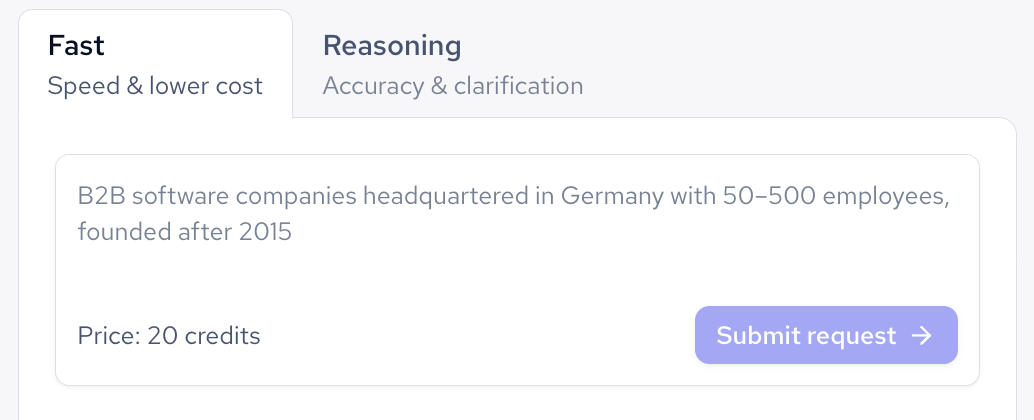
When you enter a prompt, the system goes beyond processing your exact words. It identifies your intent and focuses on your goal. Next, it chooses the right data sources to query, using the entities and filters it detects. The result is clear, structured output you can act on immediately, without the need for manual sorting or extra interpretation.
If you prioritize easy integration, Coresignal MCP with OAuth connects company, employee, and jobs data directly to MCP-compatible AI assistants such as Claude or Cursor. Tools like entity_search, entity_fetch, entity_fields, and email_enrich allow an AI assistant to query and enrich records directly in a chat interface. You do not need to build or maintain a custom integration layer.

How to automate company information sourcing?
With Coresignal, automating company information sourcing is simple. You start by describing the data you need in plain language using our self-service tools. This makes it easy to test and refine your search until you find exactly what you are looking for. Once you have identified the right data, you can connect it directly to your workflows using our API or integrations.
- Choose the right data. Start by identifying the specific company data your workflow needs. Think about whether you want to discover new companies, enrich your current records, or monitor important business signals like funding, headcount, or technographic changes. Defining these needs from the start helps keep your data strategy focused and effective.
- Select the right data access method that fits your workflow. APIs work best for on-demand search, enrichment, and live integrations. If you need bulk access or plan to process data in regular batches, datasets are often the better choice.
- Automate your workflows with integrations. Use the MCP server with OAuth for MCP-ready platforms, or connect through integrations like n8n, Zapier, Clay, or your own custom solution. This way, your data flows exactly where you need it.
- Add related business signals where useful. Supplementing your company data with employee or job posting data gives you important context on workforce, leadership, or hiring trends. This supports deeper analysis and more informed decisions.
- Keep monitoring and refining your process. Regularly check your search criteria, field mappings, failed requests, duplicate records, and the relevance of your results. This helps ensure your data stays accurate and actionable.
How does multi-source data add context to company profiles?
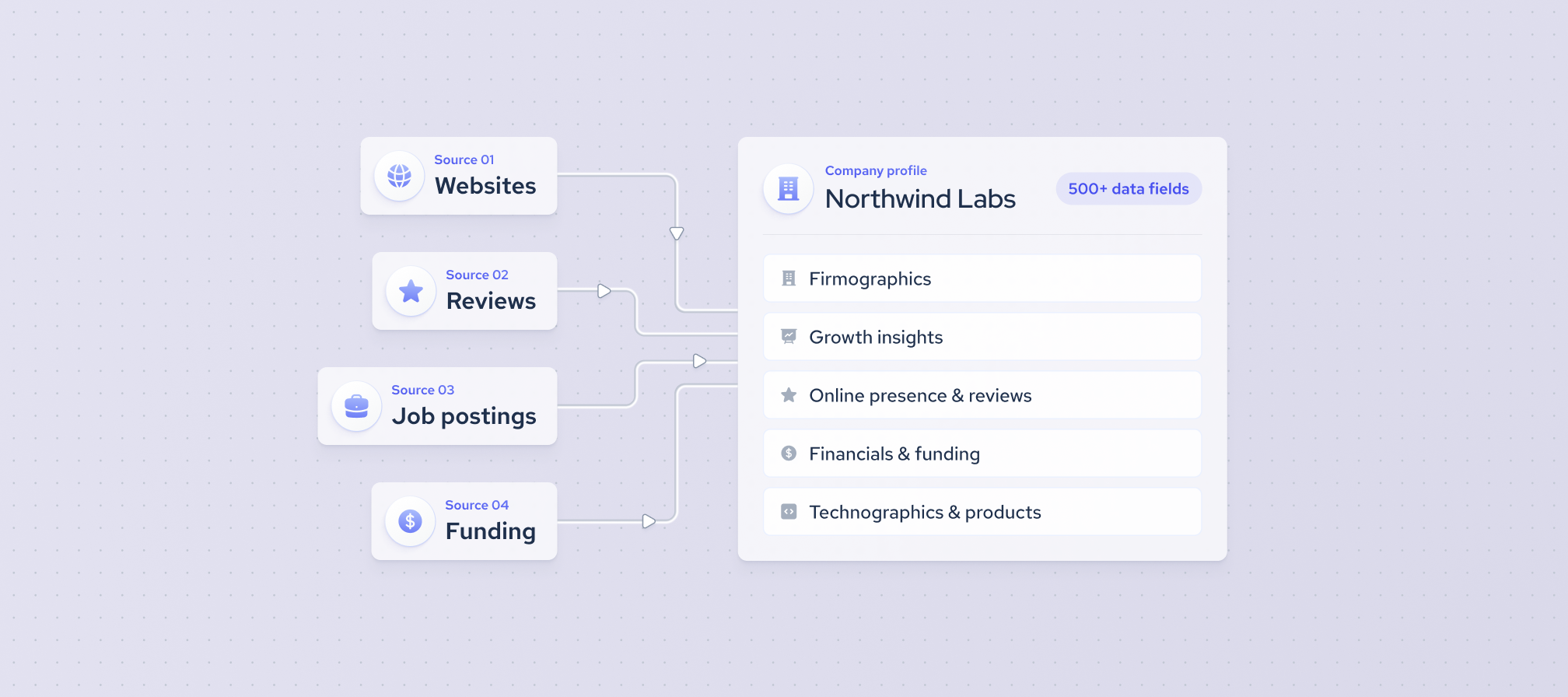
The value of company data depends on its depth and structure. A basic record with just a name and website offers limited insight. In contrast, company profiles with more than 500 fields spanning firmographics, funding, workforce, and technology provides the context you need to make informed decisions. Coresignal’s Multi-Source Company Data delivers this depth, offering broad field coverage, robust structure, and enrichment so you can act on insights immediately.
- 500+ data fields. Company profiles cover a wide range of firmographic, financial, funding, workforce, product, technology, review, online presence, and growth-related attributes.
- Multi-source data. We map and combine company information from multiple public sources into unified company records. This approach adds context and fills gaps that single-source data often leaves behind.
- Analytical and historical data fields. The dataset includes insights based on historical trends, such as changes in company metrics over time. This helps you evaluate workforce development, online activity, and other growth signals with confidence.
- Structured and ready-to-use data. Records are normalized, standardized, filtered, and deduplicated, so you can search, analyze, and integrate them into your systems without extra effort.
- AI-enriched data fields. AI-driven enrichment fills information gaps and adds new fields, including enhanced company descriptions, relevant categories, and extracted keywords.