



Business records go stale faster than a piece of bread left in the sun. People change jobs, roles within companies shift, and entire organizations relocate and change their funding methods. Stale information costs teams millions, especially with the modern-day AI systems and CRMs that require accurate information for automated workflows.
The results of Gartner’s study show that poor data quality costs organizations over 12.9 million on average, and that’s the per-year figure. That’s why companies like Coresignal enrich B2B data with daily verification and updates.
In this guide, I will address some of your main questions about B2B data enrichment and how it works, using real-world examples. We’ll also take a peek at our enrichment workflows from the dataset standpoint to learn about the potential benefits.
What is data enrichment?
Data enrichment is the process of enhancing your existing B2B records with additional, relevant information. It helps determine the company location, size, and industry for lead routing. In addition, it identifies the workforce and the tech stack and provides insights into competitive pricing, product marketing, and other business efforts. Therefore, common enrichment fields include company size, industry, location, technologies used, people, and jobs data.
In reality, I’ve seen how data enrichment leads to better segmentation, quality AI workflows, and more precise B2B data analytics.
How does data enrichment work?
Data enrichment works in steps that include auditing the existing records, choosing identifiers to match them to an external source, verifying that source, and mapping the returned fields to the schema. The enriched data is then backed into the record system.
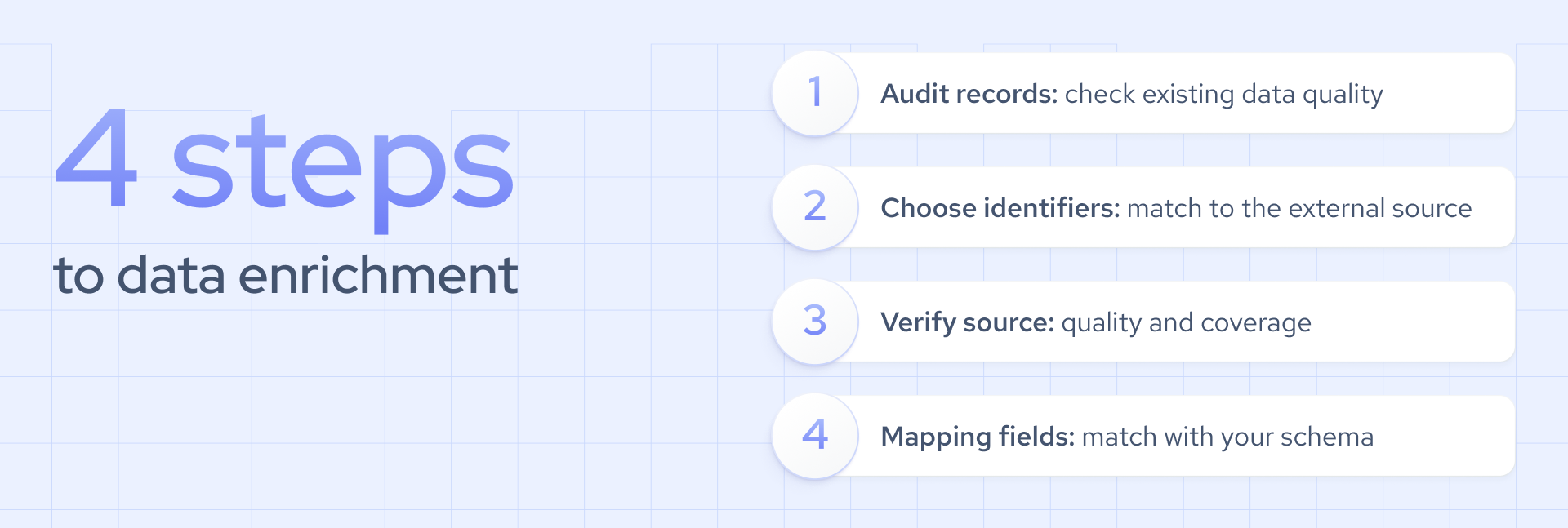
Some of the main identifiers include company domain, name, email, profile URL, location, and account IDs. Matching those identifiers is crucial for the process, as enriching the wrong records leads to poor AI workflows and inconsistent use of information.
That’s why it makes more sense to match records by URLs rather than by items like the company’s name, since this can lead to poor matches when multiple organizations operate under similar names.
The process doesn’t end here, though. Data enrichment continues through deduplication, validation, and everyday refreshment by providers like Coresignal.
What is included in a typical data enrichment service?
Instead of single data feeds, there’s a whole range of categories included in a typical data enrichment service for CRM platforms. The main data types include firmographic data (industry, company size, location, structure), employee and contact data, technographic data (digital infrastructure, tech stack used), jobs data, and financial signals.
All those categories enrich data fields, such as company name, domain, size, industry, job title, seniority level, workforce department, and contact details. Companies then pull such data to get a real-time view via APIs or get a representative dataset exported in a CSV format.
Enriched data can also be obtained as a webhook for tracking the changes or as files ready for CRM automation. Here’s a brief overview of the enrichment categories and fields:
What is the difference between data enrichment and data cleansing?
Data cleansing refers to fixing the existing information. Enrichment means adding a new, external context to make the info more complete. For instance, cleansing a record might involve removing duplicates, fixing typos, or correcting invalid fields, whereas enrichment adds new information that confirms the underlying data.
Let’s say you wish to pull company-level information about a business whose investment strategies you’ve been eyeing. Cleaned data would give you some basic insights, but enriched data will closely explain the business, its size, technologies used, people, and funding signals.
For the most accurate results, I suggest always cleansing your data before enriching it.
What are the main data enrichment use cases?
Enrichment serves a wide range of purposes that a company might have for its data. I’ll cover the main applications, from AI data enrichment to CRM optimization:
CRM enrichment
Enriched firmographic and professional data is refreshed daily, which is why it’s considered a great basis for filling in the gaps in CRM records. Specific fields that add the most to CRM enrichment include company size, location, seniority, and industry.
Lead enrichment and lead scoring
Companies that rely on scoring models can enrich inbound leads with firmographic and technographic nuances, ranking them with the ideal customer profile in mind. Without verified, up-to-date inputs, good leads can be easily dismissed by lead-scoring software.
Marketing automation and segmentation
Knowing the precise info about a company’s tech stack and its people also leads to more accurate and effective marketing strategies. Businesses tailor their campaigns based on factors such as industry, size, region, and technology.
Sales personalization
Sales representatives use enriched information such as funding signals, job data, and employee data to optimize outreach. Knowing these details gives reps insights that go far beyond basic customer records, helping them optimize their messaging, ICP targeting, and lead prioritization.
Account profiling and market research
Enriched data can use employee, firmographic, and funding data to turn basic information into actionable insights. This way, companies get a complete picture of the target accounts and markets for competitive intelligence and structural comparisons.
AI tool and LLM workflow enrichment
AI tools and workflow automation systems are only as good as the data they’re being fed. Enriched data provides structured and current B2B information, preventing AI models and agents from acting based on sheer assumption and ensuring their decisions are grounded.
Take McKinsey’s survey as an example. In 2024, the company’s review of the early state of AI confirmed that approximately 70% of high-performing organizations experienced difficulties with data governance and accuracy. As a result, there were issues when implementing that data into AI models.
With enriched, structured, and multi-source data obtained from providers like Coresignal, integrating AI tools into workflows gets a lot easier.
Product data enrichment and data-driven platforms
With enriched company, employee, and jobs data, companies can boost their HR, sales, and investment efforts. Given the critical role of this information, maintaining comprehensive coverage and timely updates is essential for proper application.
How to use an API for data enrichment?
Companies can use a data enrichment API to retrieve structured, enriched fields and sync them into their workflow. A platform like Coresignal’s B2B Data API gives instant access to real-time data on over 75 million multi-source company profiles with more than 500 data fields each.
All you have to do is fill in some basic inputs, such as the company name, work email, profile URL, or job title. The API does the rest, pushing out enriched data within seconds. Detailed outputs include firmographic, technographic, job, and employee data, along with other signals, all neatly packaged in AI-ready formats like JSON.
From there, you can use the information however you see fit, including market segmentation, CRM updates, or AI model training and automated workflows. It’s the simplest, fastest, and most convenient form of data recovery, suitable even for non-technical users.
Using natural language and Agentic Search for data enrichment
With Coresignal’s Agentic Search API, AI agents can query B2B data in natural language, without any need for format conversions. Traditional APIs, on the other hand, use predefined endpoints, filters, and identifiers.
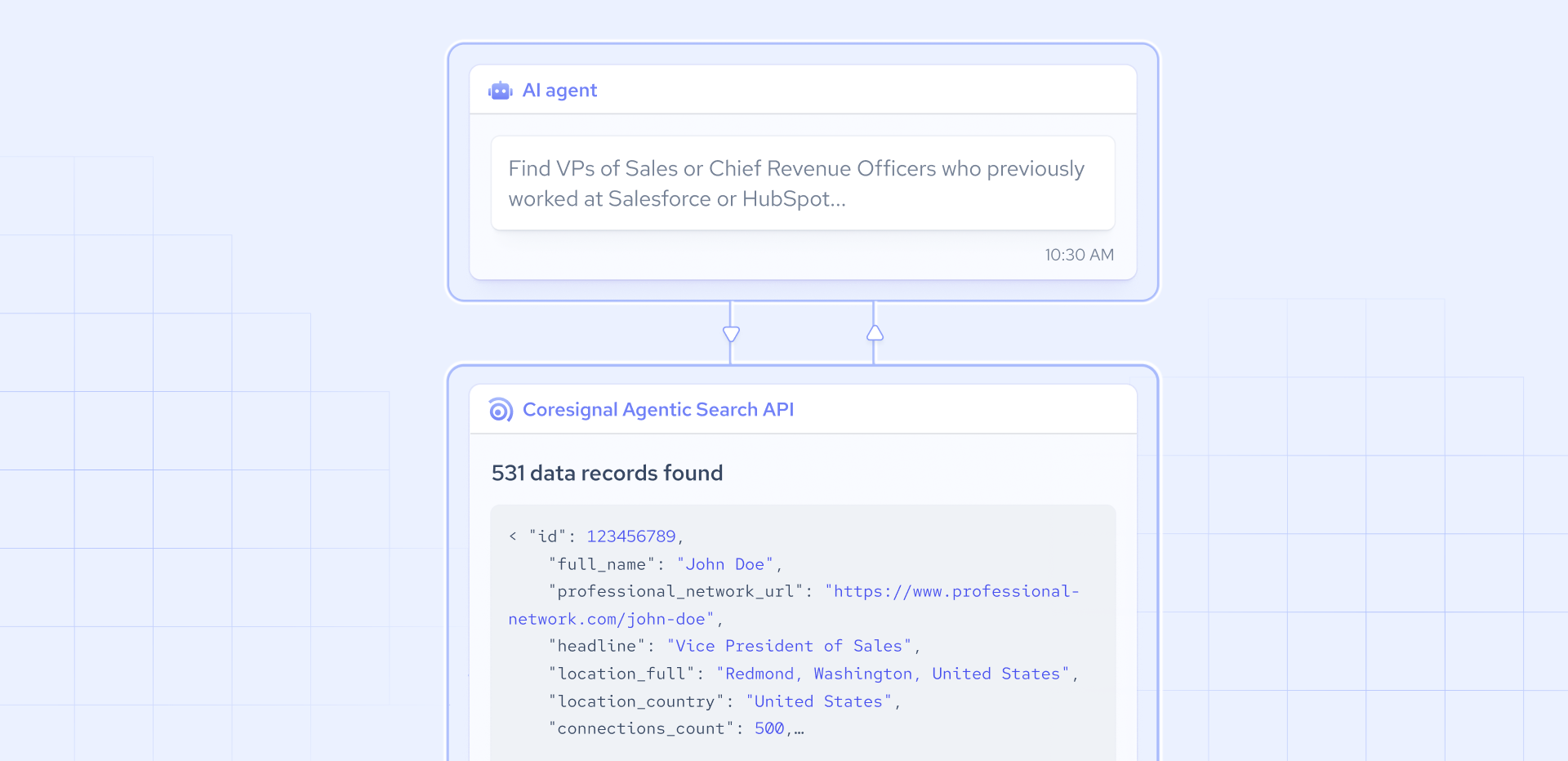
That’s the key benefit of an Agentic Search API: it makes the data easily obtainable and instantly usable by autonomous AI agents and non-technical human users. The output can still be used for segmentation, CRM updates, or AI workflow purposes, only with faster retrieval and agent-based optimization.
How to integrate data enrichment into a marketing automation system?
Data enrichment integration starts with a simple form submission, a newly routed lead, or enrollment in a campaign. If the system shows that records exist, but they’re not enriched, the next step kicks in. You can call on the API or use a workflow integration dataset to get the missing fields.
From there, they’re used for segmentation, scoring, routing, personalization, and campaign triggers. Naturally, there’s a certain level of monitoring required. That’s where the deduplication, validation, and refresh accuracy kick in to ensure the fields stay current and keep a clear field mapping for workflow integration.
What are the top data enrichment providers available right now?
The right choice of a data enrichment provider plays a key role in the quality of data you’d be getting. There’s no single best option, as it all depends on your use case, data coverage, preferred delivery format, and integration needs.
For instance, Coresignal makes sense for companies in need of large-scale B2B datasets, AI-ready APIs, and daily-refreshed datasets. On the other hand, People Data Labs is a solid choice for company intelligence enrichment, with people-focused data products. Here’s a detailed overview of the biggest providers so that you can find the one that suits your needs best:
Where can I find real-time data enrichment providers with API access?
Providers like Coresignal give users a chance to access enriched data via APIs. This format guarantees continuous collection and updating of information, as it’s a real-time overview of the data, not just a dated snapshot.
To find a fitting provider, check the update frequency, latency, and identifiers used. If you need enriched data for AI model training, make sure the APIs are AI-ready and provide information in machine-readable formats.
Different providers offer APIs best suited for CRM integration, product features, marketing automation, and AI workflows. Some even provide webhooks or change tracking to keep you in the loop as the records change.
How much does data enrichment cost for enterprise use?
The cost of data enrichment for enterprise use depends on several factors: the volume of data needed, categories included, delivery formats, geographic coverage, and refresh frequency.
Plus, going with a provider that offers real-time APIs often comes at a slightly higher price than plain bulk-dataset-based services. In some cases, providers like Coresignal give you free testing credits, allowing you to test the API’s performance for free and see if it’s the right fit.
Where can I buy a complete dataset for data enrichment purposes?
You can buy datasets from providers like Coresignal. Available dataset types include company data, jobs data, employee data, technographic data, financial data, and more. These are useful for detailed analytics and AI model training.
Multi-source datasets are the best option, as they’re already verified by comparing records across numerous websites and company pools. Pricing might depend on the output formats, including CSV, JSON, JSONL, Parquet, and custom deliveries.
Ultimately, it all comes down to your needs. While datasets are sufficient for bulk enrichment, APIs are better suited to real-time workflows.
What should you look for in a data enrichment provider?
Start your search by focusing on the basics, such as target market coverage, data freshness, and match accuracy. You’ll also want to know where the information comes from, so check the source transparency before you weigh delivery options.
Go through the available formats to see whether the provider can scale as your operations grow. Not even the strongest dataset can compensate for weak documentation or the lack of deduplication and data validation, so these are all important to consider.
Last but not least, match the provider to your needs. With all the info from this guide, you’ll be able to tell which provider suits your use case (whether it’s CRM, marketing, sales, or AI training) best.
How Coresignal supports data enrichment
As the leading provider of enriched B2B data, Coresignal offers company, employee, and jobs data via APIs and bulk datasets. Over 4.5 billion records are updated daily, with the multi-source information pulled from professional profiles, company records, and talent pools.
Delivery formats include APIs, datasets, webhooks, self-service tools, and the Agentic Search platform, suitable for a variety of tasks, from CRM enrichment to lead scoring, AI workflows, and data products. It’s a single solution for AI model training, non-technical users, automated workflows, and monitoring updates.
.webp)