

Reliable business data is important for a company background check, as it lets you learn about its operations and management and identify potential risk signals needed to make decisions when partnering with other companies or seeking investment opportunities. Keep reading to learn how to verify a company by checking its background.
What is a company background check?
A company background check is a review of important facts about a business necessary to assess risk before a commercial relationship or transaction. It gathers information about how the company runs, its past performance, market position, tech stack, and more. This process also helps confirm whether the business follows laws, uses good practices, and is financially strong.
Key elements of a company background check include:
- Legal compliance. Check company information regarding its active business licenses, statutory registration status, industry-specific permits, and litigation history to ensure adherence to relevant laws.
- Ownership and structure. Check key executives, board members, parent companies, subsidiaries, and individual beneficial owners to clarify governance and control.
- Financial stability. Analyze financial statements, credit ratings, outstanding liabilities, and payment histories to assess liquidity and long-term viability of a business.
- Public reputation. Review regulatory enforcement actions, client reviews, news coverage, and market standing to evaluate operational and reputational risk.
Running a company background check prevents you from losing money to dishonest or unstable businesses and protects your interests when building business relationships.
Why is verifying company information essential for businesses?
Verifying company information helps businesses evaluate potential partners, investment targets, vendors, or customers. Reliable business data can also help you identify potential risk signals and make informed decisions.
Benefits of verifying business information
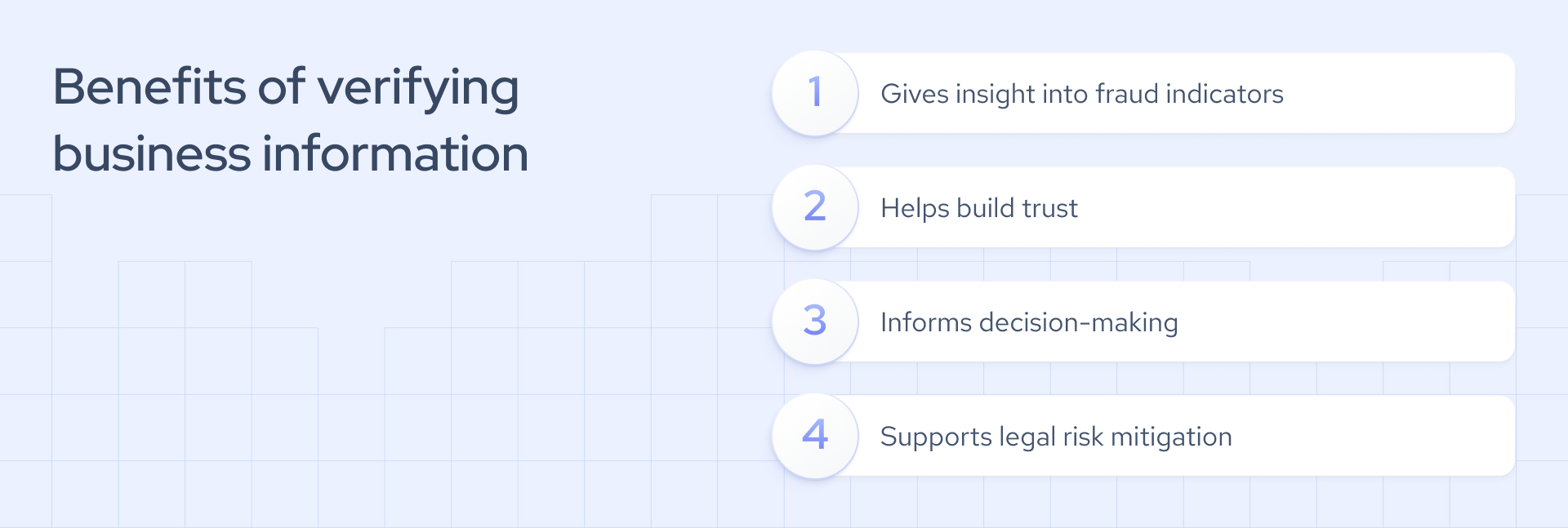
- Preventing fraud. Verifying company registration, ownership, contact details, and other information can reveal inconsistencies, false claims, or other potential fraud indicators that help protect your business.
- Building trust. When evaluating a potential business relationship, verified, consistent company information can give your business partners greater confidence.
- Improved decision-making. Knowing details about a company supports decision-makers by giving a stronger factual basis for evaluating potential partnerships, investments, suppliers, or customers.
- Mitigating legal risks. Reliable business data can provide information on a company's legal status, licenses, registrations, regulatory records, and other relevant details, helping identify potential compliance concerns.
Beyond these benefits, company background check and information verification helps your business stay strong. It helps prevent problems before they start and creates lasting, reliable business deals.
How to check if a business is legit?
To verify a business's legitimacy, run a company background check, starting with official company registries, reviewing financial standing, and assessing customer feedback. Look into the following key areas before entering into any partnership or transaction.
1. Check official data
Start by reviewing government registration documents. Some details to search for include:
- Company’s legal name
- Registration number
- Incorporation details
- Licenses and permits
- Address the company is registered at
For U.S. companies, these records are available through state business registries, the Secretary of State, and the SEC. For UK-based companies, data is available through the government platform Companies House.
2. Use outside sources
Validate information from official registries by comparing it against external sources. Official registries, reputable business databases, credit rating agencies, company websites, and news outlets provide independent intelligence to confirm that a company's public records match its real-world operations.
3. Look at their online presence
Examine their digital presence carefully. A company’s website should reflect contact information, business address, social profiles, and business operations consistent with information found on other online sources.
4. Check their business relationships
Run a company background check to investigate its professional network. Evaluate companies the business has relationships with, and treat this information as supporting context. Well-known or credible companies in the business relationships list don’t always guarantee full credibility.
5. Study their financial situation
Run a company background check related to its finances and take note of the following aspects:
- Financial statements
- Credit information
- Performance trends
Use this information as supporting context, and keep in mind that the amount and reliability of information vary significantly between private and public companies.
6. Check their employees
Verify employee profiles on professional networks. Check whether staff credentials align with company claims. Professional profiles and workforce data can give you valuable insights into company leadership, employee affiliations, organizational activity, and workforce size, while discrepancies in employment details may reveal operational problems.
7. Monitor company changes
Initial verification only captures a single point in time, but company risk often shifts as circumstances change. For critical relationships like key vendors, investors, or long-term partners, maintain ongoing monitoring. Use automated alert systems to track management turnover, credit changes, and significant corporate events so you stay informed as the partnership evolves.
Types of business data to analyze
Examining business data reveals potential risks associated with the company and showcases potential future success. Here are some key areas you should include in a company background check before making any decisions.
1. Leadership and founder background check
Look at the company's leadership team and founders closely. Review publicly available information regarding their education, previous work experience, and prior companies. Consider any legal or regulatory issues where relevant.
2. Company structure analysis
Run a background check on company’s business structure as it could indicate several concerns. Make sure to check company information for:
- Ownership. It identifies the true decision-makers and ultimate beneficial owners (UBOs) behind the business. Unclear ownership or hidden executives can signal shell companies, sanctions evasion, or high-risk individuals attempting to obscure their involvement.
- Hierarchy. It reflects the strength of the company's internal governance, operational stability, and decision-making processes. A chaotic or absent management structure increases the risk of operational breakdowns, poor financial controls, and key-person dependency.
- Subsidiaries and affiliates. This reveals how legal liabilities, assets, and debts are distributed across the corporate group. Overly convoluted corporate webs often obscure financial distress, tax evasion, circular transactions, or high-risk offshore activities.
3. Financial data evaluation
A company's financial health shows its stability and is a cornerstone of business success. Run a background check on a company by focusing on the following key areas:
- Revenue trends. Check reliable information sources for revenue direction, growth, declines, or seasonality. Do not imply that revenue must always be steady or consistent.
- Debt levels. Review debt in relation to the company’s size, financial situation, and industry. Be careful assuming that high debt alone is a sign of financial trouble.
- Liquidity. Check the company's ability to cover short-term financial obligations. This offers valuable context on its immediate financial stability and day-to-day solvency.
Detailed financial information may be more limited for private companies compared to public ones. Make sure that third-party estimates are taken from official or audited financial statements.
4. Business reputation assessment
Customers’ experiences, while not definitive evidence of a company's credibility, offer valuable insights for a company background check. They inform how the business stands out in its market and the general sentiment toward it. Here are some things to check out:
- Customer reviews. Look for recurring themes and patterns in customer feedback instead of relying on isolated reviews and overall ratings.
- Media coverage. Review only reputable news sources for information on relevant company developments, disputes, and regulatory issues.
These reviews help you make informed decisions about working with any company.
Tools and resources for business information verification
Verifying a company’s credibility requires access to reliable tools and resources to ensure a thorough company background check. These platforms provide critical insights into a business's operations, financial health, and reputation. Below are the top tools and how they can help.
1. Official government registries and databases
National registries are the most trustworthy sources for verifying a company’s registration and legal status. These databases often provide information such as:
- Registration numbers. Confirm that the business is officially recognized.
- Licenses. Ensure the company complies with industry regulations.
- Legal filings. Review records like incorporation documents or annual reports.
Examples include state-level registries such as Secretary of State offices and the SEC in the U.S., Companies House in the UK, and similar registries worldwide. Most of these platforms are free or offer affordable access to data.
2. LinkedIn
LinkedIn provides a unique look into the human side of a business. By analyzing employee profiles and company activity, you can verify:
- Company page and identity. Check if the business maintains an established, professional presence with accurate branding and official links.
- Leadership and workforce information. Assess executive profiles and staff member backgrounds to confirm verifiable experience and active roles.
- Consistency of company information. Compare posted details across platforms to ensure descriptions, locations, and milestones align.
LinkedIn is especially useful for smaller companies or startups with limited public data.
3. Providers like Coresignal
Coresignal is a great tool that provides structured, multi-source company data that can be used as a primary intelligence layer for corporate research and risk assessment. By cross-referencing records across diverse public sources, you can independently run a corporate background check and spot operational discrepancies.
Furthermore, pairing real-time company insights with historical records and change signals informs a company background check about how an organization has evolved, helping you detect sudden leadership shifts, workforce fluctuations, and emerging risks. You can extract these insights:
- Company data. Analyze key company data fields, such as name, industry, revenue, founding date, headcount changes, and more. This helps you assess a business’s stability and potential risks.
- Employee data. Review workforce trends, such as hiring rates, employee turnover, and job titles, to validate the company and assess its organizational health.
- Jobs data. Explore open positions and hiring practices to understand the company’s current activities and market focus. Sudden changes in job postings can indicate growth or instability.
By leveraging Coresignal’s fresh datasets, you can uncover crucial information about a company’s structure, workforce, and operations.
4. Credit reporting agencies
Commercial credit bureaus such as Dun & Bradstreet, Experian, and Equifax are valuable resources for assessing corporate financial health, particularly for private companies that don’t publicly disclose financial statements. These agencies typically provide:
- Business credit scores and ratings. Determine the company’s creditworthiness and commercial risk.
- Payment history and records. Provide insights into past payment behavior, debt trends, and supplier trade experiences.
- Financial indicators and risk assessments. Benchmark metrics that help evaluate financial stress and operational vulnerability.
Rather than relying on a credit score in isolation to predict solvency, treat these scores as part of a broader picture. To gauge true financial stability, interpret credit bureau ratings alongside other corporate data, cash flow context, and market research.
5. Online review platforms
Customer and employee reviews reveal how a company operates from the inside out. Platforms like Trustpilot and Glassdoor allow you to:
- Evaluate customer feedback. See what clients are saying about the company’s products or services.
- Review employee insights. Understand workplace culture, management quality, and organizational issues.
- Spot red flags. Frequent negative reviews may indicate unresolved problems.
By leveraging these tools and resources to run a background check for companies, you can find patterns across reviews. However, be mindful of the number, recency, and credibility of reviews when drawing conclusions. Individual positive or negative reviews don’t necessarily reflect a company's real quality.