
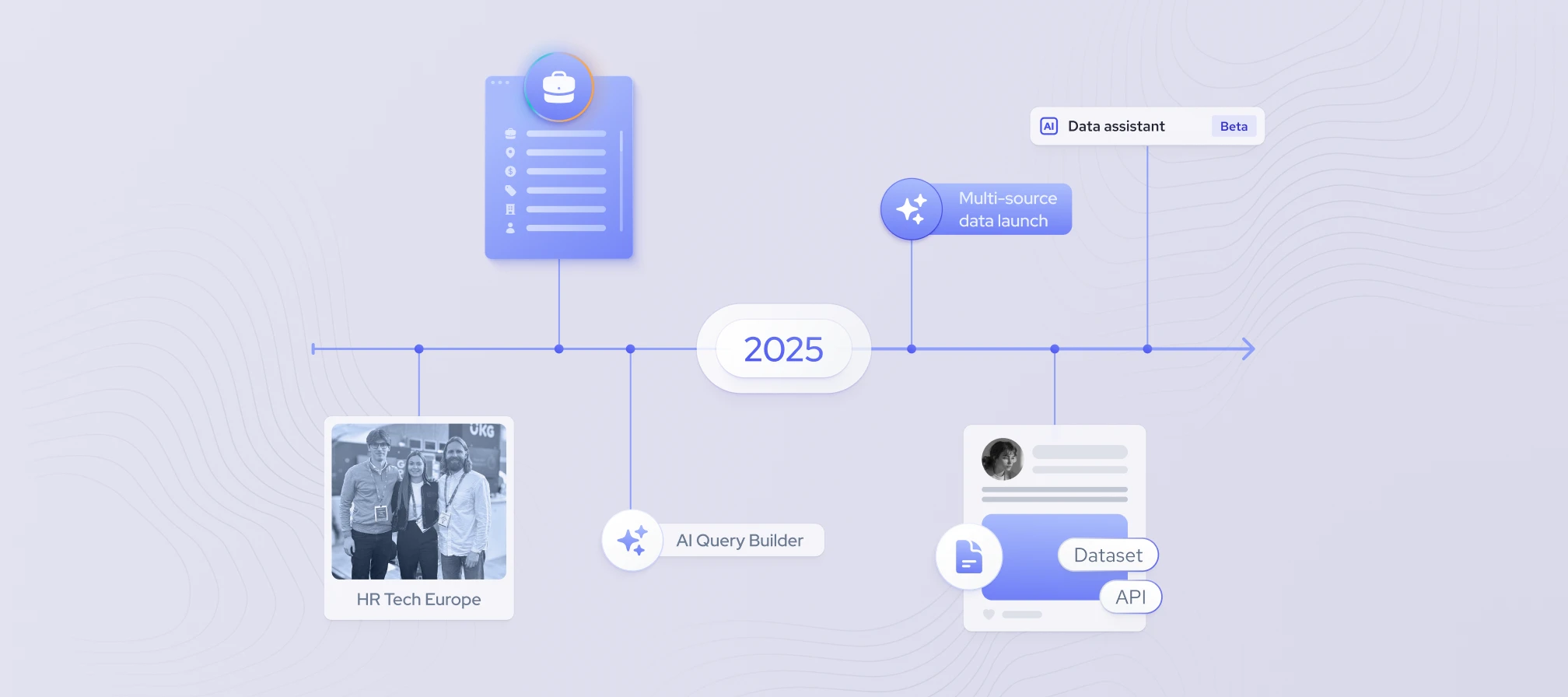
In 2025, we focused on making it easier to turn data into action. We launched two unique multi-source datasets, expanded data access through new AI tools and infrastructure, strengthened our academic partnerships, and took our insights to industry-leading events.
Take a look back at seven key highlights that shaped our year, and what they mean for the future of data-driven decision-making.

1. Conferences and summits: Driving data conversations
In 2025, Coresignal had a strong presence at leading industry events across Europe and the U.S., connecting with innovators and decision-makers in HR tech, SaaS, and AI.
We kicked off in Amsterdam at HR Tech Europe 2025, where our team engaged in conversations about the growing influence of AI in HR.
The main takeaway? AI isn't the future, as it's already reshaping how HR operates today. As a data provider, we were excited to see growing recognition that fresh, high-quality data is foundational to making AI in HR work.
Later in the year, we joined HR Tech in Las Vegas, where the focus remained on how data fuels better hiring decisions, talent insights, and workforce strategy.
On the SaaS and AI front, we traveled to the SaaStr.ai Annual 2025 events in San Francisco, then wrapped up the year at the SaaStr.ai London Summit.
Across all locations, clear trends emerged:
- There is a widening productivity gap between teams that have mastered AI-augmented workflows and those that haven't
- Data quality and freshness are becoming competitive differentiators, with companies prioritizing vendors with the freshest data
These events were a great chance to see how B2B companies are preparing for the AI-powered future, and it's clear that fresh, structured web data is what forward-thinking companies need the most.
2. Multi-Source Employee Data launch
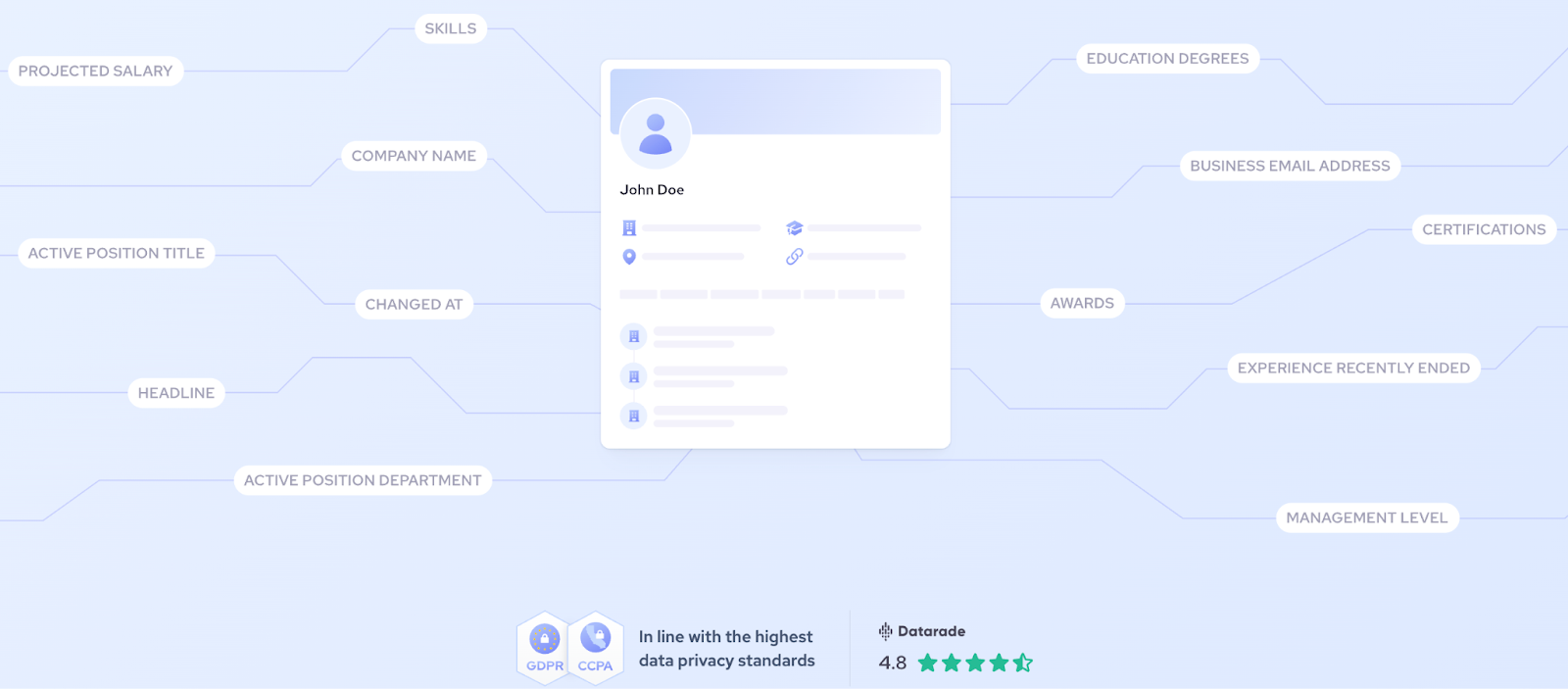
In 2025, we introduced Multi-Source Employee Data, which was a major leap forward in how professional data can be analyzed, understood, and segmented at scale. Designed for recruiters, HR tech providers, investment analysts, and sales teams, this dataset combines records from multiple public sources into unified, enriched profiles.
What sets it apart? Depth and precision. With Multi-Source Employee Data, users gain access to:
- Verified and aggregated work history
- Skills and professional experience
- Educational backgrounds
- Location and career movement trends
By gathering data from several sources, this product improves accuracy and fills gaps that often exist in single-source datasets. It offers more reliable coverage, better structure for analysis, and ensures greater completeness, making it ideal for identifying career trajectories, building talent intelligence tools, or evaluating executive movement.
This launch reflects our broader mission to offer AI-ready, research-grade data that keeps pace with the real world. As roles evolve and workforces become more dynamic, tools like Multi-Source Employee Data help businesses and researchers stay ahead of the curve.
3. Launching the Multi-Source Jobs dataset
Another major release this year was our Multi-Source Jobs Dataset – a purpose-built solution for anyone relying on job posting data to track labor market trends, business priorities, or talent demand. This dataset is designed to address one of the biggest challenges in web-sourced job data: duplication and inconsistency.
By combining postings from multiple public sources and deduplicating overlapping records, the Multi-Source Jobs Dataset offers:
- Clean, summarized job listings without duplicates
- Complete records with enriched metadata
- Structured fields are ideal for machine learning or analysis
Whether you're analyzing hiring patterns, building AI products, or simply researching roles, the dataset provides a reliable foundation for understanding the job market in real time. It's especially valuable for detecting:
- Companies expanding their teams
- Hiring trends
- Changes in demandable skills across industry sectors
This product emphasizes our continued commitment to data quality at scale, not just quantity. The Multi-Source Jobs Dataset helps users make smarter, faster, and more confident decisions about the workforce.
4. Making data access easier with AI search tools
In 2025, we focused not just on expanding our datasets but on making them easier to access, explore, and integrate. From AI-powered tools to developer-friendly infrastructure, here are three key improvements that helped users move faster with our data.
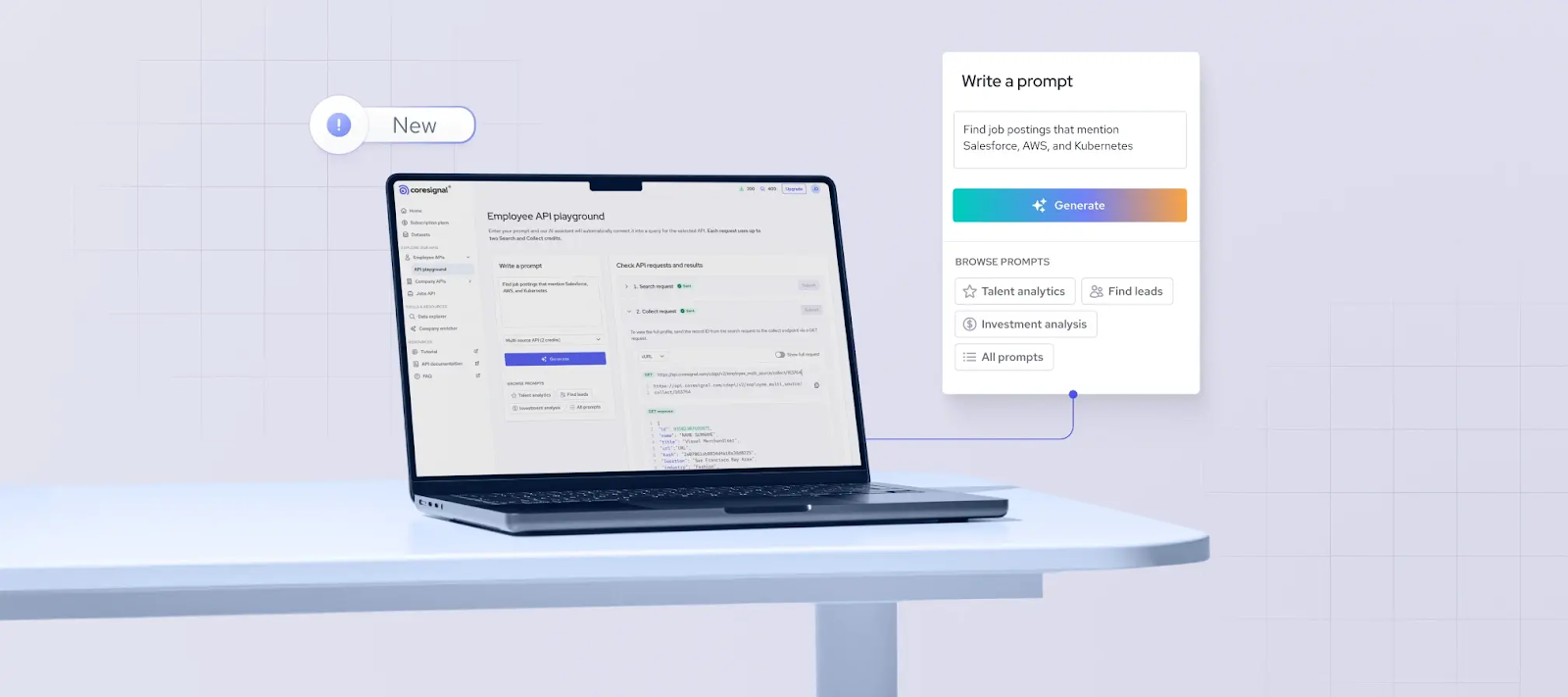
AI Query Builder: Instantly turn prompts into API queries
Available directly in our API playgrounds, the AI Query Builder lets users write natural language prompts (e.g., "Find frontend developers in San Francisco with remote work preference"). You can review and edit the generated queries, view matching records, and learn by example, making this feature a bridge between simplicity and full control.
MCP server launch: Seamless LLM-to-data integration
The launch of our Model Context Protocol (MCP) server opened a new frontier for AI integration. Now, large language models (LLMs) can dynamically pull data from Coresignal's APIs. The MCP server acts as a smart layer between your AI agents and our structured data, allowing real-time access to fresh records directly within your app or analysis workflow. It's a powerful enabler for building smarter AI products, faster.
Coresignal AI Data Search: Getting answers to your questions just got easier
For those not ready to dive into APIs, our new AI Data Search provides an intuitive way to search Coresignal's entire dataset.
All you have to do is to type your business question in plain English, and the agent returns relevant company, job, or employee records you can download in JSON format. It brings the power of structured data to sales teams, investors, recruiters, and analysts.
These releases reflect our belief that access is just as important as accuracy. Whether you're building an AI tool, querying at scale, or just exploring trends, our goal is to make it seamless to dive into the full power of public web data.
5. Launched plenty of other new products and features
While 2025 brought major product rollouts, we also shipped several targeted features and datasets that delivered big value to our users:
- Response field selection for API users. This was a highly requested feature, which allows API users to specify exactly which data fields they want in their responses. It reduces payload size, improves response speed, and makes API integrations more efficient, especially for those building performance-sensitive tools.
- Multi-Source Company API. Built on the same principles as our multi-source datasets, this API provides fresh, cleaned, and enriched company data. It extracts information from multiple public sources into unified profiles, making it easier to query for up-to-date firmographic insights, growth trends, and online presence details through a single endpoint.
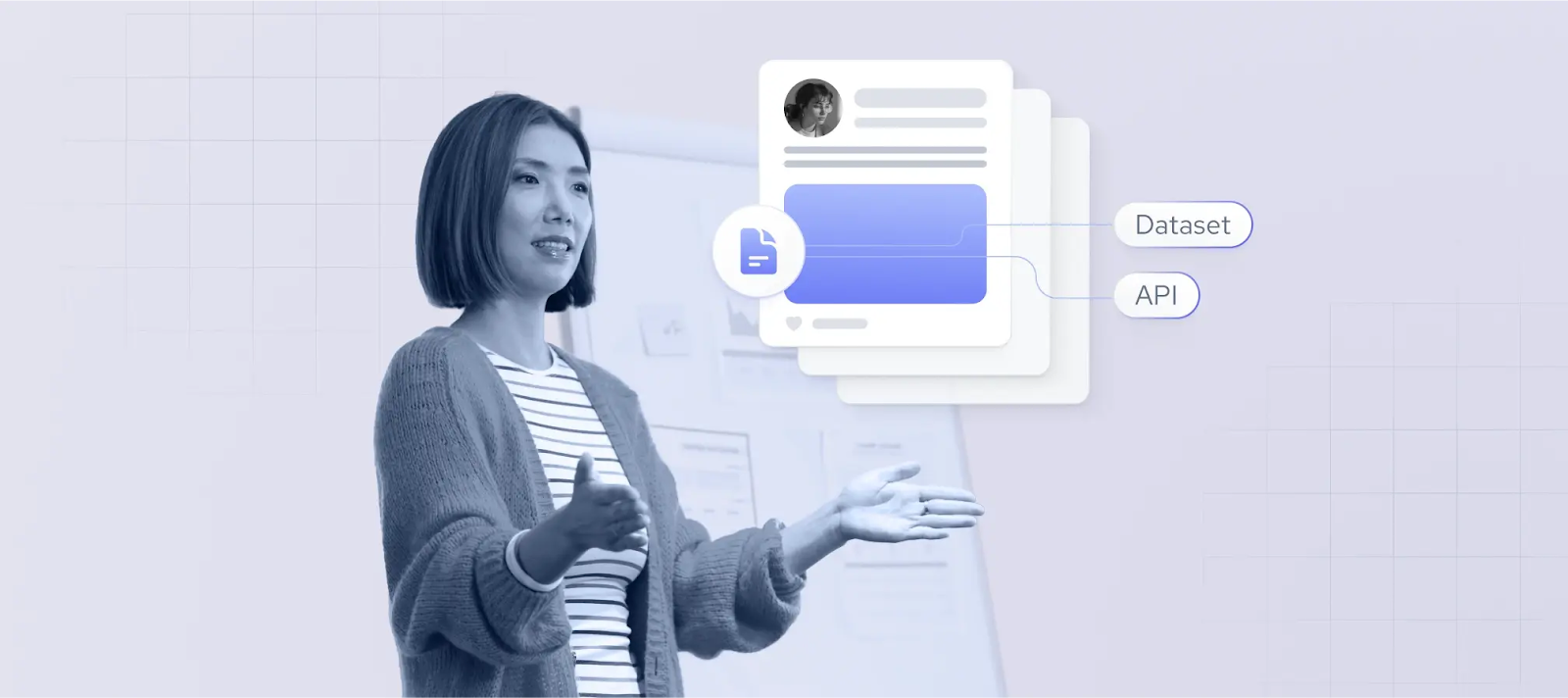
- B2B Employee Posts Dataset launch. This dataset captures public professional posts made by business decision-makers and employees. It opens up opportunities for sentiment analysis, trend tracking, and thought leadership research, which is especially relevant for GTM strategies, investors, and brand monitoring use cases.
These smaller launches reflect our ongoing focus on product refinement and customer feedback. Each addition was designed to make it easier for our users to work with structured, reliable public web data, whether they're exploring trends, enriching CRMs, or building data-driven products.

6. Pro bono program and 2 exciting academic collaborations
We have launched the latest version of Coresignal's Pro Bono Program in 2024. It's an initiative made to empower NGOs and academic institutions with free access to public web data.
With this program, universities and research organizations can gain real-time insights into labor market trends, job listings, and company growth. It helps them tell data-backed stories about the future of jobs. Since launching, we've granted access to millions of job and company records, enabling impactful research around workforce transformation, policy shifts, and economic resilience.
This commitment to accessible data also led to the launch of two academic collaborations this year:
- In the U.S., we collaborated with New York University (NYU) professors Byungkyu Lee, Maria Abascal, and Tiffany Huang at the Ohio State University to explore how the U.S. Supreme Court's 2023 affirmative action ruling is impacting the language of job ads. The research explores how diversity and inclusion (DEI) messaging has evolved across states and sectors by analyzing millions of job listings, using large language models and supportive methods.
- In the UK, we teamed up with Victor Saldarriaga, an Early Career Researcher in the School of Economics at the University of Edinburgh, for a study on gendered wording in finance job ads. The project, "The Power of Words: Gendered Wording in Job Ads and Female Hiring," examines how subtle language hints may contribute to gender differences in hiring.
These collaborations reflect our broader goal: to make AI-ready public web data a force for informed, inclusive, and actionable research. We look forward to expanding the program and continuing to support institutions that are pushing the boundaries of labor market understanding.
7. Webinar about evaluating data quality
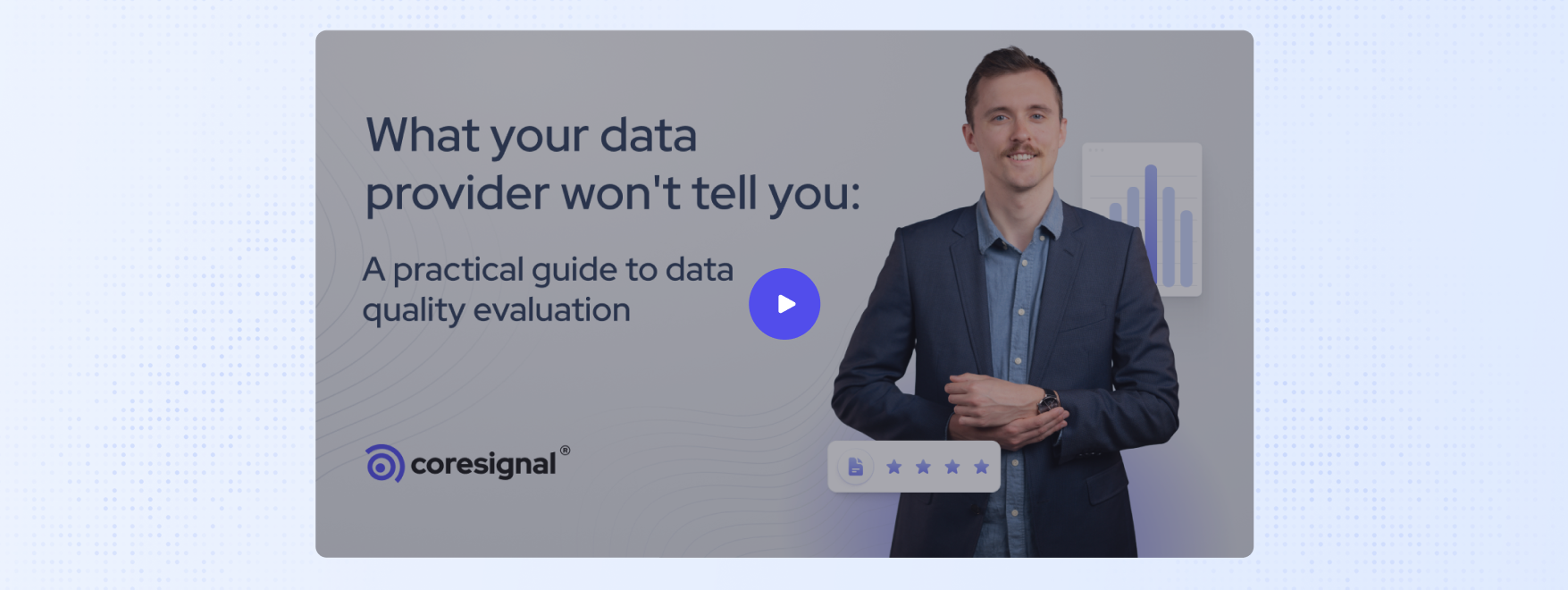
To wrap up the year, we hosted a live webinar exploring how companies can turn public web data into a competitive edge, covering real-world use cases, data integration strategies, and the newest tools in our ecosystem.
In case you missed it, we've got you covered – follow this link and get access to the webinar recording.
What's next?
In the coming year, we plan to develop our products further, ensuring even easier data access and even higher data quality with our multi-source data.
And meanwhile, thank you all for a great year, and we wish you a happy and insightful 2026.