
Would you rather work with job data scattered across languages and formats, or with structured, consistent, and easy-to-analyze dataset that is refreshed in real time? If the choice is clear, it raises another question: why so many teams still use fragmented, low-quality job data?
In most cases, teams don’t set out to use poor-quality data. They start with what’s easiest to access, without fully understanding and defining their use case.
Choosing a jobs database for tracking global job postings is complex. There’s no universal standard, because the “best” database is the one that meets clear, use-case-driven criteria.
Access to consistent, high-quality job posting data helps businesses, researchers, and AI systems track global hiring trends, identify market demand, and analyze large-scale workforce changes. This matters more than ever, as the 2025 Future of Jobs Report projects a net increase of 78 million jobs worldwide, representing 7% growth in formal employment.
This article explains what “the best job database” actually means. It outlines the key criteria for tracking job postings worldwide, and explains why these factors are important.
What does “tracking global job postings” actually mean?
Tracking global job postings involves monitoring, collecting, and analyzing job ads across countries. This process involves handling various job postings data sources, languages, formats, and the specific rules of each market.
The difference between local and global job tracking goes beyond geography. Every market has its own leading platform with a unique technical setup, as well as differences in salary transparency, qualification formats, and privacy rules, each requiring a different approach to data collection. As a result, “global” means working with diverse data sources, formats, languages, structures, and tailoring methods to each context. To track jobs effectively worldwide, you need strategies that fit each market, not a one-size-fits-all approach.
Global data means working with diverse data sources, formats, languages, structures, and tailoring methods to each context.
Key criteria for evaluating a global jobs database
So, what are the key things to keep in mind while evaluating the data? Consider the following criteria:
1. Global coverage and source diversity
To achieve accurate global coverage, focus on both the depth and reach of the job posting database. Before evaluating a database's features or pricing, ensure it accurately reflects hiring activity in your target markets. To track global jobs reliably, you need data from the right sources in each region. If a database lacks a broad range of sources, it can give a misleading picture of the market, even if it covers many countries.
2. Data freshness and update frequency
Job posting database can lose its value quickly because it is not updated often enough. For example, a listing for a job from three weeks ago may already be filled, or the company may have stopped hiring. Using outdated information in talent intelligence, competitive analysis, or market research can lead to inaccurate decisions.
To enhance your insights, Coresignal delivers real-time updates to its Multi-Source Jobs dataset that contains fresh, deduplicated job records from multiple sources. Each record is enriched with company and recruiter information, giving you clean, actionable data rather than outdated aggregated feeds.
3. Structured and normalized job data
It can be tough to analyze raw job data because companies use different titles and descriptions for the same roles. For instance, one company might post "Sr. Software Engineer," another might use "SWE III," and a third might list "Lead Developer", all for the same job. Locations might appear as "San Francisco," "SF Bay Area," "Remote - California," or simply "USA." Salaries might be listed as annual, hourly, in different currencies, or missing entirely.
A good global job database solves these problems by organizing and standardizing the data. It puts job titles into clear categories, ensures locations like "Paris" and "Île-de-France" are grouped together, and sorts fields like seniority, industry, and required skills so they are easy to filter and compare.
4. Deduplication across sources
If you collect job postings data from different platforms, the same job can show up more than once. For example, a company might post a "Data Scientist" role on LinkedIn, Indeed, its website, and local job boards simultaneously. Without removing duplicates, you might count the same job multiple times, making the number of available jobs appear higher than it really is and leading to mistakes in market analysis.
Therefore, when choosing a data provider, make sure they offer deduplicated multi-source data with proven methodology, not just claims of deduplication, but demonstrable results you can verify. At Coresignal, you can test this yourself using our self-service platform or our AI Data Search tool to explore sample data and see our deduplication in action before committing.
5. Historical job postings availability
Looking at past job postings can show patterns that current data alone might miss. For example, tracking how long jobs stay open can reveal how easy or hard it is to find talent. If certain roles are often reposted, it may indicate they are difficult to fill or have unrealistic requirements. Watching when companies increase or decrease hiring can hint at their growth, financial health, or changes in strategy before these moves are made public.
Historical data also lets you compare year over year, spot seasonal trends, and predict which skills are becoming more important or which roles are fading. Without this information, you only get a limited view. Make sure your data provider gives you access to a strong history of postings, keeps the data updated, and lets you track each job from when it’s posted to when it’s removed.
6. Scalability and API access
If you often deal with large datasets for market research, you quickly see that manual processes are not practical. API access gives you the flexibility to process data flows into your CRM, analytics tools, or other systems, rather than downloading files by hand.
Coresignal lets you pick the setup that works best for your team. If your team handles data processing and wants full control, the Base Jobs API offers bulk downloads of single-source job data. If you need detailed job postings from multiple job boards, the Multi-Source Jobs API provides deduplicated, cleaned listings with additional fields. This way, you spend less time sorting through irrelevant data and more time finding useful insights.
Why many job data sources fall short for global tracking
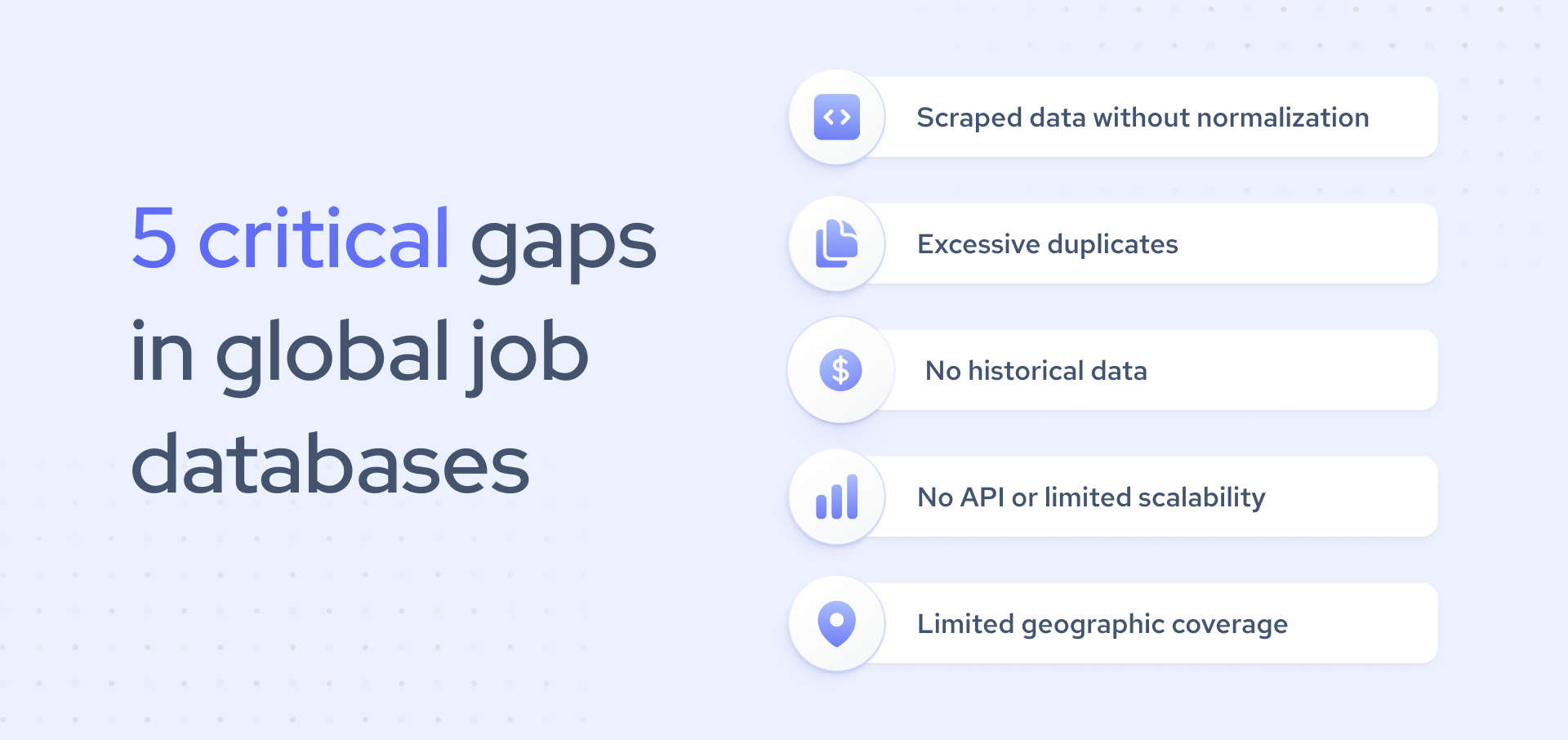
Good labor market intelligence depends on high-quality data. However, many job data providers do not offer reliable datasets worldwide. Here are 5 reasons why this happens.
1. Scraped data without normalization. Scraping job listings can quickly produce a lot of data, but without careful normalization, inconsistencies and confusion can make large-scale analysis unreliable. For example, a "Software Engineer" in one dataset might be listed as "Developer II" in another, making it hard to recognize patterns.
2. Excessive duplicates. Job ads often appear across multiple aggregators and platforms, resulting in duplicate records. If you do not remove these duplicates, hiring signals become distorted, and it becomes difficult to track real trends.
3. Only “active jobs,” with no historical data. Some vendors only show job postings that are currently open. This current approach lacks sufficient context, making it hard to spot long-term hiring trends, seasonal changes, and strategic hiring patterns. Real-time and historical data should be combined for best results.
4. No API or limited scalability. Many providers still rely on slow delivery or basic dashboards. Flexible APIs allow enterprises to keep pace, seamlessly integrating external data for real-time, global talent intelligence.
5. Limited geographic coverage. Many job data sources focus too much on a single region, making them strong locally but not useful elsewhere. Companies that want to expand globally, hire across borders, or track workforce movement need broader coverage to avoid missing important information.
What makes a jobs database suitable for market, talent, and business analysis
A good job database can help you understand workforce trends, but its usefulness depends on how well it matches your analysis goals. These examples show that a job database is most valuable when its data structure, coverage, and history correspond to the specific type of analysis you want to perform.
- Market intelligence
If you’re a market analyst watching company growth, industry changes, or what competitors are doing, it’s important to have up-to-date and broad coverage. In many cases, you need real-time updates on job data across industries and countries. Details such as company size, job roles, and location help with benchmarking and early trend identification.
- Talent analytics
HR tech, talent intelligence, and recruitment platforms require structured, normalized data on hiring and historical employee data to analyze trends and demand for roles. Bonus points if the employee data is enriched with company information.
- Economic research
If you want to analyze labor trends, workforce participation, or major economic shifts, you need data that covers several years, not just a few weeks or months. Look for providers who offer historical datasets. Also, always check that your data sources are clearly identified. If you can't verify where the data comes from, you can't trust your research results.
- AI, LLM training
When you train your LLM or AI models, focus on both the amount of data and the variety of language. Gather millions of examples that include job titles, responsibilities, qualifications, and similar details. Most importantly, make sure your data covers a wide range of language styles. This matters more than simply removing duplicates or using only the most recent data. Show your model how different companies describe the same roles, how language changes in different regions, and how job descriptions evolve over time.
There isn’t a single database that fits everyone’s needs, and that’s perfectly fine. A database that’s great for market intelligence might not work for AI training. The key is to focus on your specific use case, since that will show which features matter and which ones don’t.
How Coresignal jobs data meets these criteria
1. Global job postings coverage
Coresignal gathers job postings from over 15+ public sources, such as major job boards, company career pages, and professional networks. This helps customers track hiring activity, both locally and globally, with a single, consistent dataset.
2. Multi-source, deduplicated job data
Coresignal combines job postings from multiple sources and removes duplicates, ensuring clean, ready-for-analysis data. This means teams spend less time cleaning up data and more time on insights. Using multiple sources also adds context, since each one shows different job descriptions, posting frequency, and distribution. This gives a fuller and more reliable view of hiring activity.
3. Structured fields for scalable analysis
Coresignal provides jobs data in a structured format made for large-scale analysis. You can filter, sort, and group millions of postings without coding. The Multi-Source Jobs dataset is cleaned, organized, and updated often, giving you a more complete and current view than most one-time searches.
These are some of the useful data points you can access with this dataset:
4. Access via jobs API and datasets
You can access jobs data through Coresignal’s Multi-Source Jobs API or by getting access to the Multi-Source Job Dataset. The API supports real-time monitoring and automation, while datasets are ideal for historical research, deep analysis, or one-time projects without extra setup. Both options provide valuable, structured data, so you can choose the option that works best for you.
5. Support for real-time and historical tracking
Coresignal brings together current and past job data, so customers can track live hiring trends and see how demand changes over time. This helps you spot new roles, changes in company strategy, seasonal trends, and long-term growth, all using reliable data.
What you can analyze using a global jobs database
Job posting data is now useful for more than just recruiters. Companies across many industries use it to track trends, understand competitors, identify new opportunities, and make better decisions. Here are some ways different teams use global jobs data.
1. Tracking global hiring trends
Job postings offer a practical lens into what competitors are prioritizing. Hiring activity can signal new product lines, technology adoption, geographic expansion, or organizational restructuring.
By tracking competitors’ job postings over time, teams can benchmark hiring pace, understand functional focus, and adjust strategy based on how peers are investing in talent. The same data can also be used to improve one’s job postings by comparing role requirements, titles, and positioning against market benchmarks.
2. Market and competitive intelligence
Job postings give a clear view of what competitors are focusing on. When a company is hiring, it can point to new products, new technology, plans to expand, or changes in its organization. You can also use this information to improve your own job postings by comparing your roles, titles, and job descriptions to others in the market.
For example, data fields indicating remote work can reveal a company's approach to workforce strategy and talent access. More remote hiring may show that the company is seeking talent globally or trying to reduce costs. The seniority level can tell whether the company is focused on developing its team or building leadership. If there are more senior roles, it could indicate the company is restructuring or preparing to grow.
3. Talent demand and skills analysis
Global jobs data shows which organizations, roles, and skills are most in demand throughout markets. This helps with workforce planning and skills analysis based on real evidence. It also makes it easier to identify candidates by highlighting where hiring demand is highest and which companies are seeking similar talent.
4. AI and LLM training with jobs data
AI and machine learning teams use large collections of job data to train and improve LLMs and other models. Job postings provide timely, factual examples of how roles, skills, and requirements are described today. Using this data helps AI and LLM outputs align with current workforce trends, making them more relevant and reliable.
How to choose the best jobs database for your use case
Before you pick a provider or dataset, it’s useful to define what “best” means for your needs. You can compare company data providers based on coverage, structure, delivery methods, update frequency, and data quality. Ask yourself these questions before making a choice:
- What do we need jobs data for, and what decisions will it support?
Knowing your use case helps you figure out how much data you need, how often it should be updated, and which details are most important. Without this, you might spend too much or too little on a solution that doesn’t really work for you.
- Does the data cover the regions, industries, and roles we care about?
Coverage should align with the markets and segments in which you operate or analyze. Gaps in coverage can limit comparability and reduce confidence in insights.
- Is the data clean and structured enough for our level of analysis?
Clean, well-organized data saves time on cleanup and helps teams stay consistent. This matters even more as your data grows or if you use it for automated analysis or modeling.
- How will we access the data and integrate it into your systems?
Choose an access model that works with your current tools and workflows, so you don’t need a lot of extra engineering. Easy integration often means you can turn data into insights faster.
- Do we need real-time visibility, historical depth, or both?
Some situations require the latest signals, such as tracking hiring changes or market trends. Others need historical data to spot trends and make comparisons. Knowing what you need helps you get data that supports both quick decisions and long-term analysis, without making things too complicated.
Final answer: what is the best jobs database for tracking global job postings?
There is no single best job database for everyone’s needs. The right choice depends on your specific needs and how you plan to use the data. You should check whether the database covers a wide geographic area, gathers information from multiple sources, and removes duplicate job postings to ensure your insights are accurate. How often the data is updated and how it is organized also matter, since up-to-date and well-structured data makes analysis easier and more reliable.
You should also look for a database that includes both recent hiring activity and historical data. This lets you track short-term changes and spot long-term trends.
Coresignal’s jobs data meets these needs well for tracking job postings worldwide:
- Multi-source. Collects job postings from multiple sources across markets
- Deduplicated. Eliminates duplicate listings so job counts stay accurate
- Standardized. Organizes and standardizes job data to make analysis easier
- Real-time and historical data. Provides access to both current and historical postings
This helps you analyze global hiring patterns without depending on limited or outdated information.