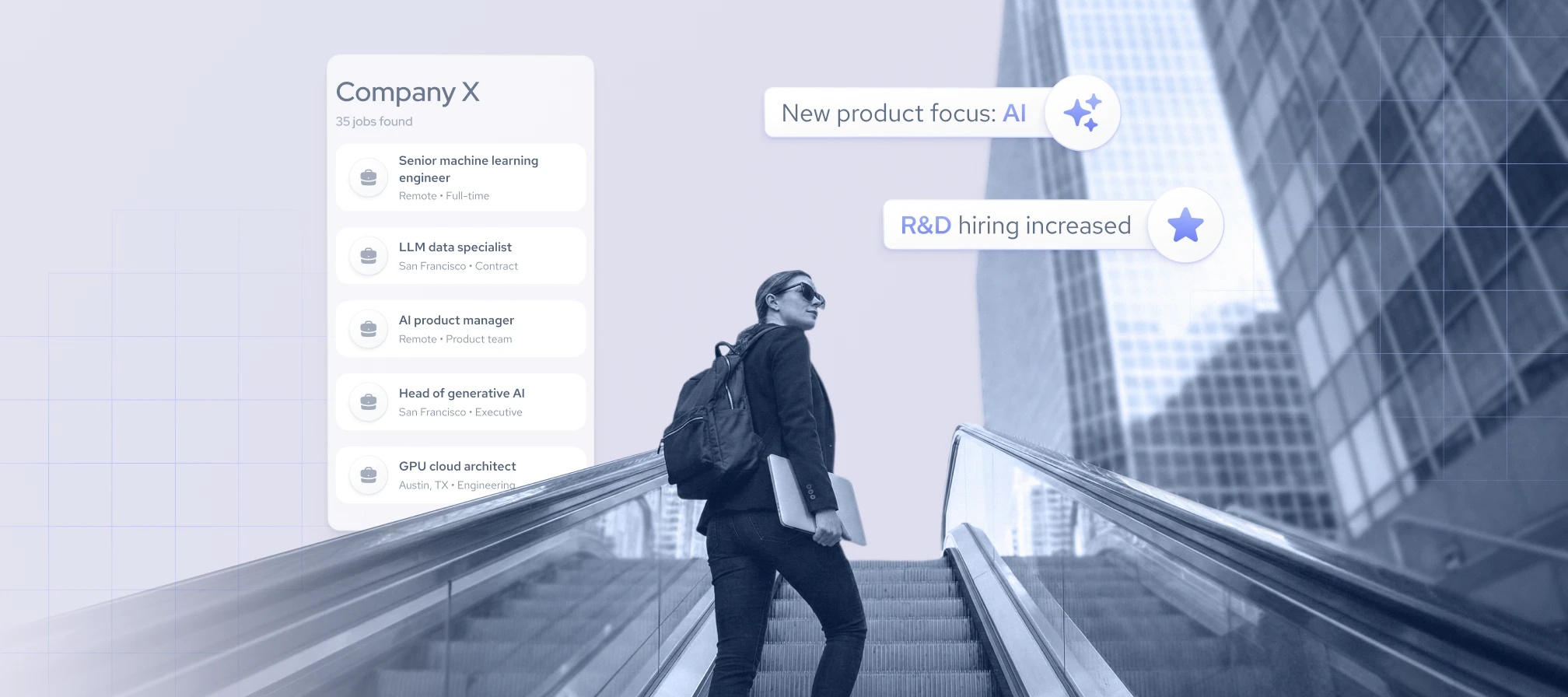

The corporate world has many ways of sending subtle messages about a certain company’s growth and business activity, and jobs data has become one of the most reliable signals. When a company starts hiring for a position, it signals what’s happening internally, often months before any official financial reports or listings.
In 2026, job postings data is used in analyzing labor market trends and competitor research. AI companies use job datasets to train their models, while tech companies use them for optimizing talent pipelines. With the rising number of organizations building job databases, the range of questions about them also increases.
At Coresignal, we source reliable datasets to empower businesses to make decisions that are based on facts. I've spent years working with data, and I've put together my thoughts on job data here. If you have any other topics in mind that you would like me to cover, feel free to reach out to me on LinkedIn.
What are the top jobs data providers today?
The best job database provider depends entirely on the use case, so there’s no universal option. You can compare top jobs data providers on factors like required scale, update frequency, coverage, but the final choice still depends on your needs.
Each of the leading providers, like Coresignal, Bright Data, Xverum, and JobsPikr, brings something valuable to the table. This brief overview of each will tell you more:
As you can see, there are different trade-offs associated with each provider. Coresignal offers daily deliveries and the widest coverage of job posting records, supporting multiple data formats, including JSON, JSONL, CSV, Parquet, and others upon request.
Bright Data combines real-time and historical records with seamless API integration, while Xverum doubles down on data enrichment through firmographics and job details for specific use cases.
JobsPikr extracts over 1 million job signals daily, with features like the Competitor Hiring Tracker helping you monitor talent acquisition strategies of other companies.
Overall, choosing the best job database provider depends solely on your application and the specific technical and business requirements.
What is included in a typical job postings database?
A detailed job posting database should provide a comprehensive breakdown of a recruitment event, including specific company details, job descriptions, required skills, and location. My experience has shown that the right database also includes details on employment type, whether it’s an internship position or a full-time contract.
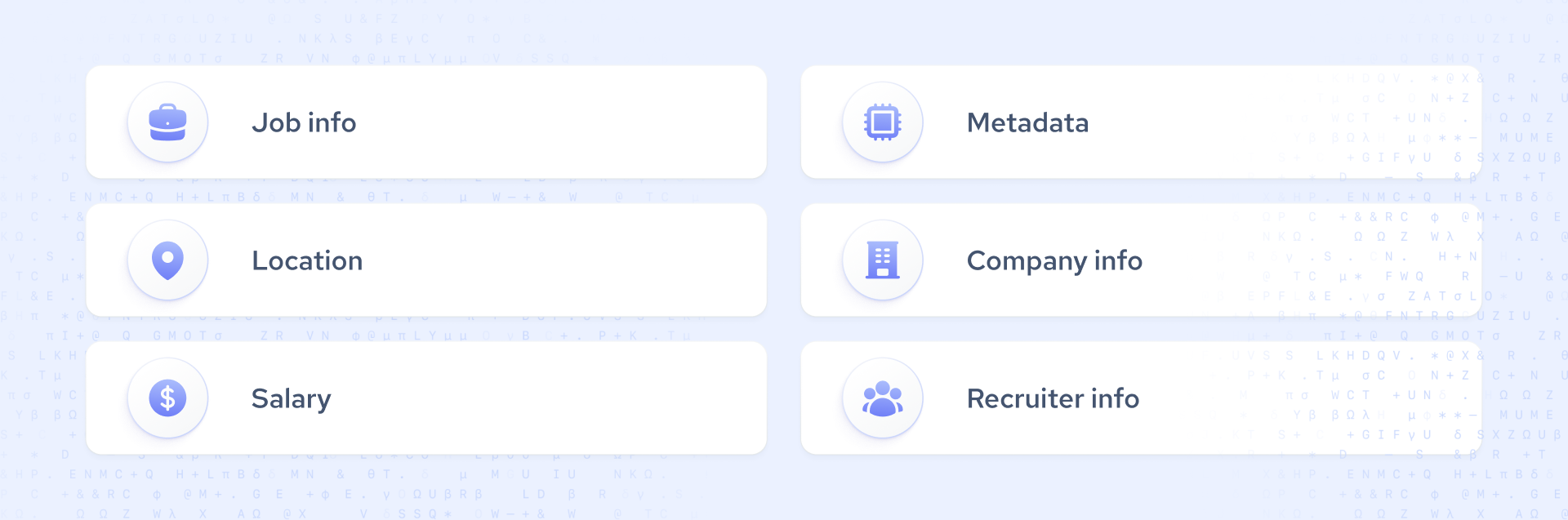
A job database shouldn’t just drown the user in job specs and details. Instead, it should empower businesses to make wage benchmarking and skills-in-demand decisions. Using datasets from leading providers like Coresignal should tick all of the following boxes:
- Job info: factual job description with employment type, number of applicants, management level, and decision-maker status;
- Location: country, city, or state-based location of the job posting, followed by the company’s headquarters location;
- Salary: brief description of salary type, range, and currency;
- Metadata: information on job status, position description, update dates, and unique source links;
- Company info: detailed information on the hiring company, including locations, funding, technologies used, and company keywords.
- Recruiter info: profile URL and recruiter's full name.
What is the best jobs database for tracking global job postings?
The best jobs database for tracking global postings depends on the user’s perspective. The best strategy is to go with a data provider that covers your markets of interest and structures the data in a way that’s easy for your team to synthesize, analyze, and process. I would recommend that you focus on the following factors:
- Structured fields
- Multiple sources
- Geographic reach
- Update frequency
- Historical depth
Platforms that handle deduplication on their end, like Coresignal, are the best choice, since job postings often appear on multiple platforms. It’s also important to use a multilingual database to avoid underestimating non-English-speaking markets.
How often should a jobs database be updated?
Whether you require job postings data for competitive intelligence, sales signals, training specific AI models, or something entirely different, it’s always best to get the most recent updates. At the very least, aim for databases that are updated daily to avoid stale job data that sends outdated signals.
It’s common for businesses to keep their job postings open long after the hire has been made, and outdated listings don’t reflect real hiring intent. It also depends on the use case: real-time updates suffice for job platforms focused on user experience, while batch updates work best for analytics and research.
How do I access job posting data through an API?
To access job posting data through an API, you usually start by getting API credentials, such as an API key, from the data provider. After that, you send requests to a search endpoint and use filters such as company name or ID, location (city, state, country, or remote), keywords (job title or description), industry, employment type, and date range to get only the relevant postings.
Usually, a job data API provides structured data such as job title, company, location, posting date, description, seniority, skills, salary (if available), and job URL, often with additional company details. Since results are paginated, you need to handle pagination by using page numbers or cursor tokens and keep requesting data until you have all records. Also, be aware of rate limits such as requests per minute, daily caps, or credit-based usage.
After you get the data, it’s usually loaded into internal systems like data warehouses, CRMs, or analytics platforms using ETL or ELT pipelines built with tools like Python, Airflow, or dbt. Organizations then use this job posting data in CRMs to trigger sales alerts when target accounts start hiring, for labor-market and competitive-intelligence dashboards, or in internal data pipelines combined with firmographic, headcount, and funding data to support growth models and strategic insights.
What is the difference between a jobs database and a job listings dataset?
A job listings database is a system of hiring records that is updated and typically contains millions of inputs, often with access to major data providers. On the other hand, a dataset is just a snapshot of the database, or a structured overview of data extracted from the database according to specific requirements.
Another key difference is in the frequency of data updates. While a jobs database is frequently updated as a system, a dataset is pulled for one-time analysis and becomes outdated immediately.
It doesn’t have the database infrastructure to support continuous updates for tracking changes over time. Here’s a brief comparison to help you distinguish between the two:
Can jobs data be used to train AI and machine learning models?
Yes, job postings data can be used to train AI and machine learning models, and it’s actually one of the best metrics for labor-market-based models. It’s mainly used for skills extraction, as job listings often include detailed requirements, tools, and certifications that are beneficial for training NLP models.
Job postings data is also used for demand forecasting in models trained to predict the roles or skills required for company growth, as well as for modeling and recommendation systems.
This is where the quality of a dataset comes into play. Poorly structured data with duplicate job postings won’t suffice for training high-performing models. In contrast, deduplication, historical depth, and geographic coverage lead to better results.
How much does access to a job postings database typically cost?
The cost of access to job posting databases depends on factors such as volume, freshness, and coverage. It’s also important to consider whether you can access the data via job posting APIs or file downloads.
Most data providers use a credit-based system, where you can access the API and spend credits per data query. Global coverage, refresh frequency, enriched multi-source records, and historical depth often dictate the cost.
Coresignal offers a free trial that gives you 200 Collect and 400 Search credits, so you can learn the ropes of the platform before you spend any cash. Paid APIs start at $49/month for the Starter plan, and reach $800/month for Pro and $1,500/month for Premium.
What industries benefit most from jobs data?
McKinsey reports that over 40 percent of executives believe the biggest threats to their organizations come from trends outside their industry or from new market entrants, especially those driven by technology. Meanwhile, fewer executives view traditional competitors as the main risk. In this situation, companies need earlier and more objective signs of strategic changes, and jobs data often provide valuable insights.
My experience and market trends show that industries that rely on understanding competitive dynamics and the movement of talent in the employment market benefit the most from job data. This includes market research, finance, recruiting, sales, and AI companies.
Financial companies and investment firms use jobs data to signal company health and track the number of employees on payroll. Consulting and market research firms use it for advisory efforts, while sales intelligence teams confirm companies’ growth and evaluate outreach based on jobs data.
The same goes for HR and tech companies that need data for talent matching and workforce planning. All these sectors have one thing in common: jobs data is especially valuable in fast-moving markets that require real-time, observable signals.
Is public web job postings data legal and ethical to use?
Job postings data is legal and ethical for databases that use publicly available records. However, it’s essential to pay attention to how data is collected and stored, and to ensure the provider follows ethical practices in this regard.
Providers that demonstrate clear custody from data sourcing to delivery represent the most ethical options. This is especially important for companies operating in areas that require compliance with regulations such as the Ethical Web Data Collection Initiative (EWDCI) in Europe and data privacy laws such as the GDPR and CCPA in the U.S. Data transparency is the name of the game here, and ethical providers are always clear about their sourcing methods.