

.webp)
AI agents can automate CRM enrichment, recruiting, lead scoring, and market intelligence workflows, but their decisions are only as reliable as the employee data behind them. Data accuracy, AI readiness, and freshness are all crucial to supporting an AI agent that brings real value to your company.
And yet, according to McKinsey’s 2026 research, eight in ten companies claim data limitations are the biggest roadblock to properly scaling agentic AI. If the data an agent uses is stale, you can’t expect the AI to identify the right outreach method or score leads. This guide explains why AI agents need fresh employee data and digs deeper into how it helps them achieve better results.
Why AI agents need real-time employee data
Before you let an AI agent handle running your workflow, you have to make sure it can be trusted to do so. Once again, it all comes down to the quality of the data. If you’re buying data from the right provider, you can grant the AI agent its autonomy. If you’re feeding it outdated or inaccurate data, it can create downstream workflow errors.
Let’s say you’re using an AI sales agent to enrich a CRM record for lead routing. If the data is fresh and up to date, the account executive gets useful context. If it’s outdated and the contact has already left the company, it’s just a waste of time and resources.
The same goes for other areas an AI agent might cover. With the right Employee API or a training dataset, the agent can appropriately decide whether to contact a lead, enrich a profile, or flag a company as growing in the industry.
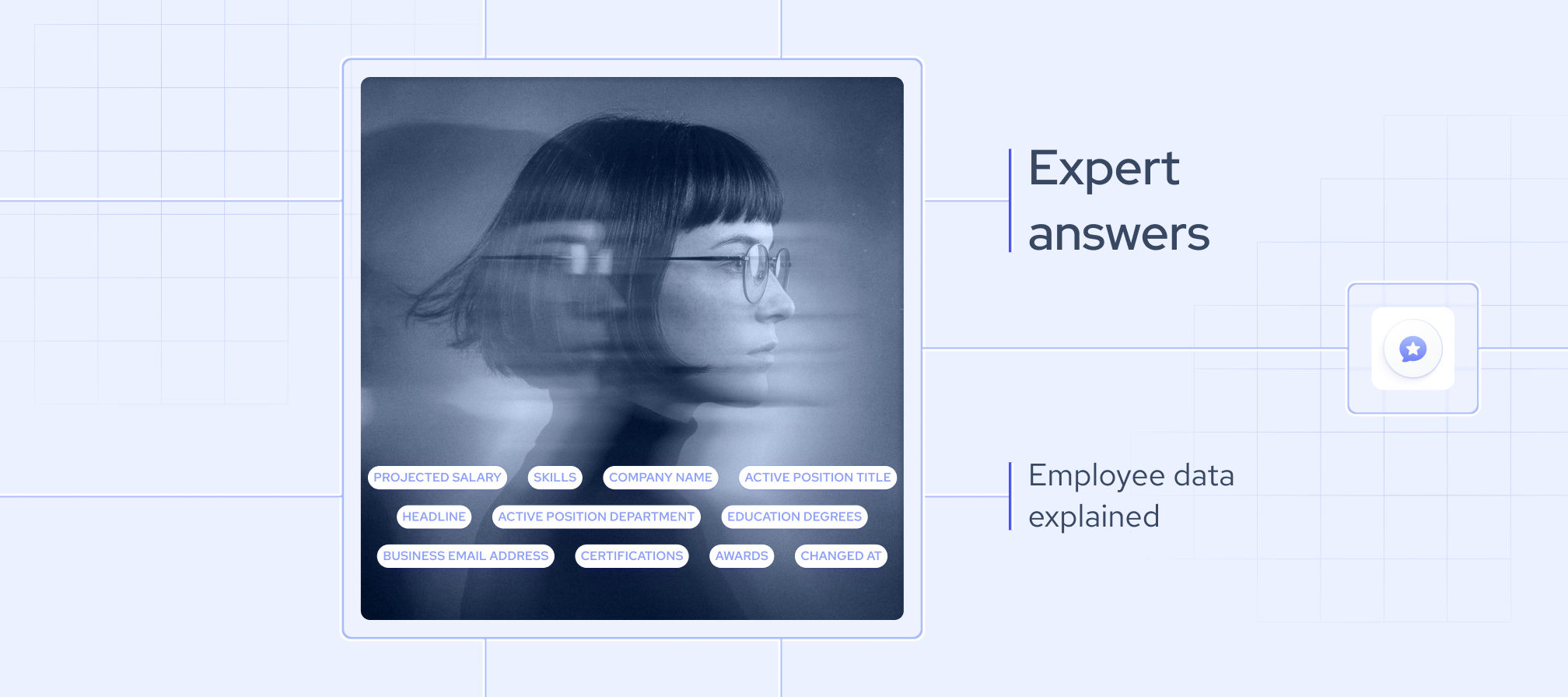
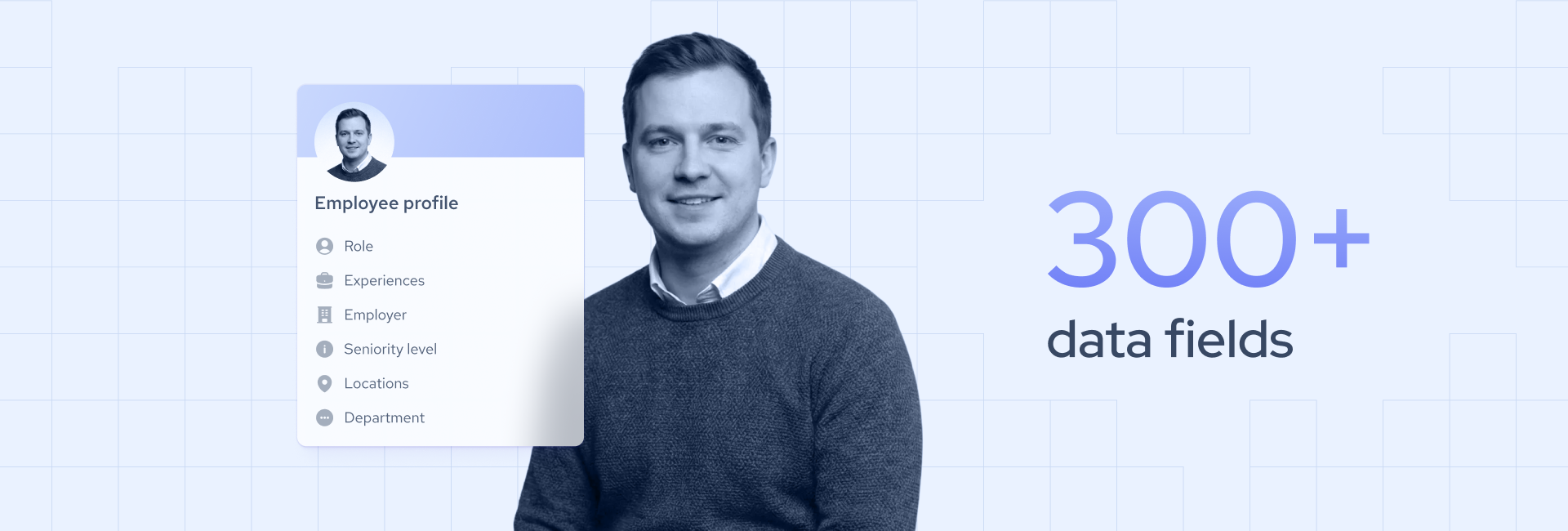
Employee records, such as role, employer, seniority level, locations, and skills, quickly become outdated, and using stale data leads to incorrect actions, as you can see in the example outlined above.
What are real-time workforce signals?
Real-time workforce signals are fresh details that indicate changes in employee or company workforce data. They lead AI agents to believe there’s something worth mentioning in a certain business or an employee’s professional career.
An AI agent acts on these signals, potentially resulting in important business decisions, which is why it’s so important that they’re up to date. For instance, a market intelligence agent might flag a certain company as stable, based on consistent staffing signals.
However, if the dataset used to train the system lacks important information on senior departures, it sends false signals, leading to errors and poor workflow decisions. After all, it’s a delicate market, and details like job changes, promotions, new hires, department growth, and location can change frequently.
Accurate signals reveal outdated CRM records, hint at the hiring momentum, and indicate department growth within a company. All these signals help AI agents decide whether to perform a specific action, such as enriching, updating, routing, alerting, or contacting the right lead.
How real-time employee data improves CRM enrichment
The biggest problem with CRM enrichment is how quickly relevant data becomes outdated. Internal company roles might change, and contacts might get promoted, move to new locations, or even transfer into completely different departments.
That’s where real-time employee data comes in, bridging the gap between CRM enrichment workflows and up-to-date employee records. It automatically updates fields such as current title, employer, department, seniority level, location, and work history.
The key term here is a pre-action check. AI sales agents can verify whether the contact still works at the target account and whether their details match those in the dataset. By performing these checks, an agent can reduce the risk of operational errors, such as outdated records or duplicate profiles, to a bare minimum.
How employee data helps recruiting and talent intelligence agents
Pulling data from an employee database or an API helps recruiting teams through AI-driven tools and models trained on such data.
They can enrich a candidate profile in real time with accurate information about where the person works now, their title, and how long they’ve been in their current role. All these real-time signals convey something to the AI agent system.
A promotion signal indicates that a candidate has recently changed their seniority level, which determines how the contact is approached. With agents based on real-time employee data, talent intelligence platforms can analyze market movements to see where talent is moving and which teams are growing in size.
How workforce signals improve market and investment intelligence
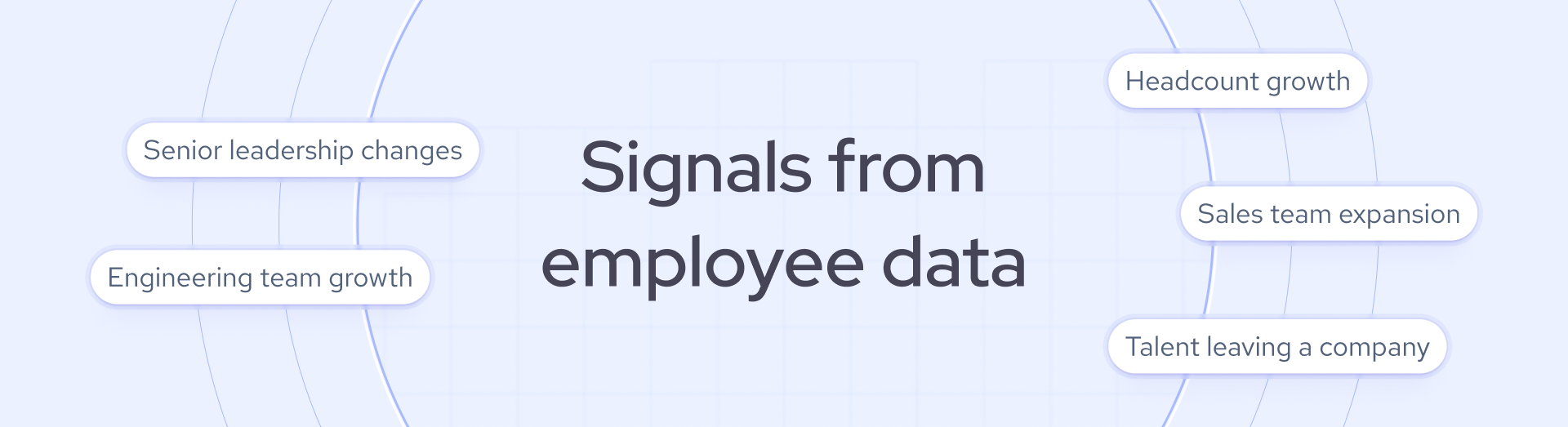
Employee data also signals to investors and market intelligence teams which companies are showing signs of growth. Here’s a snapshot of potential signals and scenarios:
- Headcount growth: A sign of healthy corporate growth and staff planning.
- Senior leadership changes: May indicate strategic shifts within the company.
- Engineering team growth: May indicate a product investment.
- Sales team expansion: Might be a sign of a go-to-market acceleration.
- Talent leaving a company: Might be a result of an internal instability or market pressure.
Employee data API vs employee dataset: which one should AI systems use?
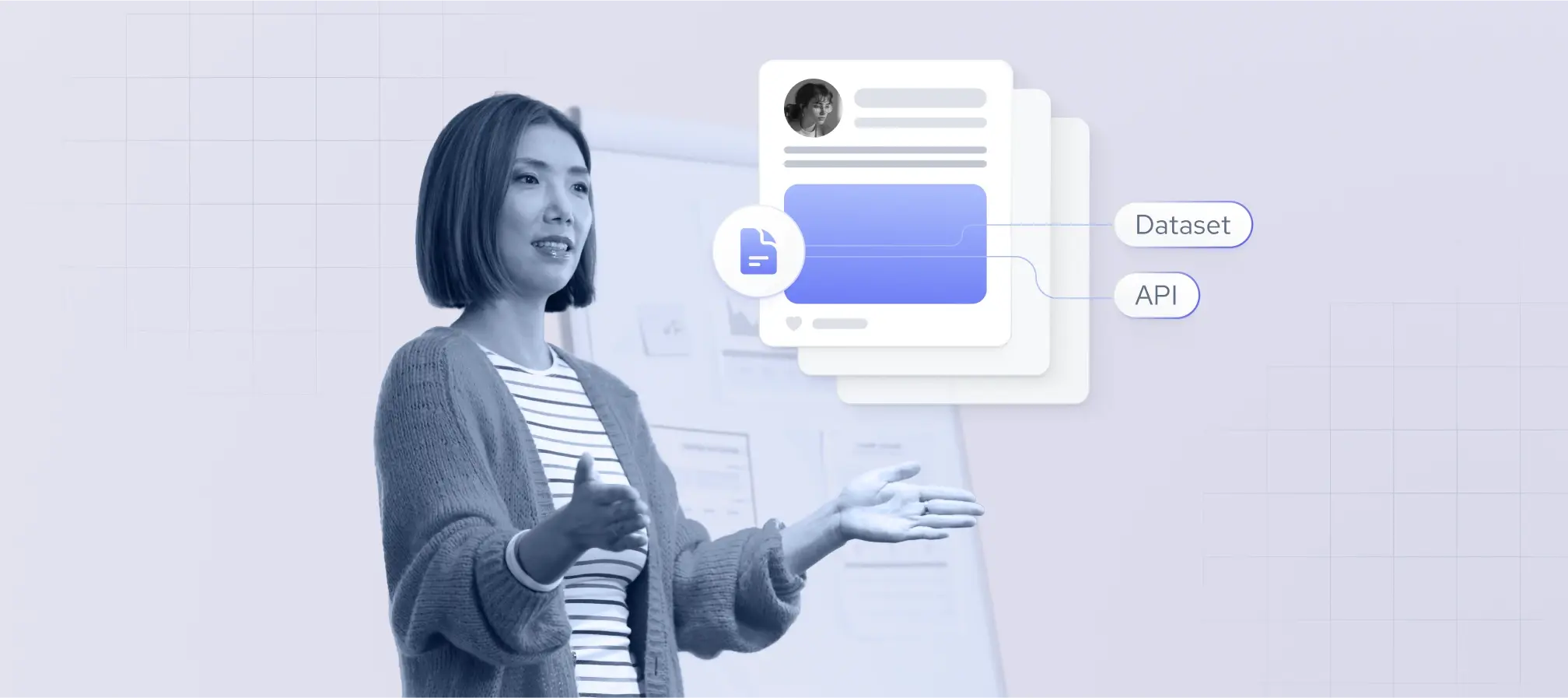
There are two main delivery formats for employee data: APIs for real-time decisions built on fresh records, and employee datasets for historical research, AI model training, or analysis. An employee API provides on-demand access to real-time records.
APIs of data provider companies like Coresignal integrate directly into the CRM enrichment workflows. Such platforms are built for high-frequency searches, with freshness being the top priority.
On the other hand, datasets are snapshots of a broader employee database, used for bulk access. They’re mainly pulled by market research teams that require historical insight and records of talent movement across specific companies, sectors, and industries.
Most companies need both. A perfect example is an everyday workforce intelligence platform that might rely on historical datasets for market segmentation while using real-time APIs to check individual profiles. Here’s a quick rundown of the main differences and benefits of each:
What to look for in an employee data provider for AI agents
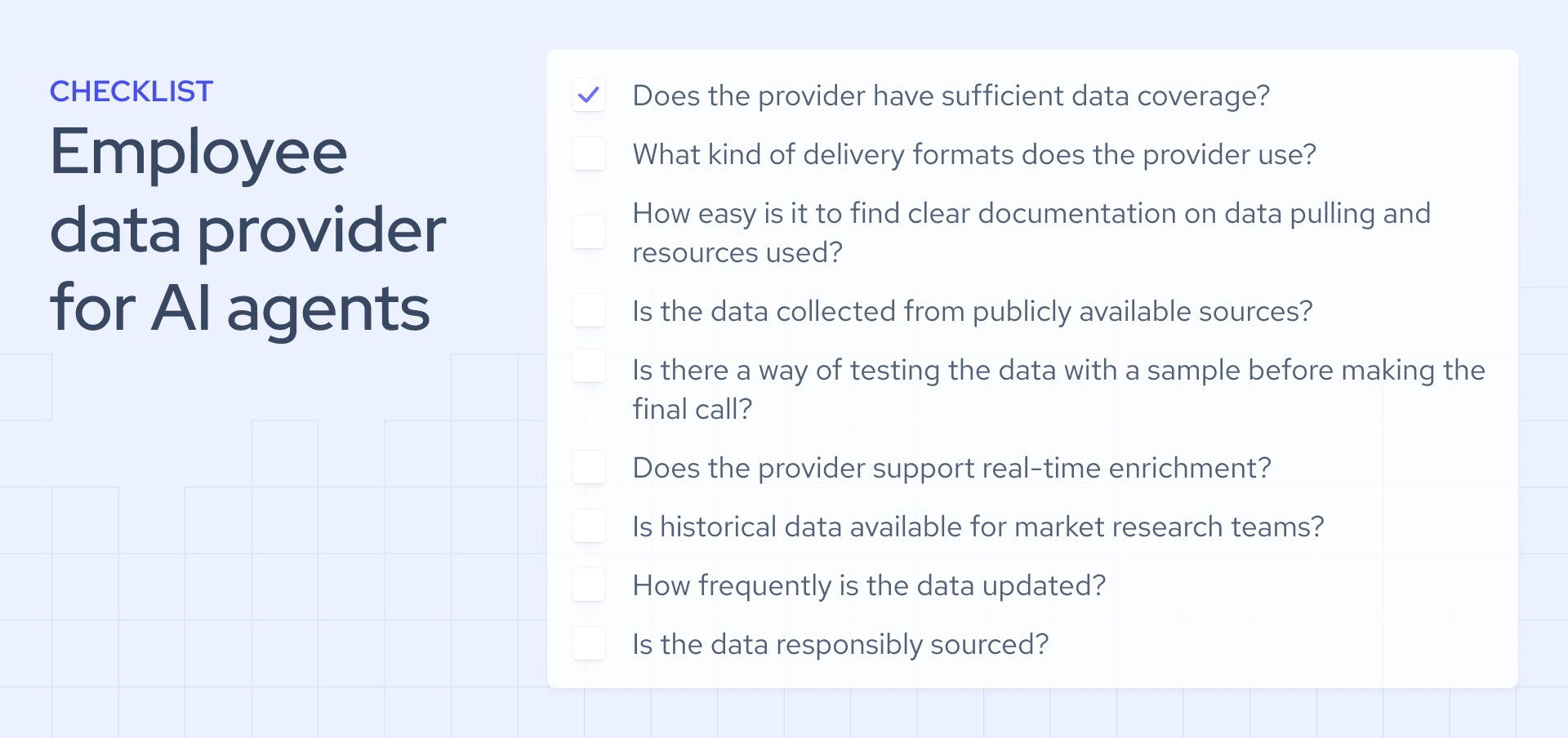
It may not be as simple as it sounds to compare employee data providers and find the right fit for your use case. Using the wrong provider to pull data might result in inaccurate, stale, or poorly enriched data, leading to failed business operations. This checklist can help you ask the right questions and find the answer yourself:
- Does the provider have sufficient data coverage for this specific application?
- What kind of delivery formats does the provider use?
- How easy is it to find clear documentation on data pulling and resources used?
- Is the data collected from publicly available sources?
- Is there a way of testing the data with a sample before making the final call?
- Does the provider support real-time enrichment?
- Is historical data available for market research teams?
- How frequently is the data updated?
- Are the data responsibly sourced, with privacy standards such as the GDPR and CCPA in mind?
In an ideal case, you’ll be looking for a provider that clearly answers all these questions. The best data providers for AI should support real-time access, structured fields, broad coverage, data freshness, historical depth, and deduplication.
Balancing the good and the bad is just as important, as you can see with ZoomInfo, which is a great choice for collecting B2B contact data in North American enterprise markets but lacks freshness for global profiles.
People Data Labs offers a developer-friendly API and detailed coverage of individual professional profiles, but at a higher price at scale.
MixRank combines firmographic and technographic data with employee signals, which is particularly useful for the technology market. However, its employee data depth might be lower than that of the closest competitors like Coresignal.
How Coresignal supports AI-ready employee data workflows
Coresignal powers data intelligence and AI agent systems by serving your team with current, relevant, and actionable data. It’s all about pulling current and structured data that AI agents can readily use.
With employee records encompassing 300+ data fields per profile, Coresignal covers the main requirements. Records include historical job experiences, seniority levels, department classifications, location, skills, education level, professional activity, and more.
The Real-time Employee Scraping API supports live verification and enrichment workflows, with fast average response times for on-demand employee record access.
Large-scale analysts can use datasets in formats such as JSONL and Parquet, which are ideal for both human analysis and AI integration. The Multi-Source Employee Dataset provides even greater depth by combining records from multiple sources into enriched, deduplicated profiles.
Final thoughts
Modern AI agents don’t simply need access to employee data. They need quicker, fresher, and better-structured data that’s easy to verify for enrichment and deduplication. That’s why buying data from the right provider is so important, as the data itself is becoming the layer that helps agents understand employee and company signals and act upon them.
As AI agents take on even more demanding roles, from enriching records to lead routing and sourcing candidates, providers like Coresignal with freshly updated data and Multi-Source Employee datasets prove to be a strong fit.