



Firmographics sit at the very heart of all company insight. Whether you’re segmenting markets or targeting specific customers, you’re heavily relying on getting accurate company data, such as size, industry, and location.
But if your foundation is even a little bit off, every decision that stems from your analysis will be shaky at best. And with Gartner estimating that low-quality data costs organizations an average of $12.9M per year, the stakes have never been higher.
That’s precisely why learning how to properly evaluate the accuracy of a company database has never been so important. It’s also what this article will be about. I’ll dive into firmographic data, its most common challenges, and dataset vs. API-based delivery of firmographics. I hope that this will set you up with a framework for finding the right data partner that suits your needs.
What is firmographic data, and why does its accuracy matter in business decisions?
If the term itself didn’t give it away, firmographic data is all about firms or companies. It covers organization-level attributes, such as the industry the company operates in, its size (number of employees), as well as its revenue range, ownership structure, and geographic location.
Firmographic data should not to be confused with company data. While company data might also include hiring and financial information, firmographic data focuses solely on business identifiers. As such, it’s the foundation for how B2B teams understand companies and how they cluster, compare, and analyze businesses.
The interpreted data is then used in numerous business workflows, including:
- Market segmentation
- Customer profiling
- Marketing and sales strategies
- Risk and compliance screening
- AI applications and model training.
In that sense, the accuracy of this sort of business data plays a critical role. If it’s incorrect or outdated, all these pipelines built on top of it become unreliable. In fact, an IBM report from 2025 found that more than 40% of COOs agreed that general data quality issues are a top priority and a leading cause of multi-million-dollar annual losses.
An IBM report from 2025 found that more than 40% of COOs agreed that general data quality issues are a top priority and a leading cause of multi-million-dollar annual losses.
How company databases collect, enrich, and maintain firmographic data
To build these vast datasets that can empower sales and marketing teams across multiple industries, company data providers rely on a variety of collection and refinement methods. But before we dive into the details, here’s what a typical firmographic data pipeline looks like:
- Collection of publicly available data on a massive scale via crawlers and scrapers
- Normalization of collected data through entity matching and record consolidation
- Enrichment of aligned firmographic data fields through external data points
- Continuous monitoring of said data for organization-level changes
Most databases start with publicly available data sources. That includes company websites, employee data, public registries, regulatory filings, and other similar records. At this stage, the focus is still solely on coverage, so providers use web crawlers and scrapers to gather raw data.
From there, the focus shifts to data normalization. After all, records from different sources might not match, whether it’s the number of employees or changing locations.
But basic firmographic data has long been insufficient, especially in more competitive fields. To address this issue, data providers enrich the collected data by adding in missing values from additional sources or adding new fields that are derived from the existing data.
And since companies constantly shut down, relocate, merge, or simply grow, keeping that data accurate isn’t a one-off thing. It requires consistent maintenance, with the best company data providers continually tracking these changes through repeated source checks.
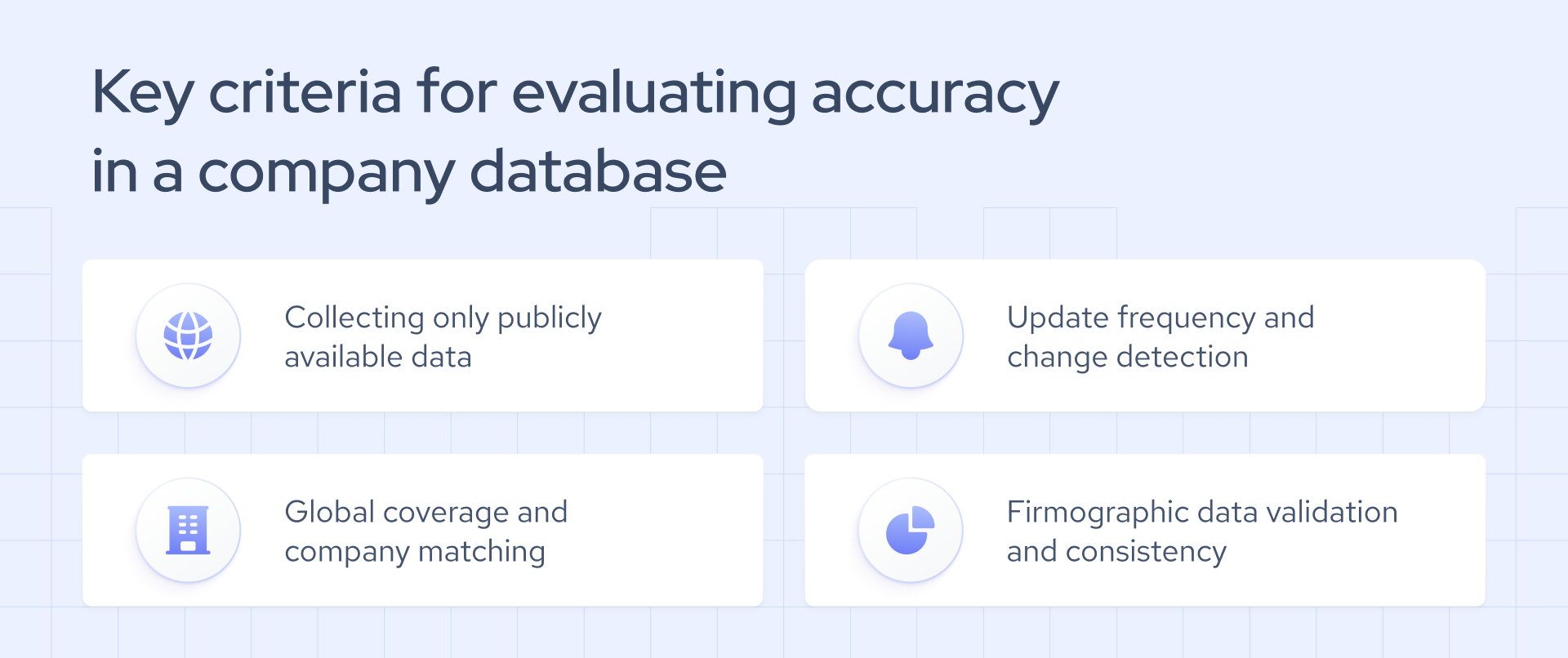
Key criteria for evaluating accuracy in a company database
Speaking of, keeping data in a company database accurate isn’t just about regular maintenance. It also depends on how that data is sourced, updated, matched, and verified over time, and that’s precisely what you should pay attention to during evaluation.
1. Data sources and public availability
Accurate firmographics always start with reliable data sources. Company data collection firms that ensure ethical data collection rely on publicly available information, such as official company websites, employee data, and other public sources. Transparency and staying in live with privacy laws plays a critical role here.
2. Update frequency and change detection
The accuracy of company attributes doesn’t remain constant across a dataset's lifespan. Employee counts fluctuate, offices keep opening or closing, ownership structures evolve over time, and even headquarters sometimes relocate.
In that sense, databases that rely on irregular or infrequent updates may not provide the most up-to-date company data. And while none of them update in real time, modern change detection systems can certainly improve accuracy.
The best providers rely on these often automated systems to continuously monitor signals and catch organization-level shifts. Over time, that simple refresh logic helps separate reliable datasets from out-of-date business data.
3. Global coverage and company matching
Keeping firmographic data accurate on a global scale is no small feat. Different local record standards, region-specific legal entities, and varying naming conventions often add up to a single company being split into multiple records. What’s worse, even unrelated entities sometimes get merged together.
To address these issues, top-tier database companies like Coresignal invest heavily in advanced company matching systems. That’s precisely what makes company data collection with regional differences accounted for much easier. More importantly, it ensures that global-scale data collection doesn’t compromise accuracy.
4. Firmographic data validation and consistency
While transparent sources, frequent updates, and advanced entity resolution logic matter a great deal, it’s actually data validation that ties everything together. This crucial stage in a dataset’s lifespan checks for missing entries, logical errors, and conflicts that may arise during data collection, enrichment, or updates.
A consistency-first approach to firmographic data is just as important. It ensures that fields for industry, employee count, revenue ranges, location, and other relevant business data follow the same logic. The best data providers go a step further by applying these standards in all their offerings, making them usable across all B2B teams and use cases.
Common firmographic data challenges in business databases
Even the best database companies can run into issues that reduce the accuracy of their data. That’s exactly why being able to recognize the most common pitfalls these providers face and adjusting your strategy accordingly is crucial for B2B teams across all industries.
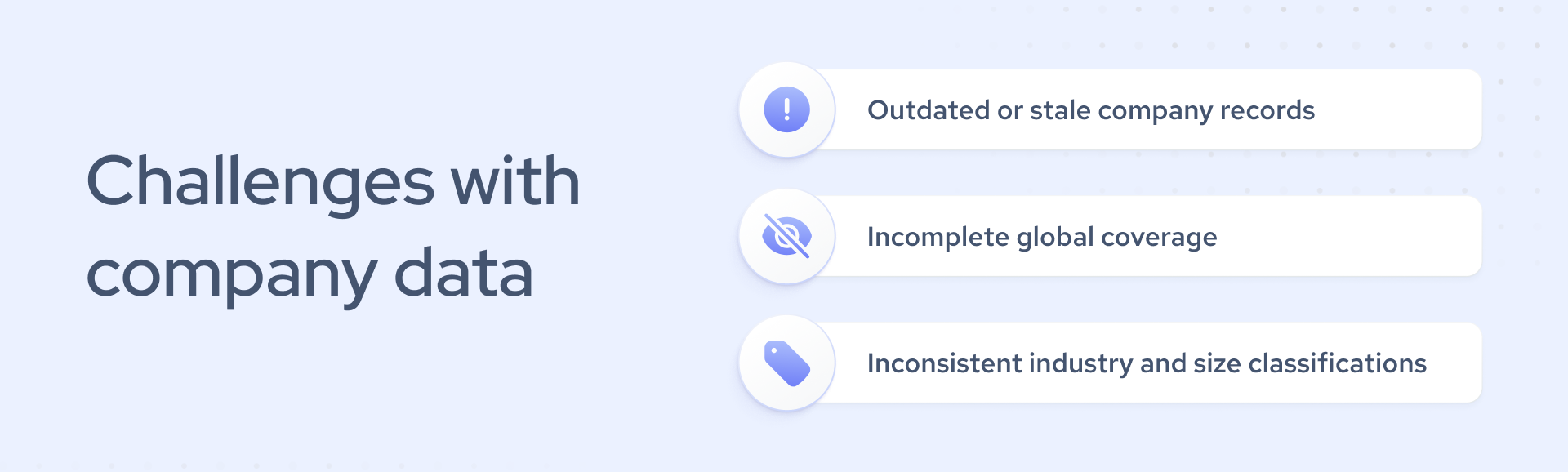
1. Outdated or stale company records
Whether it’s offices popping up in new locations or closing down, or headcounts fluctuating left and right, firmographics keep changing. In that sense, infrequently updated datasets can mislead B2B teams toward incorrect interpretation, market segmentation, and AI applications.
2. Incomplete global coverage
Not all company data providers track businesses equally across all regions. Unless you verify that a database covers the countries you’re looking for, you’re unfortunately bound to run into blind spots, and this will undoubtedly affect the quality of your data analysis.
3. Inconsistent industry and size classifications
Different data sources use different standards for industry labels and company size. Fortunately, most providers like Coresignal apply uniform rules across datasets to normalize the collected data. However, those that don’t can skew analytics and mislead marketing and sales teams.
What business data buyers should look for in company data providers
If you’re on the hunt for a data partner, a thorough evaluation is a step you simply can’t skip. Here are a few questions you should ask company data providers before committing long-term:
- Where does the provider’s data come from?
- How often is the firmographic data updated, and what exactly triggers that update?
- How does the provider match, merge, and enrich company attributes over time?
- What firmographic data validation checks does it apply before delivering data?
The right data partner will directly answer these example questions or anything else you may want to know before committing.
Transparency concerning sources, update frequency, change-detection systems, company-matching policies, coverage, and validation checks also indicates high-quality data. Meanwhile, a clear methodology makes it easier to assess whether that data will fit your specific needs.
Dataset vs. API: how data delivery impacts accuracy and usability
There’s one other distinction to make here before you fully commit to a data partner: static datasets vs. API-based delivery. So, let’s see how these two methods stack up:
As you can see, the primary difference between these two delivery methods lies in how they structure access and how fresh the data is. Therefore, the choice between them directly affects the data’s overall usability across different workflows.
In most cases, a dataset-based company database is the better choice for B2B teams doing bulk processing and historical data analysis, as well as those using data for AI and ML training.
On the other hand, a company API offers more value for teams with live systems that require on-demand, query-based data retrieval.
How to assess firmographic data quality in a company database
While provider claims are a good starting point, evaluating the quality of firmographic data in a particular company database requires a more thorough, hands-on approach. Here’s what you should focus on here:
- Sample a few company data records and check them against trusted public sources.
- Compare historical snapshots to test whether there are any stale company attributes.
- Review the provider’s documentation on data sourcing and update frequency.
- Test data consistency across similar companies and in nearby regions.
- Validate key company-level fields, such as industry, employee count, and location.
On their own, these signals don’t reveal much. But taken together, they show the bigger picture: accurate, high-quality data is not defined by volume alone. Instead, it reflects disciplined sourcing, frequent updates, and consistency-focused rules.


