



Think of candidate sourcing as talent hunting.
Instead of waiting for applications to trickle in, you're proactively discovering and connecting with exceptional professionals who aren't actively scrolling job boards but might be perfect for your role.
Effective candidate sourcing means you're always one step ahead, engaging connections that might not have applied otherwise. This approach can help you hire faster and increase your chances of finding top talent.
Why candidate sourcing is entering a new era
Candidate sourcing is the initial stage of the hiring process and involves identifying, attracting, and engaging passive candidates who may be a good fit for the vacancy but are not actively seeking a job. Talent acquisition, on the other hand, is a broader function that includes recruiting, sourcing, employer branding, and workforce planning.
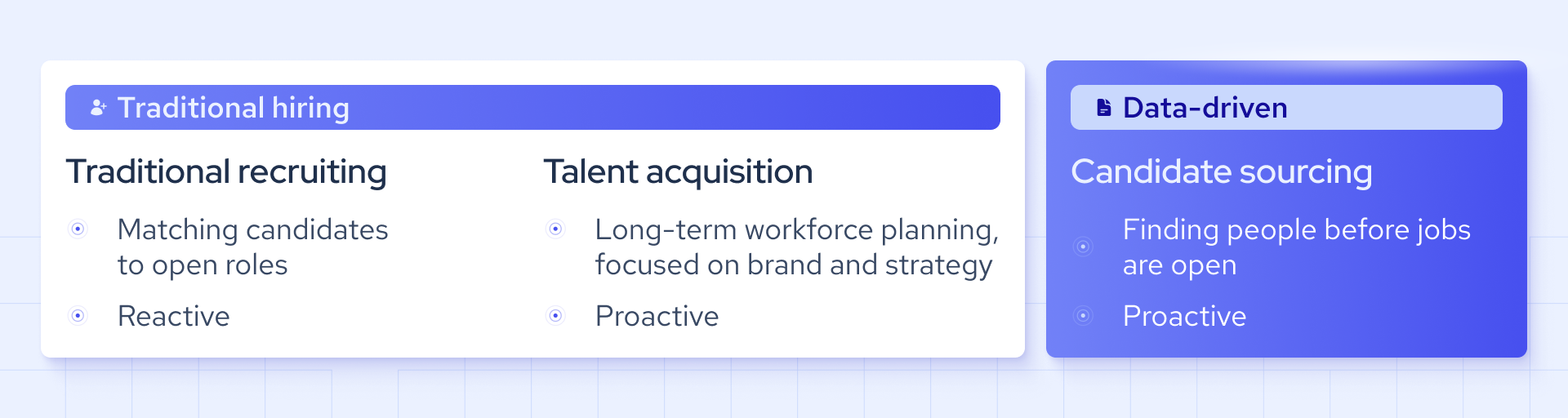
Proactive candidate sourcing speeds up the hiring process. When a vacancy opens, organizations with a ready pipeline can start the recruiting process immediately, without waiting for applicants to trickle in.
Gartner highlights that leaders in recruiting deal with pressure to reshape their strategies, expand talent pipelines, and leverage technology to drive growth in an increasingly competitive labor market. That means shifting from reactive hiring to a more innovative approach, one that looks ahead, plans for future roles, and understands where talent is available and in demand.
Why candidate sourcing is changing so fast
Shifting from a reactive to a proactive approach to candidate sourcing is crucial to keep up with a constantly evolving and dynamic market. Several talent market pressures are driving this shift:
- Skill gaps: The current job market shows signs of talent shortages and capability mismatches. According to Deloitte’s 2025 Global Human Capital Trends report, with 13,000+ survey respondents, including 2,000+ executives across 93 countries, 66% of executives admit that recent hires fell short, most often due to a lack of the hands-on experience required for today’s roles. That aligns with the World Economic Forum’s Future of Jobs survey, in which 63% of employers identified skill gaps as the most significant barrier to business transformation through 2030.
- Tighter hiring timelines: High-demand candidates don’t stay available for long, and organizations can’t afford to passively wait for applications to roll in.
- Global competition for the same candidates. Remote work and digital roles have opened a global labor market. According to the World Economic Forum’s 2024 The Rise of Global Digital Jobs Report, the number of digital jobs worldwide is expected to grow from 73 million to over 92 million by 2030. That’s a 25% increase and a clear sign that companies worldwide are trying to find candidates from the same limited pool of high-value digital talent.
- Changing candidate behavior: The best candidates are not necessarily those actively looking for a job. Most qualified professionals aren’t actively looking, and this requires a different hiring approach. You’ll need research-driven sourcing to discover where they are and what career signals indicate they might be ready for change.
That’s why candidate sourcing is evolving – right now, it's a long-term, insight-led strategy. Today, success depends on proactive, continuous talent discovery guided by real-time data and smart signals.
From traditional sourcing to data-driven candidate sourcing
Relying on hiring methods created for a slower, less competitive job market limits your ability to find candidates. Many sourcing teams still rely on manual approaches that make it harder to compete, especially when high-quality candidates move fast or never apply.
Data-driven candidate sourcing means building a broad candidate database that uses real-time and historical information, such as job changes, skills, company context, and professional activity, to identify the right talent.
When you use dynamic, multi-source datasets and automation, you gain more efficiency and insight, especially for candidate matching. With better context and a wider reach, you can find the right candidates faster and more accurately, even before they start looking for jobs.
The role of AI in modern candidate sourcing
Candidate sourcing has evolved rapidly. Traditional methods meant waiting for applications. Data-driven approaches enabled recruiters to access millions of employee records. Now, AI-powered sourcing goes even further. It helps you identify the right candidates faster by evaluating patterns at scale while your team focuses on building relationships.

AI-powered candidate sourcing is not about trusting AI software to make hiring decisions. It does not replace or eliminate the human factor in the hiring process but elevates their role. AI serves as a strategic enabler across several core sourcing functions, providing teams with greater visibility, deeper insights, and better efficiency.
How AI enhances key sourcing functions:
- Discovery: According to Deloitte's 2025 talent acquisition (TA) technology trends, TA teams use AI-powered sourcing to analyze large volumes of candidate data. It enables recruiters to identify not only active candidates, but also passive ones who aren’t applying but may be open to new roles.
- Enrichment: AI fills gaps in candidate profiles by pulling in additional data, such as job changes, skill development, and company history, so recruiters have a more complete, up-to-date view of talent.
- Candidate matching: AI uses multidimensional pattern recognition to match candidates based on role fit, career trajectory, and other contextual signals.
- Signal detection: AI identifies hidden trends across the candidate database, enabling teams to prioritize outreach.
With AI handling data analysis, recruiters can shift their focus toward what matters most: building relationships and providing a more personalized candidate experience.
Employee data as the foundation of candidate sourcing
Employee data covers information about company members: who they are, what they do, and where they work. Public employee data is what professionals share on public portals and professional networks themselves.
Unlike unstructured data from individual resumes or scattered online profiles, structured data makes it easy to analyze, compare, integrate into your recruiting systems, and find candidates more effectively and at scale. Here are the five elements that separate surface-level profiles from multi-source talent insights:
- Work experience: Full trajectory of a professional's career, including previous roles, tenure at each position, and active experience overview.
- Skills: High-quality datasets categorize skills by proficiency level and recency, helping you distinguish between someone who used Python five years ago and someone who codes in it daily.
- Education: Beyond degrees and institutions, structured education data includes certifications, training programs, online courses, and continuing education.
- Seniority: Understanding where professionals sit in organizational hierarchies is crucial for targeting the right candidates. Quality employee data maps seniority levels consistently across different companies and industries, from entry-level positions to C-suite executives.
- Industry context: The most valuable employee data is contextualized by industry trends, company size, geographic markets, and sector-specific requirements.
When using candidate sourcing strategies, it is crucial to understand that relying on a single data source, whether it's resumes, one professional network, or one job board, gives you an incomplete picture. Multi-source employee data solves this problem by aggregating information from multiple public professional sources, enabling more accurate candidate matching and a more reliable, comprehensive view of the talent market.
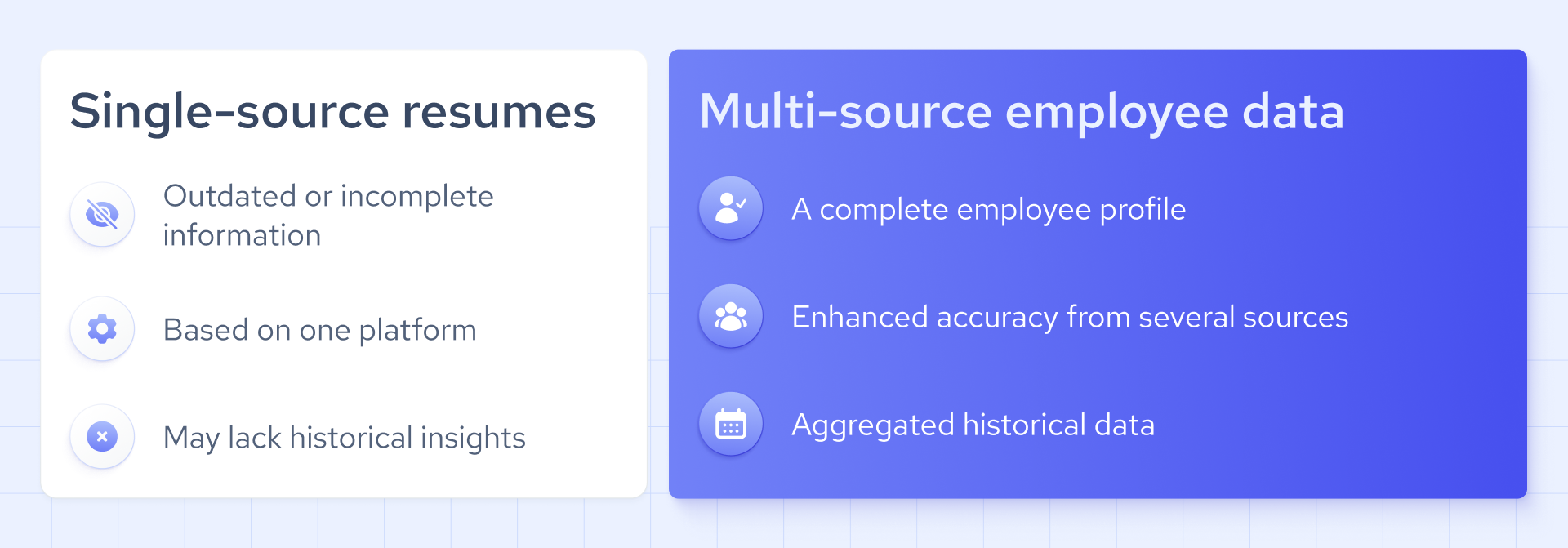
Coresignal’s multi-source employee dataset includes records aggregated from multiple public sources, now delivered daily. It includes 300+ data fields, such as:
- Job titles and departments
- Experience duration and career progression
- Skills, certifications, and education
- Location and mobility indicators
- Recent profile and career changes
Structured, multi-source employee data isn't just about having more information; it's about having the right information. When you can see the complete picture of talent in your market, you can move from reactive hiring to strategic talent mapping.
1. How to find the right candidates with employee data
If you’re looking for the right talent using employee data, you might rely on traditional methods like searching LinkedIn or other websites by hand. But if you want to work faster and get better insights, try Coresignal’s Data Search tool.
Coresignal's Data Search is an AI-powered tool that helps you explore Coresignal's employee dataset using natural language. You don’t need to learn complicated query syntax or sort through lots of filters. Just describe the person you’re looking for, and the tool will do the rest.
For example, you might want to find people working at Anthropic engineering department, as you might want to reach out if they are considering changing jobs.
Once you register for a free account on our self-service, you can navigate to Data Search menu item on the side menu. Write in your prompt into the window that opens:

Using a natural language prompt and listing all the qualities that you're interested in, you can ask our Data Search tool to find your ideal candidate. The tool takes your request, searches through employee records, and shows you a ranked preview of the results. This helps you quickly check if you’re on the right track before choosing to collect all the data.
2. Building and maintaining a candidate database
A strong candidate database offers three main benefits: faster hiring, a steady talent pipeline, and lower sourcing costs. With a database, when a critical position opens, you don't have to start sourcing from scratch. You can keep track of passive candidates, follow their career growth, and see when they earn new certifications or get promoted. As a result, you save time and money on each hire, since you can focus more on interviews and planning.
To build, maintain, and improve your candidate database, we suggest using the Employee API. Start with Coresignal's API playgrounds to experience how employee data search works. These AI-powered interfaces let you run test queries in natural language, see the structure of returned data, and understand what information you can access for each candidate profile.
API playgrounds use natural-language prompts, which are transformed into API queries. It simplifies the exploration process and makes it easy to generate custom queries, helping you avoid errors.
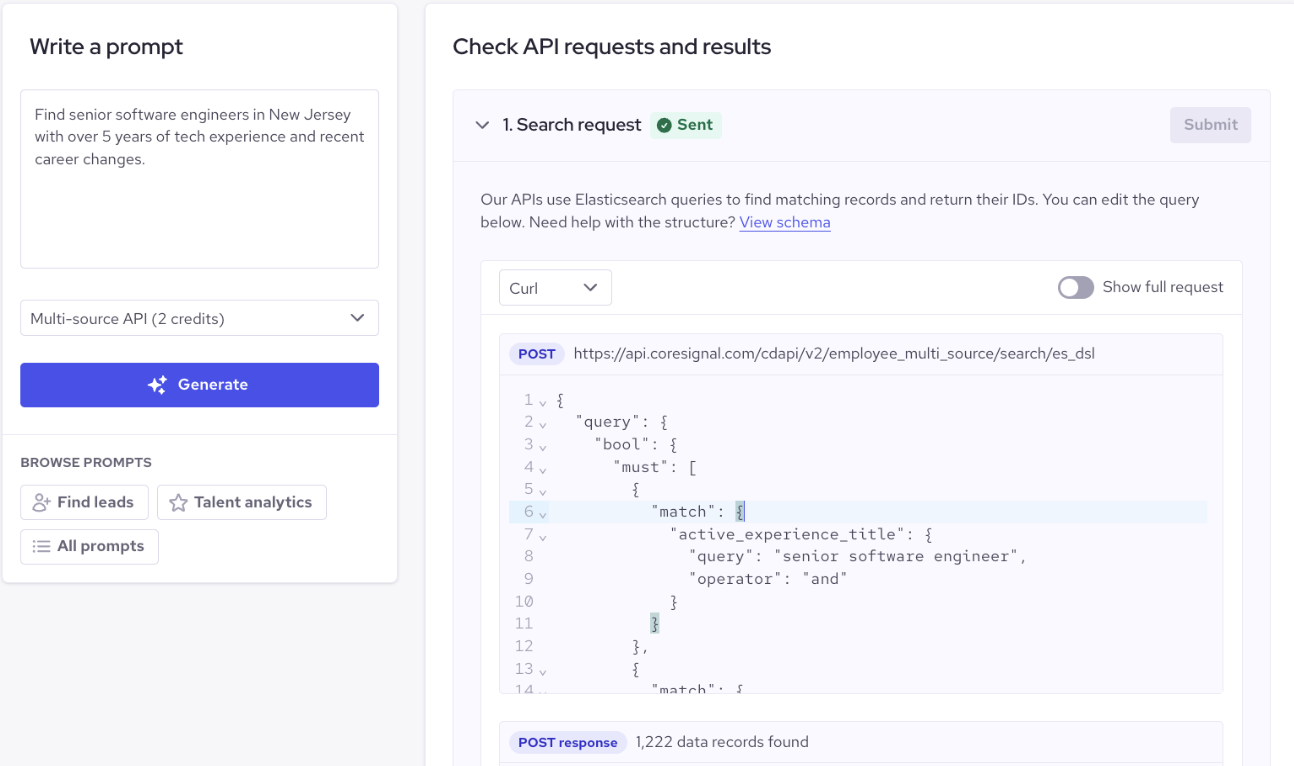
Using the Multi-Source Employee API, you can set up automated processes to fill gaps in existing records by enriching incomplete profiles with detailed work history, skills, and education credentials. The fresh data accessible via these API's ensure you're always working with current information rather than outdated snapshots.
By integrating the Employee API into your regular workflow, you transform your candidate database from a static list into a dynamic, continuously updated talent intelligence system.
3. Tracking career changes and talent movement
Static candidate records become outdated almost immediately. Professionals are constantly getting promoted, changing companies, relocating, and advancing in their careers. A database built six months ago reflects a version of the talent market that no longer exists.
Coresignal's webhooks automatically notify you when records matching your criteria change, are added, or no longer meet your specifications. Instead of manually checking profiles or running periodic searches, webhooks push changes to you in real time.
Register webhook subscriptions for specific criteria and receive instant notifications when new profiles match, existing profiles change roles or companies, or records no longer meet your parameters.
How employee data supports recruiters
Data-driven, AI-powered recruitment strategies accelerate hiring processes and provide deeper insights, but they don’t replace human judgment. Coresignal’s employee data also equips recruiters with accurate, structured, and continuously updated information, enabling better sourcing decisions.
AI can extract insights from large-scale datasets; however, recruiters remain essential for interpreting results and overcoming algorithmic biases. AI-powered and data-driven recruitment strategies do not eliminate the human factor. Instead, it elevates, enabling more informed and strategic hiring decisions.
Use cases across industries
The usage of employee data varies depending on your industry and objectives. From HR teams building talent pipelines to investors tracking market signals, every team can benefit from fresh employee data.
- Talent sourcing for HR teams. HR teams use this data to find the best candidates for their recruitment needs. It provides them with current and past employee information, including how long someone worked at a job, their location, job title, and role description. These details can help improve the AI-driven recruitment process.
- Workforce analysis and talent movement insights. Investors leverage employee data to track talent movements and identify emerging opportunities. Details like work experience, education, and connections, along with company data, help show shifts within companies and highlight broader industry trends.
- Supporting AI-driven recruitment platforms. The structured, multi-source data makes it ideal for training AI models and powering recommendation engines that surface candidates matching complex criteria.
How data-driven candidate sourcing creates a competitive advantage
Shifting from reactive hiring to a more strategic, proactive approach helps you build a stronger competitive edge and see real results. By identifying and tracking qualified candidates early, you can fill roles much faster, sometimes in days instead of weeks. This saves time and helps you find people who are a better fit.
When you use data from multiple sources, your shortlists become more accurate than if you relied only on resumes. Building talent pools also lets your team connect with candidates before your competitors do. With this method, you recruit strategically, rely on data instead of guesswork, and stay ahead of the competition.


