
Today, hiring data is one of the clearest, most immediate signals of how companies, industries, and entire markets are behaving. Who is hiring, for which roles, and at what pace often reveals growth plans, shifting priorities, and early signs of expansion or slowdown long before they appear in earnings reports.
When organizations build a consistent stream of hiring data and connect it to a broader analytical strategy, they gain an edge. This approach replaces assumptions with evidence that reflects what is happening right now, not months later.
What is job analysis in a B2B market context?
Job analysis has always been about collecting and interpreting data related to a specific role. This typically includes duties and responsibilities, required knowledge, skills, and abilities (KSAs), as well as the environment, tools, and technology used to perform the job.
But it’s 2026 now, and that same process goes beyond human resources (HR) teams handling recruitment.
It’s no longer just about defining roles and planning compensation. So, what is job analysis about today?
More importantly, what does it mean for modern B2B teams?
In a B2B context, the focus shifts from filling in the roles to business intent. Access to an enterprise-grade B2B database allows companies to analyze and translate hiring signals into insights about what skills and technologies are gaining traction, how teams are evolving, and what other businesses are investing in.
After all, job postings data reveal a whole lot about real market demands. Each posting reflects a business decision made in accordance with pre-approved plans, budgets, and concrete needs. As such, it’s heavily focused on the future, and that’s precisely why it’s indispensable for modern businesses.
How hiring data helps businesses understand market demand
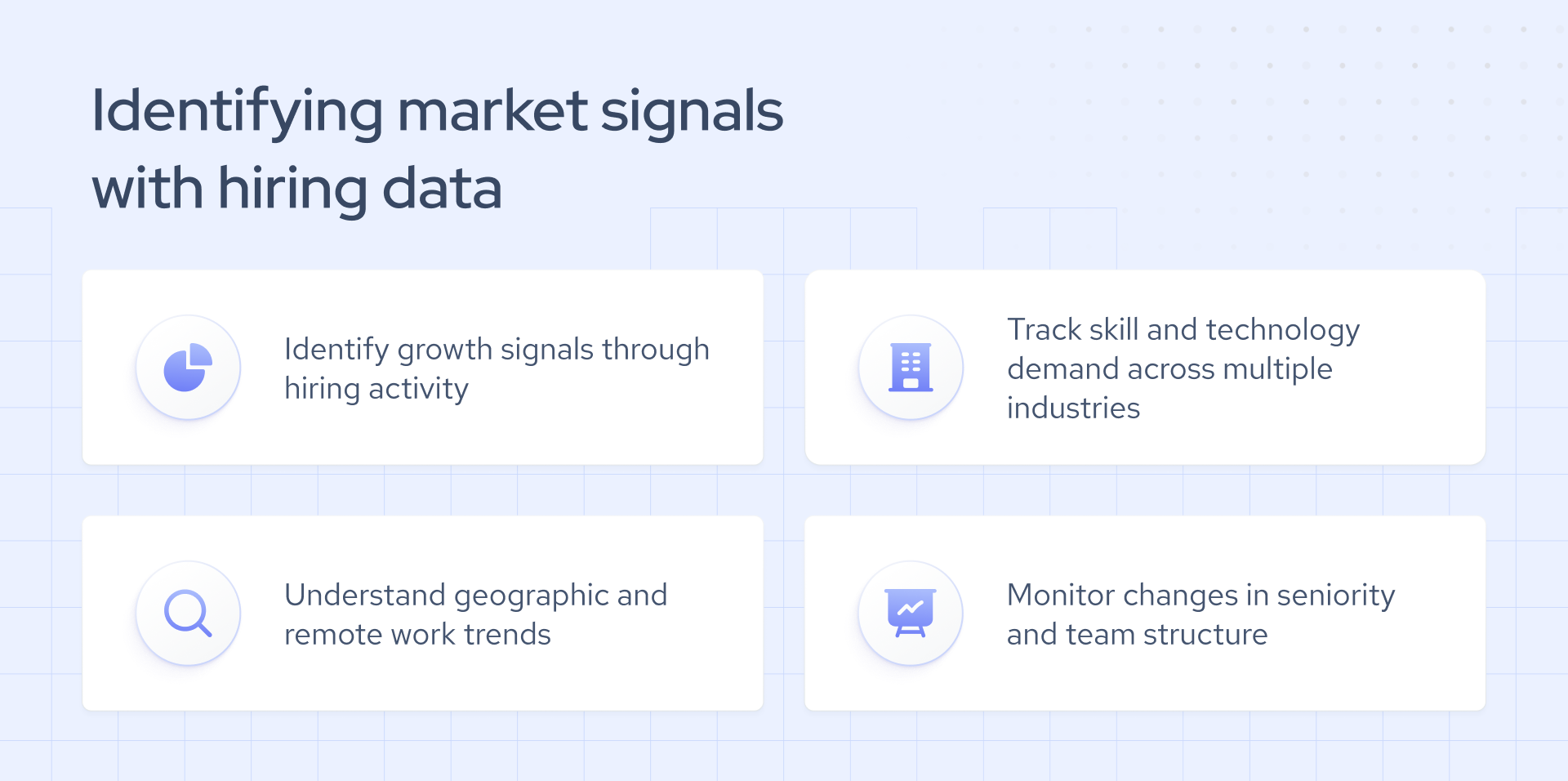
Job postings data offers a wealth of insights into ever-changing market conditions. When analyzed at a larger scale, it can help you:
1. Identify growth signals through hiring activity
One of the main advantages of analyzing large volumes of hiring data lies in the growth insights it provides. Here, a consistent increase in job postings for similar roles suggests rising demand rather than short-term experimentation.
By monitoring which key market players focus on when hiring talent, you can identify the exact segments experiencing sustained growth.
2. Track skill and technology demand across multiple industries
Analyzing job postings and recruitment trends also helps you see which skills companies are demanding. The same goes for technological advancements, such as AI.
These insights can be instrumental, enabling you to identify new, specialized roles and adopt emerging tools that are becoming crucial across multiple industries long before they go mainstream.
3. Understand geographic and remote work trends
Location-specific job postings also play a pivotal role, as they reveal the exact geographic markets that other companies are planning to expand into. Meanwhile, sudden shifts in remote, hybrid, or office-based postings reflect changing talent strategies.
Combined, these patterns allow businesses to identify both regional demand and changes in market competitiveness.
4. Monitor changes in seniority and team structure
Additionally, hiring data helps companies track and understand how competing businesses are evolving their teams.
For example, a rise in senior roles in a particular region often indicates scaling. Similarly, an increase in specialized talent may point to capacity building. In any case, this kind of job analysis reveals all sorts of insights into organizational priorities that you can benefit from.
How to perform a job analysis using job posting data
Scale is one of the most important aspects of analyzing job postings properly. Sure, a few individual postings can still give you insights, but the real value here lies in interpreting patterns across massive volumes.
And while you can certainly collect the necessary data volumes manually, doing so would be extremely time-consuming. In that sense, a much better approach is to take advantage of already structured job data, which allows for a far more effective job analysis.
That’s precisely where Coresignal’s Jobs API comes into play. Here, the API-based job data provides consistent access to both historical and current job postings data. This allows your analysts to select the right points, compare hiring trends across businesses and industries, and interpret data within a defined analytical context. It also makes the whole process easier.
Key data points to focus on when analyzing job postings
Access to large volumes of data alone isn’t enough for proper job analytics. Instead, meaningful insights arise only when you extract key data points that remain consistent across job postings for multiple companies, industries, and time periods.
Here’s what those key points typically include and what you should focus on:
- Job titles help businesses establish hiring intent and role focus
- Required skills show you exactly which capabilities are in high demand
- Company attributes, such as industry, size, and growth stage, provide context and show how demand varies between up-and-coming companies and established brands
- Location data highlights shifts in regional demand and showcases geographic expansion (or reduction)
- Remote vs. hybrid indicators show how companies are structuring their workforces
- Seniority level indicates whether companies are building leadership, scaling capacity, or doing both
- Posting dates are crucial for effective job analysis, as they anchor hiring trends in real time.
Analyzed individually, these data fields provide limited insight. But if you add them all together and conduct an analysis at a sufficient scale, this well-structured data will reveal a lot about both current and future market trends.
How to analyze market demand using Coresignal Jobs data
Before you get to perform the analysis, you’ll need an active Coresignal account. If you don’t already have one, you can sign up with your business email for a 14-day free trial and get 200 free credits:
From there, you can:
Step 1: Access jobs data on the self-service platform
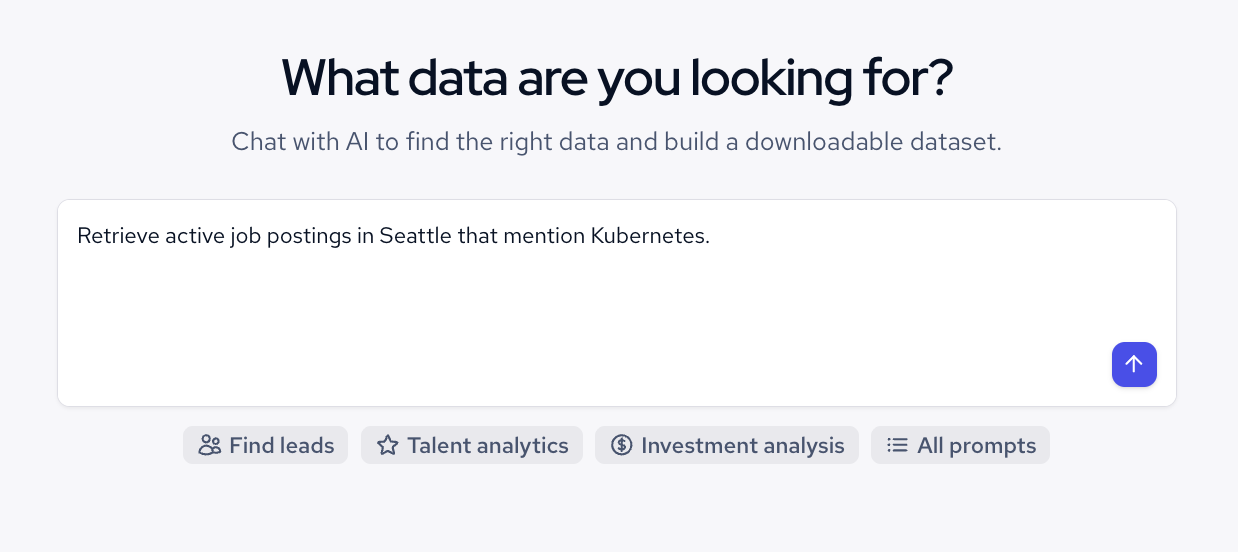
Once inside Coresignal’s dashboard, tap the AI Data Assistant option in the left-side menu. You can then use the chatbot to explore the data. It allows you to leverage the Multi-Source Jobs API for enriched, deduplicated, ready-to-use multi-source data.
Step 2: Apply filters to identify market demand signals
If you want to narrow down large volumes of job postings data before you start using it, the self-service platform will let you apply a wide range of search filters. All you need to do is fill in the Select filters and enter values area using dropdown menus.
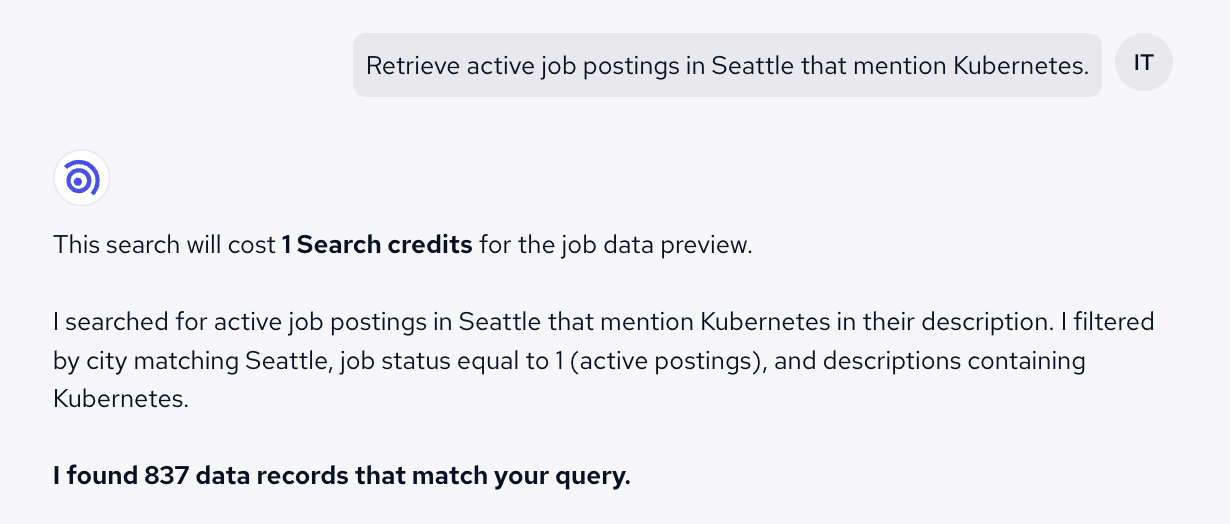
You can try with a simple prompt: Retrieve active job postings in Seattle that mention Kubernetes.
Step 3: Export job posting data for analysis
After executing the search and reviewing a data record (a job analysis example), export the data for your analytics team. Just tap the Download data button, review the request, and then click the Download button. Once the link is ready, you can download the data in JSONL format.
How to interpret hiring trends correctly
Speaking of interpreting data, that’s not something you can do with isolated points. Hiring trends only make sense when viewed in context, which requires that you consider the specific industry a particular company is in, as well as the company’s size and region and the time period.
Effective analysis also requires distinguishing between structural shifts, which are long-term changes such as automation or AI, and cyclical fluctuations, which only reflect short-term economic ups and downs.
In that sense, the best strategy is to rely on a combination of hiring signals, including required skills, specific roles, and locations, as this approach helps avoid oversimplified conclusions. And remember, changes in hiring activity rarely indicate growth or decline alone. They’re often a reflection of strategic shifts, new priorities, and restructuring efforts.
Common mistakes to avoid in job market analysis
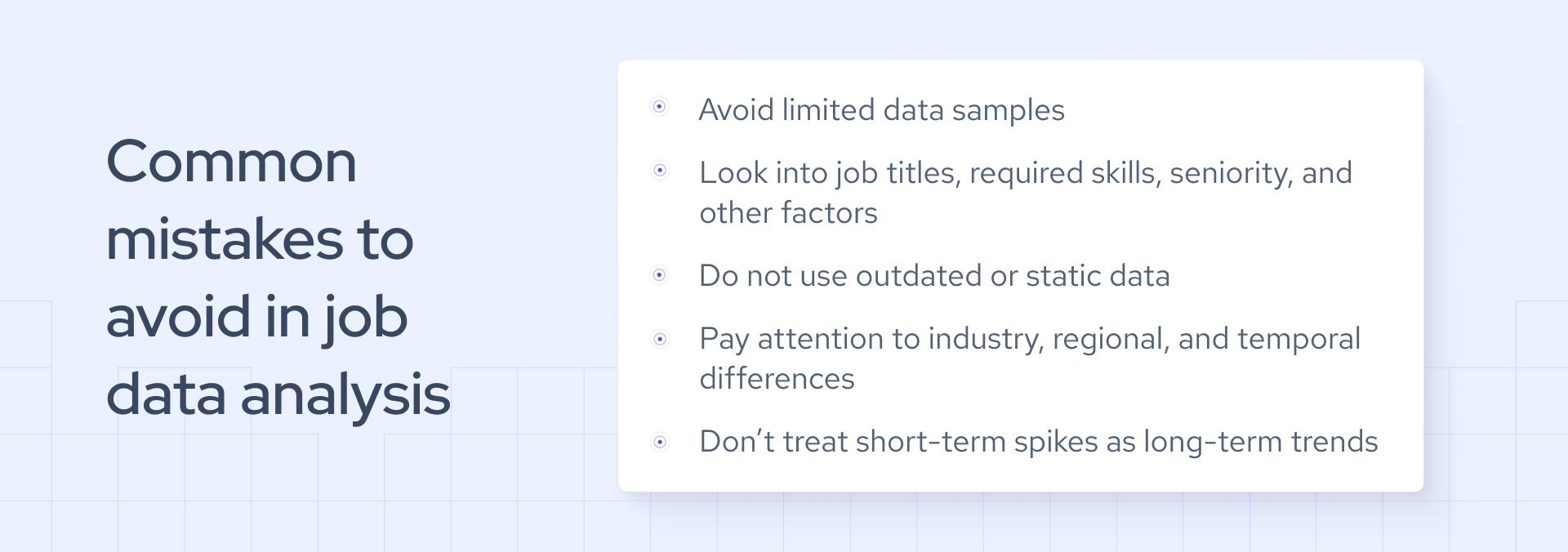
While no job analytics team is perfect, understanding what can skew results can lead to far more reliable insights. That said, here’s how to approach things:
- Refrain from basing your conclusions about the market on limited data samples;
- Don’t analyze job titles without looking at required skills, seniority, and other factors;
- Avoid using outdated or static data in an ever-changing, dynamic market;
- Pay attention to industry, regional, and temporal differences when comparing markets; and
- Don’t treat short-term spikes as long-term trends without doing over-time validations.
Practical job analysis use cases for B2B teams
Since job analysis is no longer just an HR exercise, we should take a look at some of the most common ways B2B organizations put it to good use:
1. Market intelligence and competitive analysis
Hiring data can help companies understand where their competitors are investing, which skills and tools they’re prioritizing, and whether they’re scaling or focusing on leadership roles. It provides early insights into role, capability, and location shifts that signal strategic changes.
2. Sales and go-to-market strategy
Analyzing job data also reveals gaps you might not be focusing on, be it technologies or roles. For marketing and sales teams, this is a perfect opportunity to refine ICPs, develop new strategies, optimize outreach timing, and tailor campaign messaging to trends.
3. Investment and industry research
For investors and organizations seeking industries to support, job postings can be a strong indicator of early momentum. Meanwhile, sustained growth in certain sectors reflects even more confidence, which further solidifies investment opportunities.
Why job analysis should be part of every data-driven business strategy
This type of analysis is no longer just about hiring talent; it’s about turning all this data into actionable insights. By identifying patterns across jobs, skills, technologies, and locations, companies can predict market shifts and respond to them well before competitors.
That said, this isn’t a one-off thing. Making informed, data-backed decisions requires a steady flow of job postings, with continuous analysis becoming a key part of an organization’s long-term data strategy.