




Here’s a reality check for 2026: without access to scalable, structured business data, companies cannot consistently generate insights or improve business performance.
Despite plenty of internal data, many organizations still struggle to connect the dots. Fragmented systems, static reports, and inconsistent formats make it difficult to extract meaningful business insights.
That’s where high-quality business datasets come in. They provide a structured, scalable foundation that supports decision-making across functions, from product development to market expansion.
In this article, let's explore the whole journey from data to action and learn how businesses are using public web data to do it. So, how to ensure better performance in 2026?
Why business data matters more than ever in 2026
Business data is the operational basis for that fuels business strategy in every industry, from sales intelligence to investment research.
Yet many B2B companies still lack the reliable data needed to understand market shifts, competitors, or spot emerging opportunities. Internal systems often paint an incomplete picture, since CRM records may be inconsistent and market reports age like milk.
Gartner predicts that by 2027, about 50% of business decisions will be supported or automated by AI agents. Today, trusted data pipelines and actionable insights are more important than ever.
By 2027, 50% of business decisions will be augmented or automated by AI agents for decision intelligence. (Gartner)
In 2026, markets shift faster, and the competition is higher. But AI tools are only as effective as the data feeding them. In this environment, companies can no longer afford to guess or rely on outdated or incomplete information.
To operate effectively in this environment, companies need access to high quality external business data that is fresh, structured, and scalable. Datasets that combine firmographics, employee profiles, job postings, and other signals help companies go beyond internal noise and see the broader context in real time.
Why data alone isn’t enough to improve business performance
Well-chosen business data, especially once it's cleaned and structured, can help businesses to extract actionable insights. However, on top of the high quality data, you will also need to establish the right internal processes.
Many businesses deal with the same recurring challenges:
Turning business data into actionable business insights
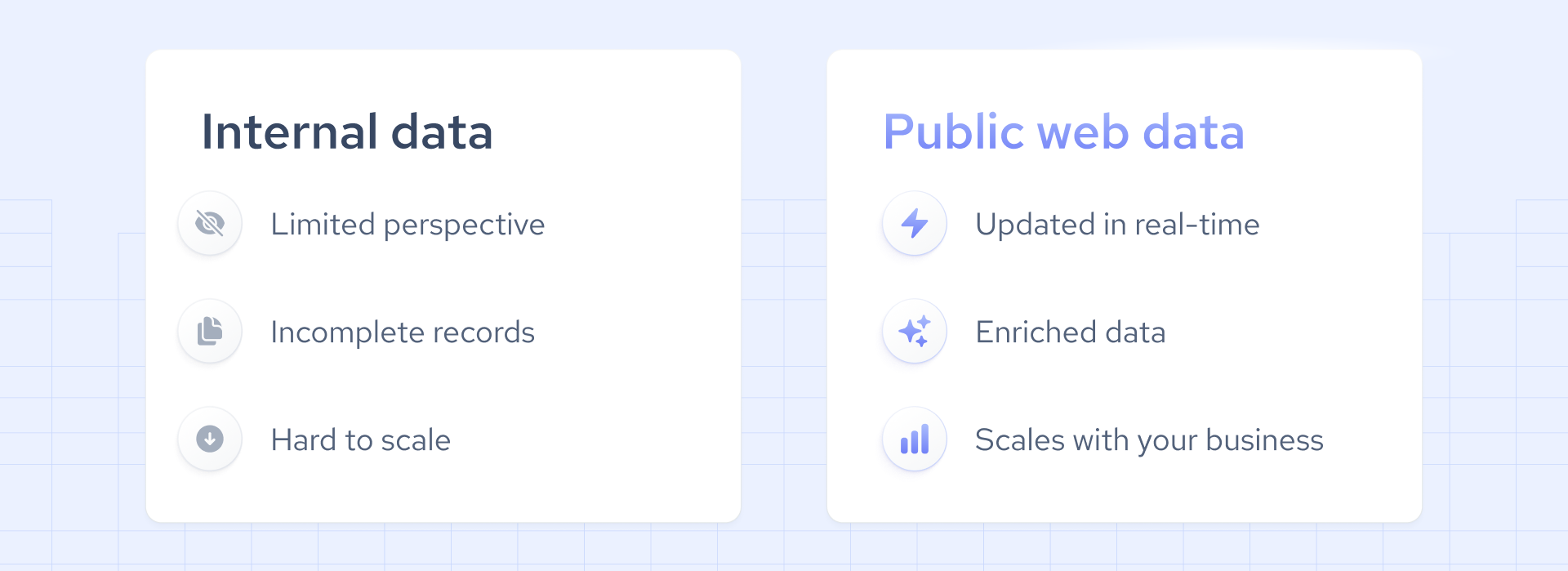
Many companies rely heavily on internal data, such as CRM or product usage metrics. This only offers a limited perspective. In order to fully understand customers, markets, and competitors, companies in 2026 increasingly turn to external sources and public web data.
To gather actionable business insights, data should be:
- Aligned with business goals and KPIs. It must be connected to the specific decisions or goals your teams are working towards.
- Up-to-date. The data has to be updated frequently enough to reflect the current state of your market or business.
- High quality. Only deduplicated, cleaned, and well-structured data that contains information from multiple sources will show you the full picture.
External datasets offer signals that internal systems can’t provide:
- Changes in headcount across competitors
- New job postings that suggest expansion plans
- Shifts in company leadership or funding
- Emerging tech stacks or new partnerships
The role of public web business data in performance-driven decisions
Signals from public web data ensure with planning, forecasting, and execution. They help teams validate market assumptions, anticipate competitor moves, and spot emerging opportunities.
Unlike internal systems, which focus on what’s already happened, structured company datasets from public data offers a live feed of market behavior. That visibility allows companies to act earlier, move faster, and respond to change with precision.
This isn’t just about having more data; it’s about having the right kind of data to align strategy, execution, and growth. The right business data, when selected and used effectively, disrupts the status quo and drives the evolution of your company.
By combining internal data with external signals, companies gain a richer, more actionable perspective.
From insights to business performance: how B2B teams apply data in practice
In performance-driven companies, data doesn’t simply look nice in dashboards; they guide decisions across teams, driving concrete results.
Here’s how different B2B functions use business insights powered by structured datasets:
Fresh business insights must be integrated into workflows, tools, and team routines to influence decisions and improve outcomes.
Building a data foundation that scales business performance in 2026
To compete effectively, B2B companies need continuous access to structured, reliable business data.
That’s why high-performing teams build their operations on a scalable data foundation. This typically includes two core components:
- Datasets. Ideal for large-scale analysis, benchmarking, and identifying patterns. They allow teams to compare past and present and explore long-term trends across markets or segments.
- APIs. Best suited for real-time enrichment, integration into internal tools, and triggering automated actions. APIs keep workflows dynamic and insights fresh by delivering current data on demand.
But infrastructure alone isn’t enough. The real value comes from using multi-source, ready-to-use business datasets from trusted providers such as Coresignal. With our multi-source datasets, your company can:
- Reduce blind spots. Fill gaps that internal systems can’t cover.
- Improve data reliability. Use cleaned, deduplicated data for confident decision-making.
- Detect patterns and trends at scale. Spot signals early and respond faster than competitors.
This kind of foundation isn’t just about efficiency; it’s about enabling smarter, faster, and more strategic decisions.
In 2026, performance in business depends on the quality, structure, and flow of your data. The organizations that invest in the right foundation now will be the leaders of tomorrow.


