



For companies competing for top talent, relying on resumes and LinkedIn profiles alone is no longer enough. Today’s talent acquisition teams need a broader, deeper view of candidates, one that goes beyond job titles and current employers.
Enriched talent data offers that broader perspective. By aggregating professional information from multiple public sources and structuring it for analysis, enriched datasets reveal patterns and insights that traditional sourcing methods can’t. Whether it’s identifying passive candidates with highly relevant experience or spotting shifts in workforce trends before competitors do, enriched data transforms how companies attract, evaluate, and retain talent.
What is data-driven recruitment?
Data-driven recruitment is an enhanced hiring process based on employee data. By adding data to your hiring activities, you can find the right fit for your company in terms of professional candidate experience, education, and more.
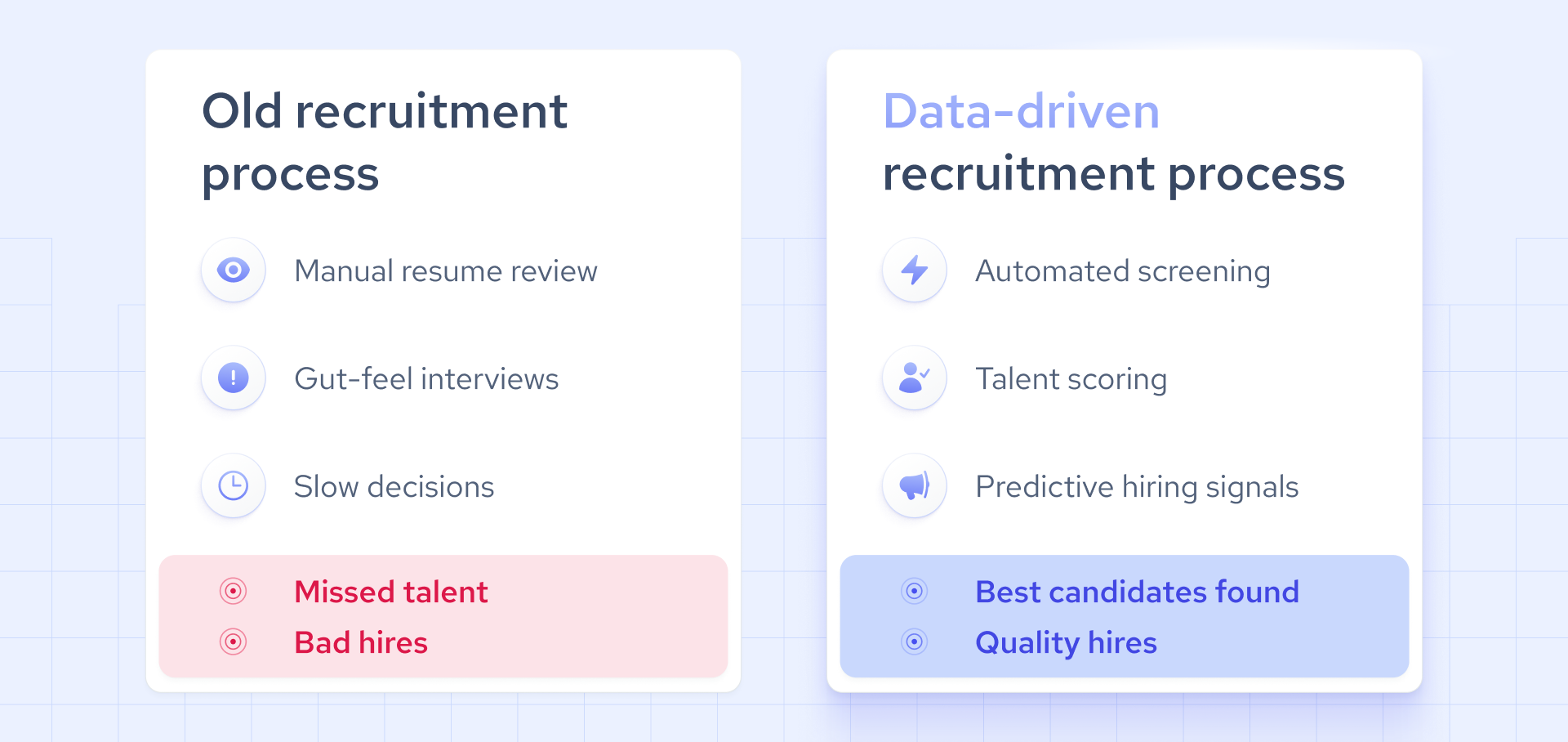
Traditional methods are no longer a viable solution if you want to stay competitive. At this point, different strategies and approaches should be considered. Data-driven recruiting alleviates the burden of manual search and hiring using your gut feeling.
According to a McKinsey survey with 1,993 participants from 105 nations, HR and talent leaders frequently rank AI among their top technology investment priorities. 64% say that AI is enabling their business innovation.
By implementing data-driven recruiting, you mitigate the guesswork and base your hiring decisions on substantiated data. As a result, you skip interviews with unqualified candidates, save resources, and most importantly, save time.
Data solutions
Data-driven recruiting improves the overall efficiency of business operations. Depending on your company’s needs, Coresignal offers various types of public web data solutions.
Benefits of data-driven recruitment
Coresignal’s rich employee and company data, combined with recruitment analytics, can help you maximize the benefits of your data-driven recruitment process. Here are a few benefits of implementing a data-driven recruitment strategy:
Why is internal data not enough for effective recruitment?
Relying solely on internal recruitment data, such as historical hiring performance, retention rates, and candidate funnel metrics, can limit your strategic perspective. While these insights are valuable, they only reflect your organization's past and present hiring patterns. They don't offer a complete view of the talent landscape.
Innovative recruiters understand that to compete for top talent, you need to look beyond your internal systems. That’s why they complement internal metrics with enriched external data sources, such as labor market data, company and employee data, and job-posting data, to gain full market visibility.
What external data enhances data-driven recruitment?
To build a truly data-driven recruitment strategy, you need access to more than just internal KPIs. External data fills the visibility gaps and equips talent teams with a broader, market-aware perspective. The most impactful external data types include:
- Job-posting data: Offers insights into which companies are hiring, what roles they're prioritizing, and which skills are in demand. This helps recruiters anticipate market shifts and identify emerging opportunities.
- Employee data: Provides granular information about professionals, such as job titles, experience, skills, and location, which helps refine candidate targeting and uncover untapped talent pools.
- Company data: Enables benchmarking against competitors, tracking of headcount trends, and identification of companies undergoing expansion or restructuring - key signals for outbound recruitment strategies.
- Labor market data: Delivers a macro-level view of talent supply and demand across industries and geographies, helping recruitment teams make informed decisions about where to source and when to scale.
Together, these datasets help recruiters move from reactive hiring to strategic workforce planning. When integrated into the recruitment workflow, external data empowers teams to forecast hiring needs, prioritize roles, and personalize outreach based on real-world context.
Data-driven recruitment process
Data-driven recruitment improves the entire hiring process:
- Find qualified candidates
- Minimize the chance of unqualified hires
- Reduce hiring costs
- Scan job offers
- Set clear hiring goals and define key metrics
- Gather and enrich recruitment data from multiple sources
- Optimize sourcing, screening, and scoring using recruiting data
- Track market trends, talent movement, and generate hiring signals
1. Find qualified candidates
You can reduce the chances of interviewing or hiring unqualified candidates by screening their professional records using Coresignal’s multi-source data. Professional candidate experience and education will provide you with solid information about a potential hire.
A data-driven approach to recruitment is superior to guesswork and gut-feeling decisions. You get substantial information to base your decisions on, therefore removing the need for guessing.
The best dataset for this solution is our employee data.
2. Minimize the chance of unqualified hires
Bad hires are the bane of existence for a recruitment team.
First of all, it takes time to notice a bad hire.
Secondly, it takes time to see that the new employee is not a good fit for the position. On average, it takes 8 to 26 weeks for an employee to become fully productive. And time is valuable.
Finally, you lose a lot by hiring an unqualified candidate. The employee is most likely being paid more than they are earning for the company. If that does not change after the onboarding period has ended, that is bad news for you.
In the end, you will need to start the recruiting process all over again. Unqualified hires are detrimental to a company's overall performance and need to be avoided.
3. Reduce hiring costs
Hiring is possibly one of the most costly and resource-draining parts of business; therefore, the talent acquisition team needs to proceed with caution for maximum benefit. Hiring success will most likely impact the overall success of a company.
It is especially true for small businesses. It has been estimated that small company owners spend up to 40% of their time on tasks that do not generate revenue. One of those tasks is hiring. Every single hire can make or break a small business.
If you want to save time, you can opt for an HR hiring agency. However, it can prove to be too expensive.
For instance, according to Glassdoor, a job board website, an average employer in the United States spends around $4,000 and 24 days to hire a new employee.
Coresignal’s employee and job posting data solutions can help you minimize those costs by providing access to professional information about a potential candidate and job boards' data to improve your knowledge about certain aspects of a job posting.
4. Scan job offers
Scanning job offers can be a useful way to see what job postings work better than others. You can find inspiration and improve your own job posting. You can see how other recruiters approach potential candidates and what benefits they offer. As a result, you can find certain loopholes in their postings or see how they can be improved to fit your situation better.
5. Set clear hiring goals and define key metrics
Every effective recruitment strategy starts with clarity. Defining your hiring goals, whether it’s expanding into new markets, accelerating time to hire, or improving candidate quality, sets the direction for your efforts. Once goals are established, outline the key metrics that will track progress. These may include conversion rates, cost per hire, diversity ratios, and offer acceptance rates. Clear goals and measurable KPIs ensure alignment across recruitment teams and make it easier to evaluate the impact of data-driven strategies.
6. Gather and enrich recruitment data from multiple sources
To move beyond surface-level insights, recruiters must integrate data from diverse sources. Start by combining internal applicant-tracking system (ATS) data with external datasets, such as public employee profiles, job postings, and labor market data. Coresignal’s multi-source data provides structured and standardized insights, without irrelevant or duplicated information. Enrichment adds depth, turning basic candidate data into a more actionable profile by filling in missing experience, validating skills, or identifying current roles.
The result is a more complete, accurate view of the talent landscape that improves both targeting and personalization.
7. Optimize sourcing, screening, and scoring using recruiting data
Data plays a critical role at every stage of recruitment. For sourcing, enriched external data helps identify high-potential candidates who match current and future role requirements. During screening, structured data enables faster filtering based on relevant experience, skills, or location. Scoring models, whether simple or AI-assisted, can rank candidates more consistently by combining historical success data with enriched profiles. These data-driven processes reduce manual work, minimize bias, and enable recruiters to prioritize the most promising applicants efficiently.
8. Track market trends, talent movement, and generate hiring signals
External datasets give recruiters a live pulse on the talent market. Job posting trends highlight which roles and skills are in demand. Employee data reveals movement between companies, signaling organizational change or expansion. Company-level insights, such as headcount growth or leadership changes, can serve as early indicators for future hiring needs. By monitoring these external signals, recruiters can spot shifts before they appear in traditional channels, giving them a competitive edge in identifying and engaging top talent early.
How to enrich your recruitment data?
Recruitment data enrichment means enhancing your existing candidate and hiring data with additional, high-value information from external sources. This process gives recruiters a fuller picture of the market, candidates, and the competition, enabling smarter decisions at every stage. Coresignal’s employee data and company data can also improve efficiency by enriching databases for data-driven hiring.
Here’s how it’s done effectively:
- Start with your internal data: Use what you already have, such as candidate resumes and interview feedback, as a foundation. Identify the data gaps that limit visibility or decision-making.
- Integrate external datasets: Add layers of insight with job-posting data, employee profiles, and firmographic company data. This allows you to verify candidate experience, uncover new sourcing channels, and benchmark against industry hiring trends.
- Use enrichment tools or APIs: Leverage platforms that offer structured, continuously updated public web data. APIs are especially useful for enriching records at scale and keeping your databases current without manual effort.
- Focus on relevance and accuracy: Not all data fields are equally valuable. Prioritize those that align with your recruitment goals, like current role, skill set, career trajectory, or employer hiring activity.
- Make it actionable: Enriched data should fuel smarter sourcing, personalized outreach, improved screening, and clearer reporting. Integrate it into your workflow so recruiters can act on insights in real time.
The goal of enrichment isn’t just to have more data, it’s to have better data. With the right inputs, talent teams can move faster, improve match quality, and respond more intelligently to a dynamic job market.
Choosing the right recruitment data provider
Selecting the right data partner is critical for building an effective, innovative recruitment strategy. The impact of your hiring strategy depends heavily on the quality of the data behind it. However, not all recruitment data providers offer the same level of coverage, freshness, or reliability. In order to get the best quality data, these are the key factors to consider:
- Data quality and freshness: Ensure the provider delivers accurate, up-to-date records. Stale or incomplete data leads to poor candidate matches and missed opportunities.
- Coverage and scale: Look for broad geographic and industry coverage, especially if you're hiring across multiple markets or sectors.
- Multiple data types: A strong provider offers multiple datasets, such as employee data, job postings, and firmographics, to support comprehensive hiring strategies. Multi-source employee data is necessary for a complete, up-to-date view of employee profiles.
- Delivery options: Flexible access via datasets or APIs lets you choose what best fits your team’s tools and workflows.
- Data enrichment capabilities: Choose a provider that enables you to enhance your internal candidate records with additional external data fields for deeper insights.
- Compliance and ethics: Confirm that the provider collects only publicly available data and adheres to ethical web data standards.
- Market reputation: Check for industry recognition, case studies, and reviews to ensure reliability and expertise.
Need data for data-driven recruitment?
Data-driven recruitment is superior to a traditional hiring process. You no longer need to scan the resumes manually and waste your precious time that could be dedicated to tasks that generate profit.
Coresignal is a reputable provider of recruitment data. With millions of employee records sourced from multiple public platforms, Coresignal’s multi-source employee data helps recruiters uncover rich professional profiles, track talent movement, and identify hiring signals at scale. It’s a powerful resource for building more precise and proactive talent pipelines.
- Our datasets help to get information about potential candidates faster than usual
- With fresh and relevant data, the hiring teams can find the best candidates for business growth through valuable recruitment channels
- A data-driven recruitment process gives access to top performers in their field
Try Coresignal’s self-service platform with a 7-day free trial or reach out to us for answers to any of your data-related questions!


